The cost of stalling women’s reservation
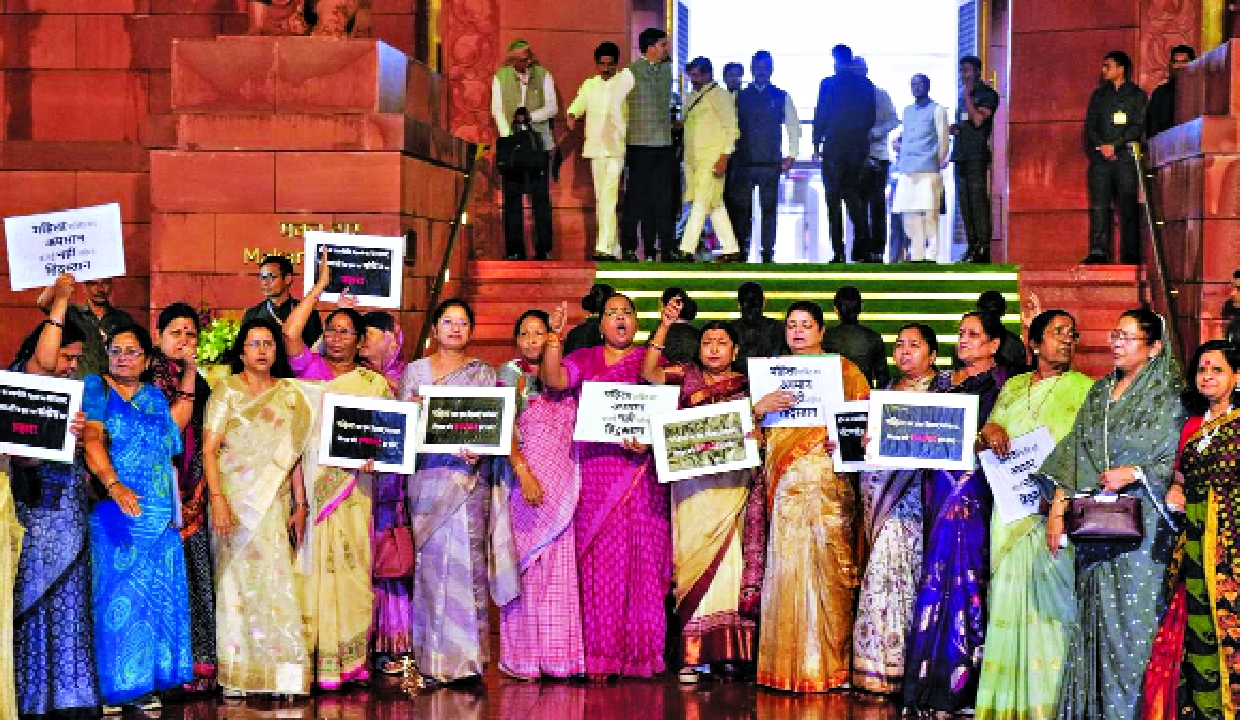
The latest impasse over women’s reservation in Parliament lays bare a deep contradiction: even as empowerment is loudly championed in public, procedural hurdles and tactical objections continue to stall a transformative reform
India stands at a pivotal moment in its democratic evolution, one where the question is no longer whether women deserve one-third political representation, but whether a few family-owned political parties are willing to enable it. The recent inability to advance the operationalisation of women’s reservation in Parliament has exposed a troubling contradiction. While the principle of empowering women in governance enjoys broad rhetorical support, sections of the opposition, particularly parties aligned with the INDI bloc, have continued to create hurdles at critical moments. By invoking technical objections around sequencing, delimitation clarity, and procedural conditions, they have effectively stalled progress. The optics were even more striking when, to the surprise of many, some opposition leaders appeared to celebrate the outcome-an outcome that delayed the transfer of political power to women across the country.
In contrast, the government has maintained a clear and consistent position. As Prime Minister Narendra Modi stated in his address to the nation, empowering women through political representation is not a matter of political convenience but a national priority. He emphasised that the government remains committed to delivering this right to the women of India “at any cost,” and that while current parliamentary arithmetic may pose constraints, the resolve to implement women’s reservation is firm.
The larger issue, however, is not merely political. It is about what India stands to gain or lose from this reform. The case for women’s reservation is often framed in terms of fairness, but the more compelling argument is about governance.
India is one of the few countries with strong, large-scale empirical evidence on how women’s political participation affects governance outcomes. The landmark research by Raghabendra Chattopadhyay and Esther Duflo provides a clear answer. Studying reserved panchayats in West Bengal and Rajasthan, they found that women-led local governments invested 62 per cent more in drinking water infrastructure in West Bengal and 56 per cent more in Rajasthan compared to their male-led counterparts. These were not symbolic differences; they reflected a systematic reorientation of public spending towards essential services that directly improve quality of life, health outcomes, and productivity. The reason is straightforward. Women leaders bring different lived experiences into decision-making. In the same study, 31 per cent of women identified drinking water as a key public concern, compared to just 17 per cent of men, making women 82 per cent more likely to prioritise it. Representation, therefore, is not just about presence; it is about perspective, and perspective shapes policy.
When such representation scales up to Parliament, the implications are profound. A more gender-balanced legislature is more likely to prioritise issues such as maternal health, nutrition, sanitation, childcare, and safety-areas which have long been under-emphasised but have direct economic consequences. Poor childcare limits workforce participation, unsafe public spaces restrict mobility, and weak health infrastructure increases long-term fiscal burdens. These are not merely “social issues”; they are core economic concerns.
Beyond policy priorities, women’s participation improves the quality of governance itself. Diverse decision-making bodies are less prone to narrow thinking and more likely to evaluate policies through multiple lenses. This leads to more balanced, inclusive, and effective policymaking. In a country as complex as India, such diversity is not optional; it is essential for responsive governance.
The impact also extends to justice and institutional accountability. Issues such as gender-based violence, workplace harassment, and unequal access to economic opportunities often suffer from inconsistent political attention. A stronger presence of women in legislatures increases the likelihood that these concerns receive sustained focus, better legal frameworks, and more effective enforcement. Governance thus becomes not only more inclusive but also more just. Perhaps the most significant impact is economic. India’s female labour force participation remains below its potential. Structural barriers, ranging from safety concerns to lack of childcare, continue to limit women’s full participation in the economy. When policy addresses these constraints, the gains are substantial. Higher female participation expands the labour force, increases household incomes, and strengthens overall economic growth. No country aspiring to become a global economic powerhouse can afford to underutilise half its talent base.
There is also a powerful intergenerational effect. Research by Lori Beaman and her co-authors shows that sustained exposure to women leaders reduces the gender gap in aspirations by 32 per cent among adolescents and by 25 per cent among parents. In simple terms, when young girls see women in positions of authority, they begin to imagine themselves there. Over time, this reshapes education choices, career trajectories, and the very structure of opportunity.
The Modi government’s broader policy framework has laid the foundation for this shift. Initiatives such as Beti Bachao Beti Padhao, Pradhan Mantri Ujjwala Yojana, Pradhan Mantri Jan Dhan Yojana, and Pradhan Mantri Mudra Yojana have expanded women’s access to education, health, finance, and entrepreneurship, with Mission Shakti integrating these efforts.
India has debated women’s reservation for decades. The evidence is clear, and the benefits are undeniable. What remains is the political will of a few parties. When implemented, this reform will not just change who sits in Parliament; it will change how India is governed. And every delay is not just a procedural pause; it is a missed opportunity to improve governance and accelerate India’s progress.
India has debated women’s reservation for decades. The evidence is clear, and the benefits are undeniable.
What remains is the political will of a few parties. When implemented, this reform will not just change who sits in Parliament; it will change how India is governed
The writer is a Professor of Finance and a Part-Time Member of the Economic Advisory Council to the Prime Minister; Views presented are personal.