Israel-Lebanon 10-day ceasefire: A fragile pause
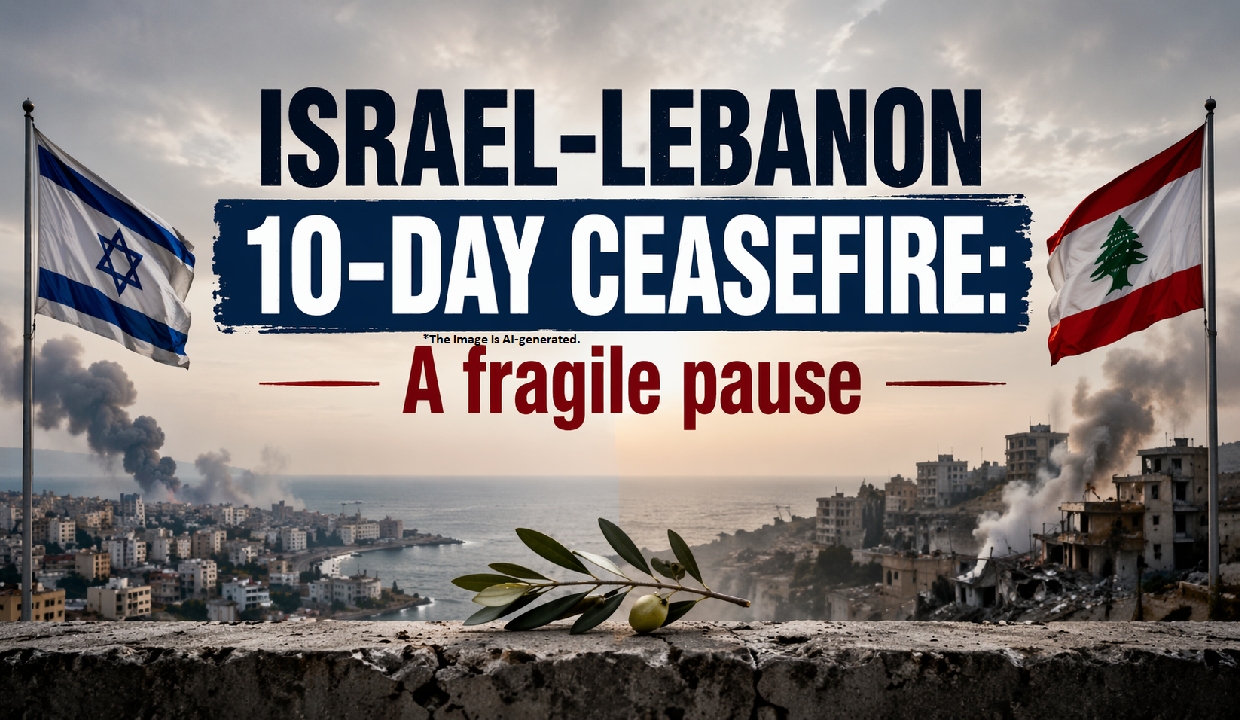
There is yet another positive development in the ongoing volatile situation in West Asia. US President Donald Trump has announced a 10-day ceasefire between Israel and Lebanon, brokered by him. It would be premature to celebrate it as a definite step towards lasting peace in the region, but it does provide a break from ongoing attacks and counter-attacks that are killing innocent people. With over a million displaced in Lebanon, even a temporary halt allows humanitarian relief and creates diplomatic space. It also offers a sigh of relief for displaced Lebanese families, who are returning hesitantly to their homes reduced to rubble by air attacks. It is indeed a window of hope.
Yet, the big question is: will this last? And if it does, what happens after it is over? Will it lead to lasting peace? The key player here is not the US, which has brokered this ceasefire, but Israel, which remains adamant about continuing hostilities.
Since the US and Iran agreed to a month-long ceasefire, Israel opened its Lebanon front to technically avoid violating it, while at the same time provoking Iran into launching a counter-offensive. Within hours of the US-Iran ceasefire, Israel reportedly sabotaged it with a massive 100-missile strike on Lebanon, killing over 250 people. Iran’s swift retaliation almost jeopardised the truce.
That said, this 10-day window is significant. It indicates that the conflict has reached a point where active players are exhausted and seeking relief, even if it is momentary. More crucially, Tehran has made de-escalation in Lebanon a precondition for engaging in talks. In that sense, the ceasefire is less a standalone event and more a piece of a larger West Asian puzzle. However, its credibility remains deeply uncertain. Ceasefires in the Israel-Lebanon conflict have historically been fragile. The involvement of Hezbollah further complicates matters, as it is aligned with Iran rather than purely Lebanese state interests. The key question, therefore, is how credible Trump’s assurances are and whether they can be taken at face value. While the US remains Israel’s principal ally, Netanyahu has not always complied with Washington. Past instances of Israeli defiance show that US influence, though significant, is not absolute. If Israel perceives its security interests to be at stake, it is unlikely to adhere to a time-bound ceasefire, regardless of who announces it. Analysts have already warned that any breach could derail parallel US-Iran negotiations, which remain tentative. The linkage between Lebanon and broader regional diplomacy means that failure here would have consequences far beyond its borders. The conflict has already triggered economic anxieties, disrupted supply chains, and raised concerns about maritime security.
A sustained ceasefire could stabilise energy markets and reduce the risk of a wider confrontation involving Iran and US forces in the region. Conversely, a collapse would intensify polarisation, draw in more actors, and deepen the instability that has long defined West Asia.
A 10-day ceasefire between Israel and Lebanon, announced by Trump, offers a fleeting pause, but with past instances of Israeli defiance, its credibility remains uncertain