India’s triple border crisis
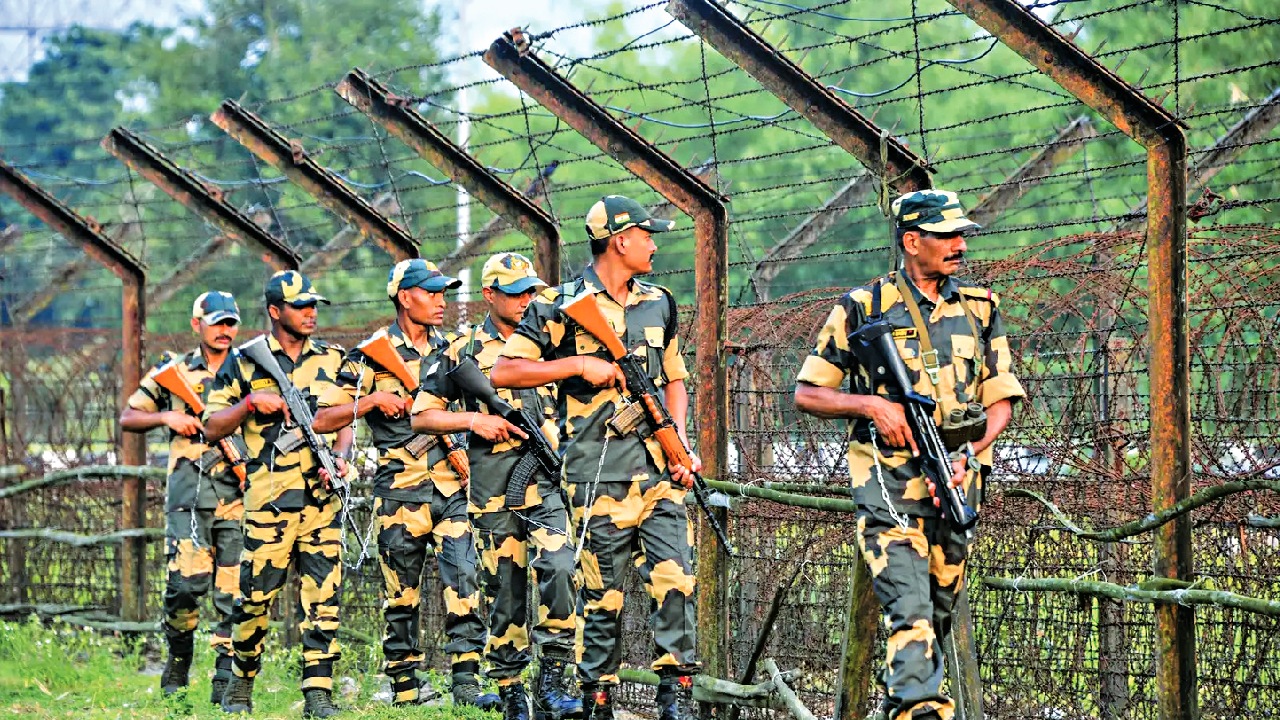
India confronts an unprecedented convergence of security threats across its 15,200 km land frontiers and 11,098-kilometre coastline, amplified by emerging technological challenges. With instability erupting simultaneously in Pakistan, Bangladesh, and Myanmar, combined with maritime vulnerabilities and AI-enabled hybrid threats, India faces its most complex perimeter security challenge.
Pakistan has always been involved in posing multifaceted threats. Pakistan ranked twelfth on the 2024 ACLED Conflict Index with disputed elections, economic freefall reaching 35.4 per cent inflation, and its 25th IMF bailout. Militant violence more than doubled with 856 attacks in 2024. The April 2025 Pahalgam attack killing 28 triggered Operation Sindoor, India’s most significant military strikes since 1971.
Pakistan weaponises narco-terrorism as hybrid warfare. Drone-related drug smuggling cases spiked to 179 in 2024 from just 3 in 2021, with over 800 kg heroin and 1,200 kg opium seized. ISI-backed drug cartels fund terrorism while addicting Indian youth, particularly in Punjab and Jammu & Kashmir, where one addict walks into Srinagar OPD every 12 minutes.
The Sir Creek dispute adds another flashpoint. Pakistan’s military build-up in this 96-kilometre tidal estuary prompted Defence Minister Rajnath Singh’s October 2025 warning. The disputed waters facilitate terrorist infiltration-the 2008 Mumbai attackers captured an Indian boat here-while control determines access to oil and gas reserves worth billions. Bangladesh’s terror revival is extremely worrisome for India. The August 2024 upheaval ousting Sheikh Hasina has unleashed chaos. Murders average 11 daily in 2025-a 25.9 per cent increase-while mob lynchings surged 1,250 per cent. Indian security forces detected 1,104 infiltration attempts in 2025, the highest in nearly ten years.
Most alarming is the revival of Jamaat-ul-Mujahideen Bangladesh, dormant for eight years. With ISI support, JMB recruits from illegal immigrant camps and Rohingya settlements, instructing infiltrators to work in Muslim-dominated areas while planning attacks. The JMB-Al Qaeda nexus now targets India’s northeast and West Bengal. Bangladesh’s growing rapprochement with Pakistan-with direct trade resuming for the first time since 1971-enables cooperation between anti-India terror outfits, creating a dangerous arc of instability.
In Myanmar, the military junta controls only 21 per cent of territory while rebels hold 42 per cent, with over 3.5 million displaced and 6,486 civilians killed by April 2025. The conflict directly fuels Manipur’s ethnic violence. An estimated 40,000 Rohingya reside in India in sensitive areas like Jammu, West Bengal, and Delhi. Indian intelligence has documented links between Rohingya and terrorist organisations, including a 2018 NIA prosecution charging a Rohingya man with building Al-Qaeda networks. With 70,000 Rohingya fleeing into Bangladesh over the past year, India faces the dilemma of balancing humanitarian obligations with security concerns about terrorist recruitment and radicalisation. Cross-border drug trafficking from the Golden Triangle, arms smuggling, and insurgent movements further exploit the porous frontier.
Maritime vulnerabilities also pose serious threats. With a coastline spanning 11,098 kilometres, India’s maritime trade worth $800 billion annually faces escalating threats. Chinese naval presence with six to eight PLAN submarines under the String of Pearls strategy, and terrorist infiltrations across the Arabian Sea, Bay of Bengal and Palk Strait threaten sea lanes. India’s 12 major ports and 217 non-major ports face exposure to smuggling, terrorism, and cyber intrusions. Maritime drug trafficking surged with 10,564 kg seized in 2024.
Most alarming is terrorism’s evolution-educated professionals including doctors, engineers, and academics now leverage technical expertise for sophisticated attacks. Analysis of Islamic State recruits shows less than 2 per cent were uneducated. The November 2025 Delhi blast, perpetrated by educated professionals using biotechnology knowledge, exemplified this threat. Women jihadists add another dimension, with more trained as combatants and suicide bombers, exploiting reduced security scrutiny. Adversaries deploy AI for sophisticated propaganda, deepfakes, and coordinating hybrid attacks. India’s dependence on foreign AI infrastructure creates strategic vulnerabilities.
Technological fortification is essential. The Comprehensive Integrated Border Management System integrates sensors, communication networks, and command-control solutions. Plans announced in April 2025 aim to cover the entire India-Pakistan border with electronic surveillance within four years, incorporating anti-drone systems that intercepted 294 Pakistani drones in Punjab in 2024. Border infrastructure funding jumped 50 per cent to Rs 5,597 crore in Budget 2025-26. The government sanctioned Rs 31,000 crore for fencing the Myanmar border, while approximately 3,141 kilometres of the Bangladesh border is fenced. In counter-narcotics operations, narcotics worth INR 25,330 crore were seized in 2024 — a 55 per cent increase over 2023. BSF’s jurisdiction extended from 15 km to 50 km from international borders enhanced interdiction success. The Indian roadmap envisions AI, machine learning, and big data integration by 2026-27, with AI-powered smart fences and predictive algorithms, though indigenous capability development remains crucial.
India’s challenges demand nuanced responses. With Bangladesh, engaging diplomatically while monitoring the Pakistan-Bangladesh-JMB nexus remains critical. For Myanmar, balancing support for democratic forces with pragmatic engagement requires calibration. The Sir Creek dispute needs resolution through sustained diplomatic engagement while maintaining military deterrence. Maritime security requires naval and coast guard modernisation, regional cooperation frameworks, and intelligence-sharing. The AI domain demands urgent indigenous capability development to reduce dependence on foreign infrastructure.
Most critically, India must integrate security with economic development, cultural sensitivity, and diplomatic engagement. Enhanced inter-agency coordination between military, paramilitary, intelligence agencies, and state governments remains essential. The simultaneous instability in Pakistan, Bangladesh, and Myanmar-combined with maritime vulnerabilities, narco-terrorism, and AI-enabled hybrid threats-presents India with an existential challenge.
However, with strategic investments in technology, infrastructure, indigenous AI capabilities, maritime power projection, and adaptive diplomacy, India can transform vulnerabilities into strengths.
The test lies in implementing a cohesive vision that anticipates threats, protects sovereignty, enables prosperity, and maintains regional stability in an increasingly volatile and technologically complex security environment.
(The author is a retired Additional Director General of Indian Coast Guard and a defence and strategic study expert); views are personal