A thousand cuts of silent conflict

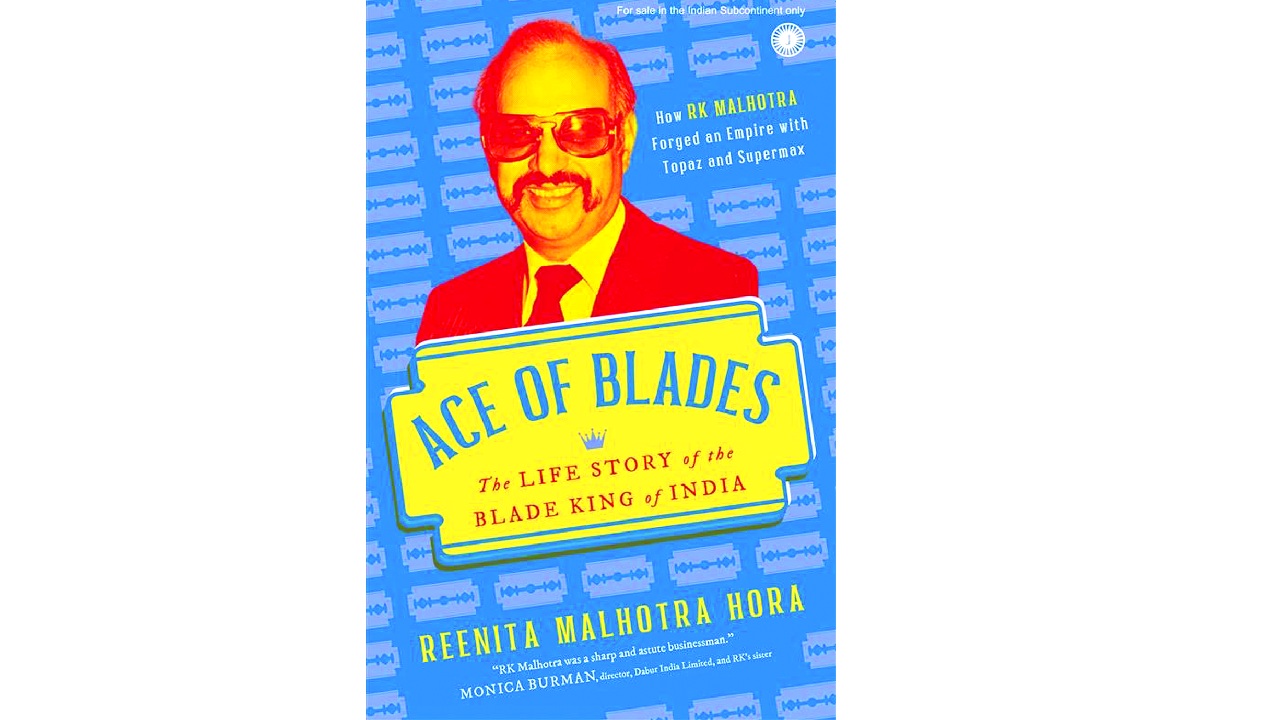
Who isn’t family? The Munjals of the Hero group, the Mittals of the Bharti group, Analjit Singh of the Max group, the Ambanis of the Reliance group — are all family-controlled businesses. How do these families run their companies? In her book Ace of Blades, Reenita Malhotra Hora chronicles the life journey of Rajinder Kumar (RK) Malhotra, the baron of the Malhotra group that ruled the shaving blade market in the consumer segment for decades. He was also Reenita’s father.
The story starts in Oct 2020 in Buckingham Gate, the London home of RK Malhotra and his wife Veena for the past decade. With the world ravaged by COVID and octogenarian RK fast losing his cognitive memory, Reenita hastened to London to interview her father for his story. RK’s father HL Malhotra had migrated to Calcutta in the 1940s. Starting out as a hotelier at the Oberoi Grand, in 1950 he zeroed in on the business of razor blades for shaving.
A young RK completed his Mechanical Engineering abroad, but in a twist as predictable as those in Hindi films, was told to come back home and handle the expanding family business. And the narrative surfs through various ups and downs of their razor blade business across decades and how they navigated storms riding on efficiency, instinct, and shifty values. Sibling rivalry between RK and his two brothers that almost came down to physical assault only made things worse for themselves. There was no meritocracy, only family hierarchy, in which Ved Prakash (VP), the most incompetent and malicious one, was vested with unbridled authority to veto anything merely by virtue of his being the eldest sibling. Their one-upmanship and treachery harmed their own enterprise the most. Evidently, the Malhotras made no attempt to emulate respected industry peers like the Tatas, the Oberois (whom they were related to), the Burmans (related through matrimony), or Wipro. The book hardly makes mention of the Malhotra group’s employee welfare schemes, talent development, or corporate governance. There are cited instances of even the London-educated RK ‘barking’ at his head of sales or calling another senior employee ‘bugger’. They had, it appears, only two means to get results — incentive or coercion. They could buy out people but could rarely get buy-ins. Maybe it was the overpowering market dominance that gave them this swagger. Poetic justice, perhaps, that the story should end with RK’s company getting bought out by a Private Equity firm and RK getting packed off. For all his ‘vision’ and the claim to be a ‘Rambo’, RK hadn’t realised that he had opened the doors to his own ouster.
Through startling incidents, Reenita also bares to her readers the toxic misogyny in the family that she says typified traditional Punjabi culture. Her mother’s promising academic career was throttled by the Malhotras, and she was relegated to just another “Mrs Malhotra” of the family and an accessory to her husband. Not surprising, one reckons.
Editing — The disclaimer “Some scenes and dialogues have been fictionalised” notwithstanding, the narrative of the book itself reads like the script of a TV soap. Episode after episode, the same characters float in and out, with each episode (chapter, in this case) bringing out an incremental degree of what we already know about them. Also, if by design it was meant to read like fiction, then the editorial should have let the situations and dialogues flesh out characters. Instead, those little ‘voiceovers’ like “RK’s strategic mind worked at a different level” appear redundant. The overdose of adverbs and adjectives, and repetitive use of phrases like ‘tapestry’, come in the way of fluid storytelling too. On page 277, an entire sentence has been practically repeated — “Here he had come to mend relationships despite being plagued by the domestic situation that had arisen in his nuclear family, yet VP had completely turned the conversation to favour his business position”. The very next sentence is almost identical. This book suffers from rather ordinary editing.
But credit must be given to Reenita for her exceptional boldness and honesty in being the voice of people like her. Escaping the dynastic prison that was her father’s home, she found liberation, and therefore the platform to speak out and restore her mother’s dignity. Ace of Blades is evidently her catharsis, worthy of being read.
(The book reviewer is National Award-winning author of Bollywood books, a columnist, a public speaker, a book reviewer and a Bollywood commentator); views are personal