Recreating the legacy of eternal statesman
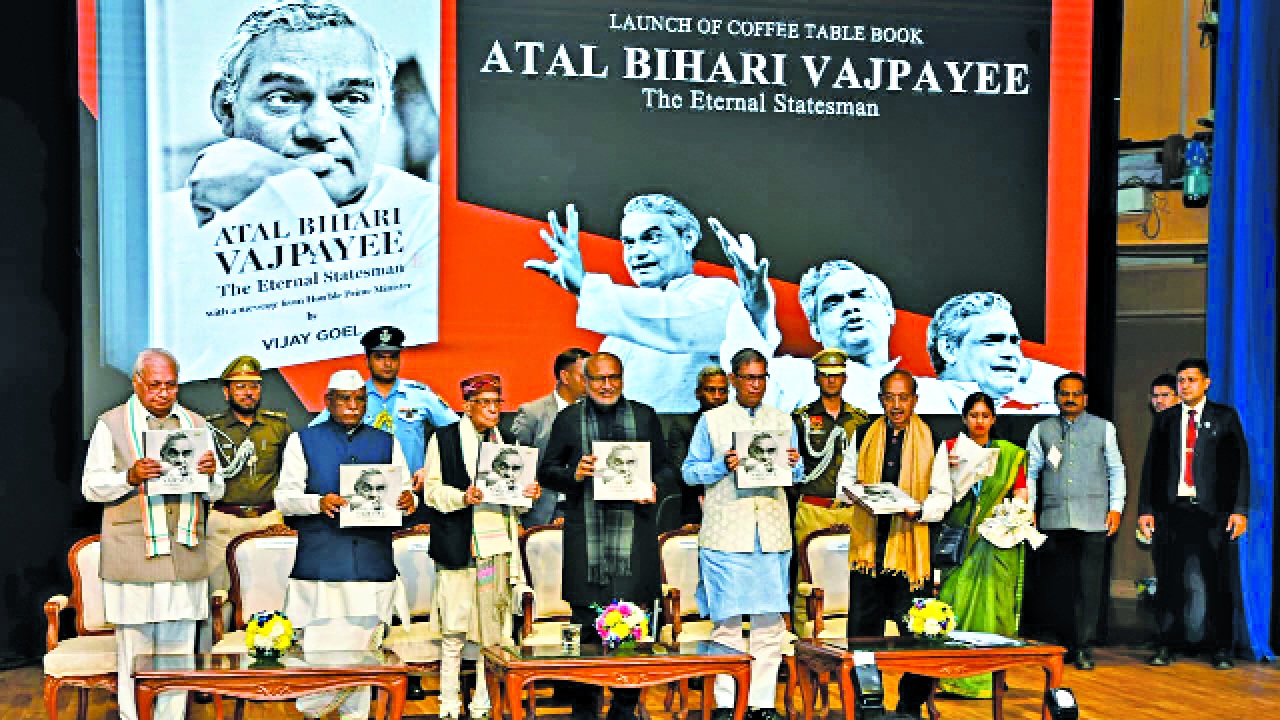
In the ever-expanding archive of books on modern Indian politics, Vijay Goel’s latest coffee-table book “Atal Bihari Vajpayee: The Eternal Statesman” emerges as a work of rare intimacy and historical depth. Dedicated to the life and legacy of Bharat Ratna Atal Bihari Vajpayee, this 312-page coffee-table volume is not merely a tribute, it is a visual and emotional chronicle of a leader who redefined the grammar of democratic conduct in India.
Richly illustrated, elegantly designed, and personally narrated in parts by Vijay Goel - who shared a five-decade association with Vajpayee - the book reads as both tribute and testimony.
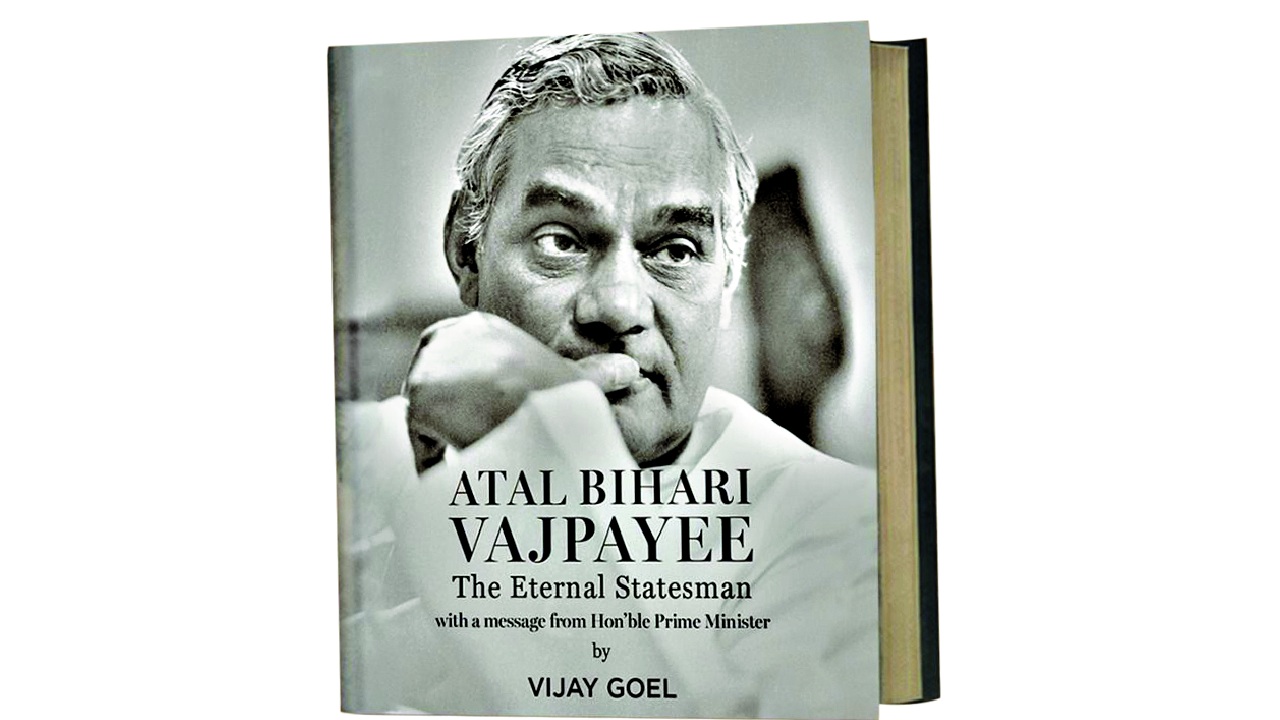
Published by Heritage India Foundation and priced at `4,000, the book is available on Amazon and stands out as perhaps the first and one of its kind comprehensive pictorial biography of Vajpayee, combining rare archival material, personal reminiscence and political documentation.
A Message from the Prime Minister
The volume opens with a message from Prime Minister Narendra Modi, who underscores Vajpayee’s transformative leadership in areas ranging from infrastructure and telecommunications to strategic policy and coalition governance. The Prime Minister’s words situate Vajpayee not merely as a leader of his time but as an enduring institutional influence. Prime Minister Narendra Modi highlights Vajpayee’s transformative contributions in areas such as information technology, infrastructure, telecommunications, and modern communication, noting that his policies unlocked new opportunities for India’s youth.
Reflection of a Fifty-Year Association
What distinguishes this book from conventional political biographies is the author’s proximity to his subject. Vijay Goel shared a fifty-year association with Vajpayee. He witnessed Atal ji from his college days as an electrifying orator to his tenure as Prime Minister commanding global respect. Goel worked with him in multiple capacities such as a BJP worker, as a party office-bearer, as a Member of Parliament, as a Minister, and eventually as Minister of State in the Prime Minister’s Office. Vajpayee shared close familial ties with Goel’s family, and it was this trust and confidence that led him to choose Goel to work in the PMO.
The book traces Vajpayee’s journey from his birth in Gwalior in 1924 to his 8emergence as a parliamentarian of rare eloquence and eventually a three-time Prime Minister. The early chapters on his upbringing, education at Victoria College and DAV College, and his formative association with the RSS are particularly illuminating. They reveal a young man shaped as much by intellectual discipline as by ideological conviction.
Goel’s narrative captures Vajpayee’s early rise in the Bharatiya Jana Sangh under the mentorship of Syama Prasad Mukherjee and Deendayal Upadhyaya. The images from the Calicut session, the Kanpur conference, and the protests of the 1960s and 70s bring alive a political era when ideology was debated fiercely but articulated with civility.
The Smiling Prime Minister
One of the most striking features of the book is the recurring smiling face of Atal ji across its pages. Whether in Parliament, at party meetings, or at international summits, the warmth and smile in Vajpayee’s expression remains constant.
Memories through Rare Photographs
With steadfast patience and perseverance, Vijay Goel has brought together rare and unique photographs, many not usually seen in the public domain. Some come from his personal collection; others have been sourced from archives and associates over the last four years into making this coffee-table book. These images document not just public milestones but private moments such as laughter, reflection, camaraderie. They show Vajpayee the poet, the administrator, the coalition-builder, the parliamentarian, the journalist, but above all, the human being.
A Tribute worth Preserving
Atal Bihari Vajpayee: The Eternal Statesman is more than a commemorative coffee-table book. It is a moral archive of an era brought out evocatively and vividly. As a coffee-table book, the production quality is impressive. Captions are detailed, contextualizing events in a storyline format, such as the cow protection rallies, the East Pakistan crisis, the bullock-cart protest against fuel price rise, and student movements of ronological structure - from Early Life to Sadaiv Atal - ensures clarity, while the index enhances research value. For historians of post-Independence India, the volume doubles as a visual archive of opposition politics, coalition era dynamics, and the ideological evolution from Jana Sangh to BJP.
In chronicling the life of Atal Bihari Vajpayee, Vijay Goel has offered not just a book, but a memory preserved in print - steadfast, reflective, and, in every sense, Atal.