Light that lingers beyond the season

In an age where literary anthologies often become hurried compilations bound by theme but not temperament, Light of Spring, curated under the banner of Kala, arrives as a thoughtful and measured offering. It is not merely a seasonal metaphor; it is a philosophical inquiry into renewal, fragility and the quiet revolutions that define human experience.
Spring, in this anthology, is not treated as spectacle. It is not only blossom and breeze. It is hesitation before change, the tremor before confession, the courage before departure. The curators have resisted the temptation of overt symbolism and instead allowed each writer to interpret “light” through personal, social and existential lenses.
Bringing together 45 short stories by emerging writers, the anthology reflects a spectrum of voices at different stages of literary evolution. The diversity in perspective — geographical, generational and emotional — lends the collection both freshness and unpredictability. What unites these varied narratives is not uniform style, but a shared sincerity in engaging with the idea of renewal.
What stands out most is tonal diversity. Some stories unfold in the stillness of domestic interiors — balconies overlooking crowded cities, kitchens carrying unspoken histories, ageing protagonists confronting relevance. Others move outward into public spaces, where politics, memory and morality intersect. The anthology does not insist on optimism; rather, it explores transition. And in doing so, it achieves authenticity. As with any anthology of emerging voices, a few stories may read as unpolished in places — their edges visible, their craft still evolving. Yet that very rawness becomes part of the anthology’s strength. There is an immediacy in these narratives, an absence of excessive refinement, that preserves emotional truth. The reader senses not perfection, but presence — and that lends the collection a refreshing honesty.
Stylistically, the prose across contributions varies — lyrical in some pieces, sparse and journalistic in others. Yet the curation ensures cohesion. The language is accessible without being simplistic, reflective without becoming indulgent. The pacing of the anthology itself mirrors the season it invokes: gradual, attentive and patient.
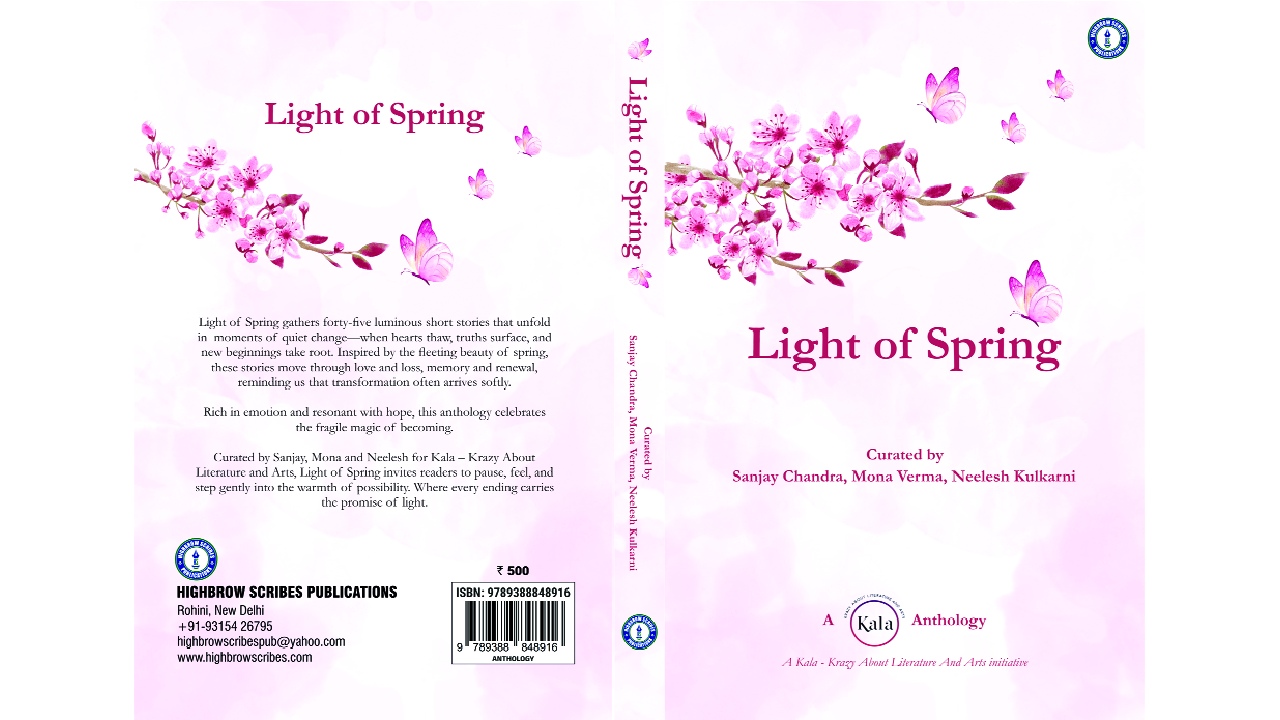
If there is a critique to be made, it lies perhaps in its quietness. Readers expecting dramatic climaxes or experimental narrative structures may find the collection understated. But therein lies its integrity. Light of Spring is not an anthology that demands attention through volume; it earns it through sincerity.
Importantly, the anthology signals something larger than itself. Under Kala’s literary vision, this appears to be the beginning of a seasonal quartet —an ambitious conceptual arc that promises Summer’s intensity, Autumn’s introspection and Winter’s austerity. If Light of Spring is the overture, it sets a tone of seriousness and literary commitment.
In a cultural moment increasingly driven by speed and spectacle, this collection makes a case for pause. It reminds us that renewal is rarely dramatic. More often, it is a shift in perspective, a softened voice, a quiet decision to begin again. And perhaps that is the truest light of spring.