Bangladesh turns a new leaf
When Tarique Rahman landed in Bangladesh after 17 years in exile, the slogan that echoed around him was deliberate and resonant: “I have a plan for Bangladesh.”Standing amid the charged atmosphere of his return, I could not help but hear another line in my mind — one that felt equally urgent: “I have questions for Bangladesh.”The cadence inevitably recalls Martin Luther King Jr. and his immortal words, “I have a dream.” Today, in Bangladesh, many carry their own version of that dream. For some, it is embodied in Tarique Rahman — a leader shaped by exile, political inheritance, and long-distance observation.He is the son of former Prime Minister Khaleda Zia and former President Ziaur Rahman, one of the country’s most consequential figures. For supporters, that lineage represents continuity and unfinished history. For critics, it raises questions about dynastic politics. But in the week I spent in Dhaka — from polling day to vote counting - one thing was undeniable: expectation surrounded him.
A Different Political Mood
I have reported on Bangladesh through some of its most defining crises - from the aftermath of the 2016 Holey Artisan Bakery attack in Gulshan to the long shadow of the Rohingya refugee crisis, and through years of political confrontation between the Bangladesh Nationalist Party (BNP) and the Awami League. But this visit felt different.
The July uprising and the dramatic fall of Sheikh Hasina’s Awami League government altered the national mood. The fatigue with prolonged dominance by one political force was palpable. Anger was not abstract — it was conversational. I heard it from students at Dhaka University, from rickshaw pullers navigating impossible traffic, from business leaders worried about stability, and from policy analysts in quiet office rooms.
This election was watched closely in global capitals. Diplomats and regional powers waited to see whether Bangladesh would recalibrate its democratic trajectory. When the results were announced, the message was unmistakable: the BNP secured a sweeping mandate.
For many I spoke with, the scale of victory was not surprising. Bangladeshi voters have a pattern — they deliver decisive mandates. Fragmented coalitions rarely appeal here. Stability, many believe, requires centralized authority, especially in uncertain times.
The First Question
During my stay, I tried repeatedly to secure a one-on-one interview with Tarique Rahman. It did not materialise. On February 13, I found myself near him after Friday prayers — close enough to exchange only a brief smile, no words.
But on February 14, at the InterContinental Dhaka, amid a crowded international press gathering following the official results, I managed to ask the first question of the evening.It was direct.
What will define your foreign policy - especially relations with India, Bangladesh’s immediate neighbor with whom it shares history, culture, and deep economic ties?And what role will the International Crimes Tribunal (ICT) play under your leadership? His response was measured.
“Foreign policy will be based on Bangladesh first,” he said — a phrase signaling strategic autonomy. It hinted at recalibrated engagement not only with India, but also with China, the United States, and regional blocs.
On the ICT, senior party leaders emphasised that it remains part of the judiciary, not the executive — and should operate independently of political influence.
The tribunal has long been contentious. Critics argue it has been politically selective. It has delivered verdicts against opposition leaders and, more recently, even against Sheikh Hasina. Whether reforms will follow or whether continuity will prevail remains one of the defining questions of this administration.
From Exile to Executive Power
Seventeen years in exile to Prime Minister — it is a dramatic political comeback.But exile builds narrative; governance tests credibility.From my ground assessment, the challenges are immediate and complex. Campaign promises are easier made than implemented. The proposed health card scheme offering 2,500 taka in support has become a talking point in tea stalls and television studios alike. Women in lower-income neighborhoods are watching closely.
Job creation is urgent. Law and order must stabilize after months of unrest. Institutions need rebuilding. Investor confidence — across trade, tourism, and education — must be restored. International partners will be assessing policy signals carefully.The expectations are immense.
A Mood of Cautious Hope
What struck me most during this week was not celebration - but restraint.In many parts of Asia, landslide victories trigger fireworks and triumphal rallies. Instead, after securing a sweeping mandate, Prime Minister Tarique Rahman urged party workers to offer prayers for those who lost their lives during recent unrest rather than celebrate publicly.
That gesture resonated.
Bangladeshis are politically aware and emotionally invested. They have endured polarisation, security threats, economic strain, and institutional fatigue. They understand that a change in power does not automatically guarantee change in governance.
Across Dhaka - in quiet conversations and crowded tea stalls - I sensed cautious hope. A desire for economic opportunity. For less confrontation. For governance that feels accountable rather than overpowering.
Having covered Bangladesh since the aftermath of the Holey Artisan attack, I have seen the country wounded and resilient. This election feels like another historic pivot. Whether it marks genuine democratic renewal or simply another chapter of concentrated authority will depend not on the scale of victory - but on how this majority governs, and whether it listens as carefully in office as it did on the campaign trail.On a personal note, I leave Dhaka grateful.Over this week, I made friends who guided me through political corridors and backstreet conversations alike. They offered insight, candor, and warm hospitality. Abar dekha hobe.
Tarique Rahman: A profile
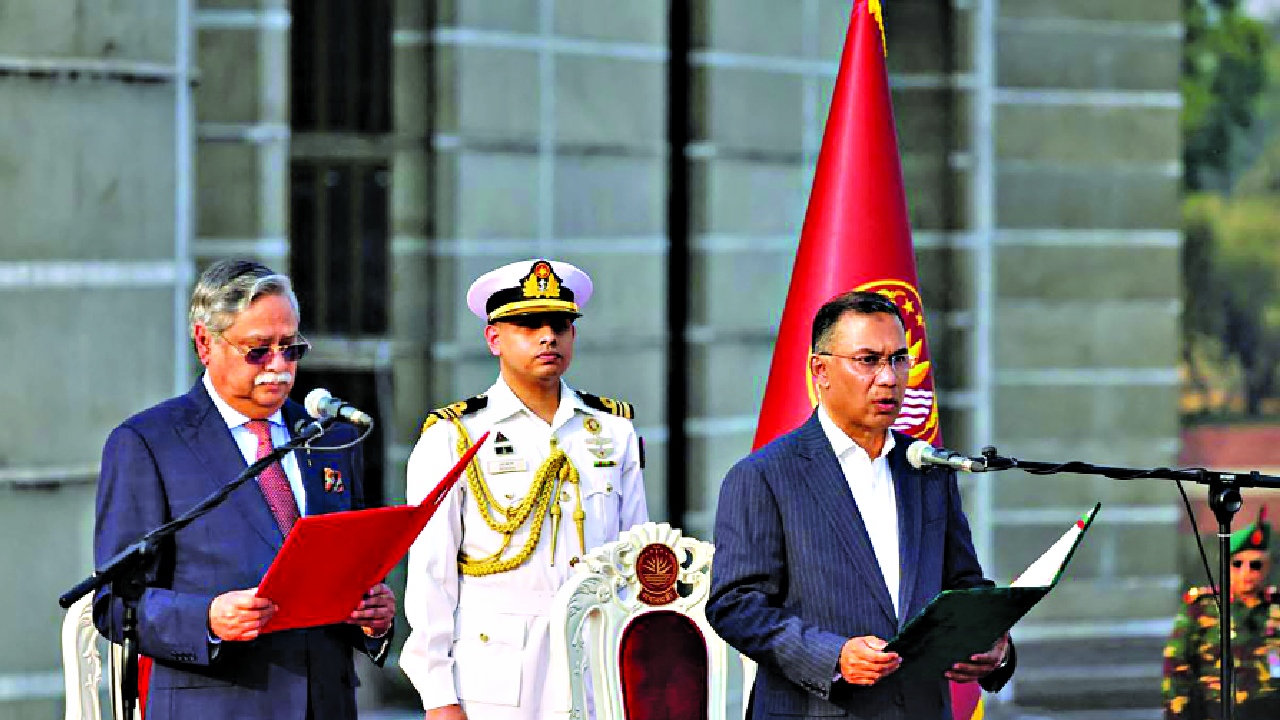
Tarique Rahman was sworn in as the 11th Prime Minister of Bangladesh on February 17, 2026. He is the chairman of the Bangladesh Nationalist Party (BNP) and the eldest son of two former leaders: President Ziaur Rahman and Prime Minister Khaleda Zia.
Political Profile & Leadership
Landslide Victory: Rahman led the BNP to a decisive win in the February 12, 2026, General elections-the first since the 2024 uprising-securing 209 seats in the Jatiya Sangsad.
Historic Oath: In a departure from tradition, he was sworn in at the South Plaza of the Jatiya Sangsad Bhaban rather than the presidential palace.
End of Exile: His premiership marks the end of a 17-year self-imposed exile in London (2008-2025), where he lived following political persecution and legal charges under the previous regime.
Policy Focus: His administration has prioritised price control, improving the law and order situation, and implementing anti-corruption measures.
Personal & Professional Background
Education: Attended BAF Shaheen College and Dhaka Residential Model College; he briefly studied Law and International Relations at the University of Dhaka before moving into the textile and shipping business.
Family: Married to Zubaida Rahman, a physician; they have one daughter, Zaima Rahman, who is a barrister.
Legal Redemption: During the Sheikh Hasina administration, he was convicted in absentia for various charges, including the 2004 grenade attack. However, following the 2024 revolution, appellate courts acquitted him of all charges, clearing his path to office.
Key Election Results
BNP Landslide: The BNP-led alliance won 212 out of 300 parliamentary seats, surpassing the 151-seat majority mark.
New Leadership: Tarique Rahman, son of former President Ziaur Rahman and former PM Khaleda Zia, is set to become the next Prime Minister.
Main Opposition: The Islamist Jamaat-e-Islami alliance emerged as the primary opposition, securing between 68 and 77 seats.
Awami League Barred: The party of ousted former PM Sheikh Hasina was prohibited from contesting.
Youth Influence: The newly formed National Citizen Party (NCP), born from the student-led “Monsoon Revolution,” won at least six seats.
Voter Turnout & Referendum
High Participation: Nationwide turnout was approximately 60 per cent, a significant increase from the 42 per cent recorded in the disputed 2024 polls.
July National Charter: Held alongside the election, a national referendum on constitutional reforms passed with roughly 60.2 per cent approval. Key reforms include:
- Implementing two-term limits for Prime Ministers.
- Creating a bicameral legislature (upper house of parliament).
- Strengthening judicial independence and presidential powers.
International & Domestic Impact
Democratic Reset: Observers from the European Union described the polls as “credible and competently managed”.
India Relations: Prime Minister Narendra Modi congratulated Tarique Rahman, signaling a potential reset in diplomatic ties.
Minority Representation: Direct representation for women and ethnic minorities fell to a two-decade low, with only seven women and four minority candidates directly elected to parliament.
The writer is an Associate Editor (Foreign Affairs) at The Pioneer