Women’s Bill falls: A reform lost in distrust
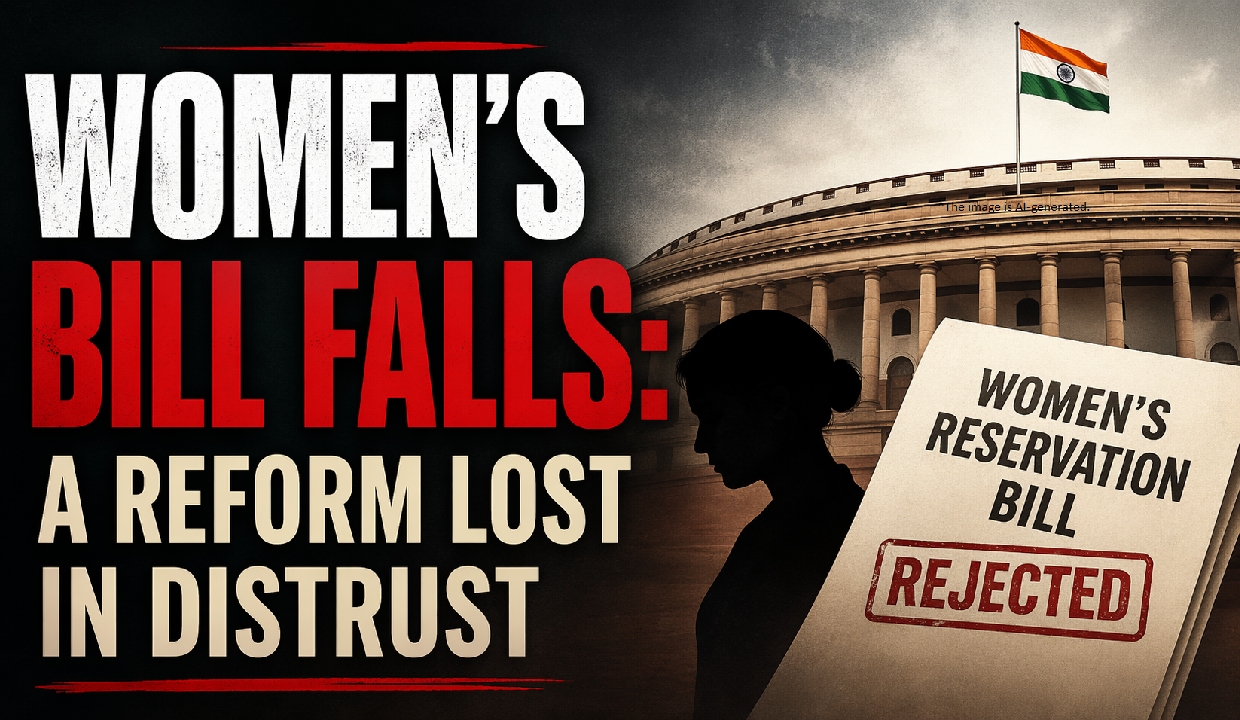
The Women’s Reservation Bill: where empowerment and federal equity clashed, and consensus gave way to confrontation, stalling a long-awaited reform
In an unprecedented development, the Women’s Reservation Bill fell on the floor of Parliament, dashing hopes of women’s reservation of 33 per cent in the Lok Sabha. The government had worked hard on it and had called a three-day special session of Parliament to pass the bill. But that was not to happen as the opposition parties and regional parties did not agree to the provisions of the proposed bill. The southern states, in particular, felt that their representation, though might improve in absolute terms, would decrease in proportion to the northern states, where population is dense and the sole criterion for the delimitation was the head count. The collapse of the women’s reservation amendment in Parliament shows the lack of political consensus on reform, representation, and federal balance. The subsequent address to the nation by Narendra Modi sought to recast the defeat as a moral and political betrayal by the Opposition, but the reality is perhaps more complex and needs to be studied carefully. Setting aside the Opposition’s reservations does not help, as their fears must be assuaged. What the government had proposed was a set of three Bills that attempted to expand the size of Lok Sabha while ensuring 33 per cent reservation for women. This linkage—between representation and redistribution of seats—proved to be its undoing. The Opposition parties — the Indian National Congress, Samajwadi Party, Trinamool Congress, and Dravida Munnetra Kazhagam — viewed it with suspicion, fearing that the absence of a written guarantee on proportional seat distribution could open the door to a politically sensitive delimitation exercise based on outdated population data of the 2011 census. They also said that the upcoming caste census would be a better basis for deciding the seat allocation in the Lok Sabha. Southern states, which have historically performed better on population control, have long feared losing parliamentary weight if delimitation is conducted on raw population numbers.
By failing to codify assurances within the Bill, the government left space for mistrust. In that sense, the Opposition’s resistance was rooted in structural anxieties about federal equity. Yet, the Opposition too cannot escape responsibility. By voting down a measure tied—however imperfectly—to women’s representation, it risks being seen as prioritising political calculus over a long-pending social reform. Their negation would cause further delay in ensuring women's participation in politics. However, the women’s representation must be carefully thought out. As the ground reality is grimmer. The attempts to ensure women’s political participation at lower rungs remain uneven. More often, women may be in power, but the centre of power remains elsewhere. In his address, the Prime Minister chose confrontation over conciliation. His characterisation of the Opposition’s actions as “foeticide” and branding them “anti-reform” may energise political supporters, but it does little to rebuild the consensus necessary for constitutional amendments. Equally, the Opposition’s dismissal of the bill reflects a hardened distrust. The way forward lies not in confrontation but in building consensus through dialogue and debate.