US courts hit Trump’s immigrant war
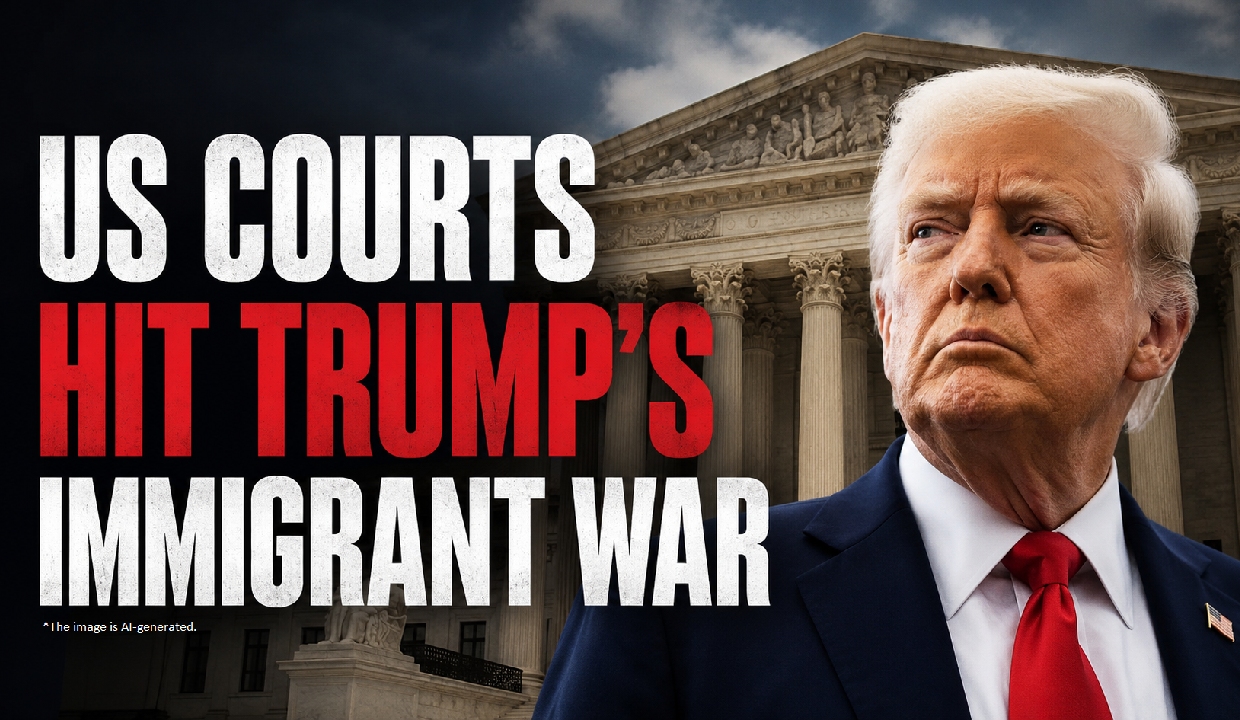
A federal judge has struck down Trump’s $100K H-1B visa fee, giving relief to millions of skilled workers applying to work in the US
In a ruling that reverberated from Silicon Valley to Bengaluru, a federal judge in Boston’s District Court for Massachusetts vacated President Trump’s September 2025 Presidential Proclamation that had imposed a staggering $100,000 fee on every new H-1B visa petition. The verdict was unambiguous: the President had imposed a tax without Congress’s consent, and that is simply unconstitutional.
The fee was framed by the administration as a guardian of the American worker. Trump himself argued the steep price tag would ensure only the “truly extraordinary” would qualify. The logic was seductive in its simplicity: make it expensive, and only the best will try. But the logic collapsed under legal scrutiny. The court ruled that what the White House called a “regulatory payment” was, in substance, a revenue-raising mechanism - a tax in all but name. The power to levy taxes belongs to Congress, not the Oval Office. In striking it down, the court also cited violations of the Administrative Procedure Act and the constitutional separation of powers.
The collateral damage of the fee, had it stood, would have been enormous. Universities such as Stanford, Michigan, and the University of Florida — each receiving more than a hundred H-1B approvals annually — faced a severe hiring crunch for researchers and faculty. Hospitals reliant on foreign-trained doctors and nurses were equally exposed. Twenty Democratic state attorneys general had sued on precisely these grounds: that public institutions, from schools to clinics, could not absorb a six-figure surcharge per hire.
For small and mid-sized technology companies, the fee was not a deterrent but a door slammed shut. For India, the stakes were highest. Indian nationals are, year after year, the single largest group of H-1B recipients. The fee threatened to make hiring Indian engineers, scientists, and healthcare workers economically indefensible for most employers, effectively pricing an entire nationality out of the American labour market.
Monday’s ruling offers that community a window of relief, but it is not a clear sky yet. And that is the crucial caveat. This is not the Supreme Court speaking, and this is not the final word. The Trump administration is widely expected to appeal, and a parallel lawsuit filed by the US Chamber of Commerce in Washington, DC, is still working its way through the system. A third case filed in San Francisco by religious and labour groups adds yet another front. The possibility of conflicting rulings across three appellate circuits makes a Supreme Court hearing increasingly likely. What remains is a legal and political battlefield. The administration could yet seek a stay pending appeal, which would immediately restore the fee.
What the Boston ruling does establish, loudly and clearly, is that immigration policy cannot be made by proclamation when it amounts to taxation. For India’s vast technology diaspora and the global talent pipeline that feeds American innovation, this is a moment of relief — earned by the courts, not by politics. But relief, in this climate, must be mistaken for nothing more than a pause.