Perils of doomscrolling
There was a time when boredom was simply part of existence. People waited at bus stops, stood in lineups, ate meals, travelled short distances and even sat alone without needing to be entertained every second. Today, screen time, attention spans, the death of reading - parents raise these issues at every meeting, and they are not wrong to worry. But the conversation almost always points in one direction, from adult to child, as though the problem were something children caught on their own, like a cold, and the adults were merely trying to cure it.
The truth is less comfortable. Children do not learn their relationship with the phone from the phone. They learn it from their parents. A child asked to put the device away at the dinner table, while a parent checks a message ‘just once’, receives two lessons at the same time and picks the one that is demonstrated rather than the one that is stated. Parents should understand that they are the first screen a child studies.
Long before they hold their own phone, they have watched, hundreds of times, what a face does when it hears a notification; how conversation pauses, how attention lifts and travels somewhere else, how the person in the room quietly becomes less important than the person on the screen. That is the curriculum which parents deliver every day without meaning to. Digital platforms are built around this precious commodity termed attention. Infinite scrolling makes no natural stopping point; autoplay removes the need to make another decision; continuous notifications pull users back, while likes, messages and new content offer small and unpredictable rewards. One may assume they are casually checking their phones, but the reality is that their attention is being competed for, seized and monetised.
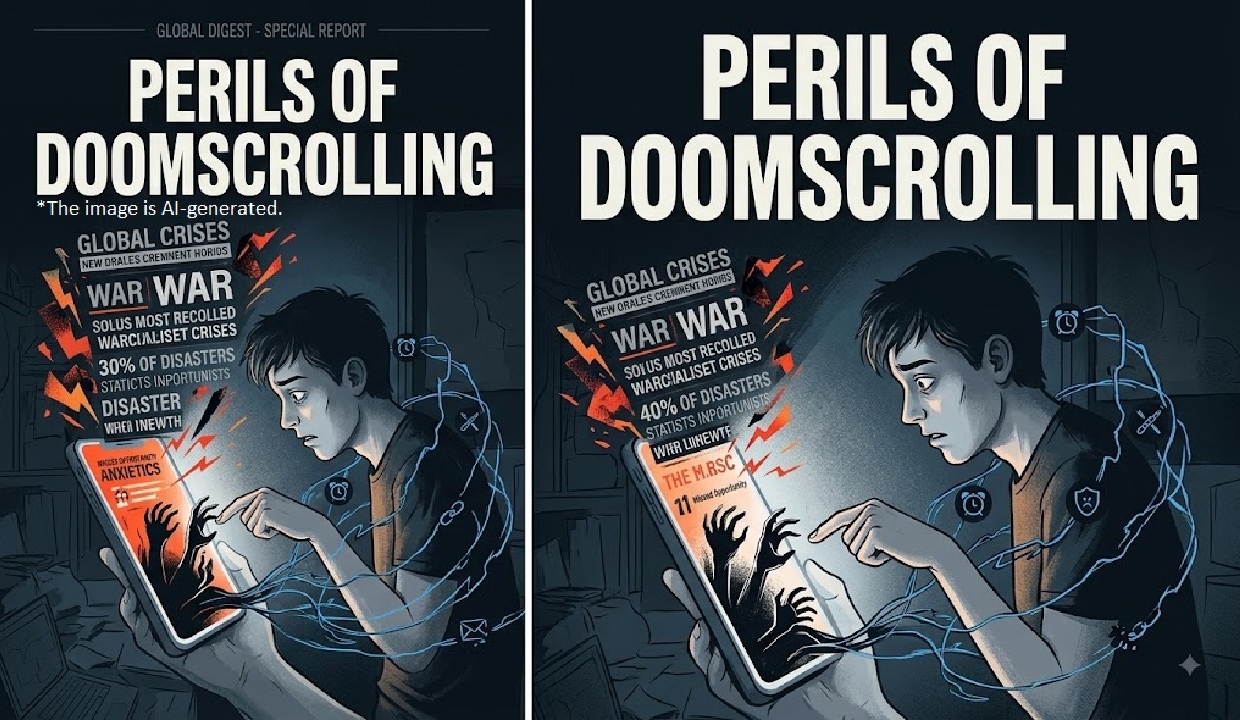
Doomscrolling makes this interaction even more difficult. During stress, loneliness, anxiety or boredom, the phone offers immediate escape. We scroll hoping to feel better, informed or connected, yet often emerge more restless than before. Bad news sends us searching for more bad news.
Social media provides other people’s lives as exciting, productive and happy, feeding the fear that something important is happening somewhere without us. Perhaps the most worrying consequence is not the number of hours spent online, but what those hours displace. Parents scroll while children seek their attention, and children copy what they see.
Friends sit beside each other, yet their minds are far away in other digital rooms. Many of us surrender our first waking moments and our final sleepy minutes to a mobile screen. Nostalgia is not the answer. The pre-digital world was not perfect and is not coming back. Technology has transformed education, employment, healthcare and communication in remarkable ways.
What one needs is not digital rejection but digital discipline. Small boundaries can restore surprising amounts of control. One does not have to check their phone right when they wake up. Meals can be eaten without looking at screens.
Reading a book, writing a list by hand or sipping a cup of coffee in peace can reclaim moments which these devices have gradually occupied. We often ask what smartphones are doing to children. Adults/parents must ask what their own habits are teaching them. Digital behaviour is shaped as much by example as by instruction. Remember, technology was created to make life easier, not to become life itself. The real challenge of the digital age is no longer learning how to use technology; rather, it is learning when to stop and remember that real life still happens beyond the screen.
The writer is an educator and a councillor; Views presented are personal.