India’s middle class needs opportunity more than subsidies
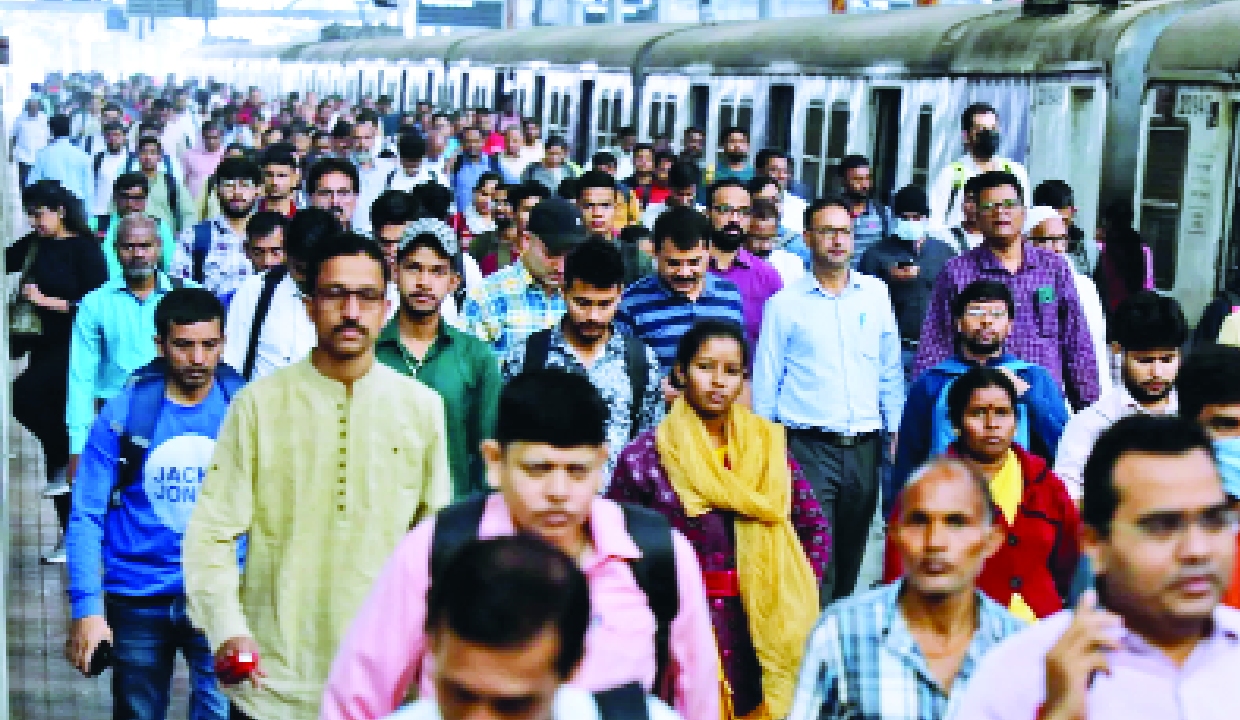
In almost every Indian city, there is a family the country needs to talk about. The father pays his income tax in full, on time, every year. The mother has taken a loan for their daughter’s engineering degree. There is an insurance premium due each March against an illness they hope never comes. This family asks the government for very little. It is the Indian middle class, and it has quietly
become the engine of the country’s economy — and the government’s own record over the past decade shows it understands that the next phase of reform must focus on this family.
Yet, few people realise just how powerful this engine has become. Speaking in France earlier this year, the finance minister pointed out that India’s middle class has expanded by about 6.3 per cent every year since 1995 and now forms roughly 31 per cent of the population. The World Economic Forum estimates make this even clearer. Today, 4 out of every 5 rupees spent by Indian consumers come from middle-class and better-off families. By 2036, that is expected to increase to more than 9 out of every 10 rupees. By 2047, this group is projected to include over one billion Indians.
The growth of the middle class is also reflected in India’s tax base. The number of income-tax payers has more than doubled, from 5.26 crore in 2013-14 to 12.13 crore in 2024-25, and Income Tax Return filings have doubled in the same period, from 4 crore in 2013-14 to 8.18 crore in 2023-24, according to the Press Information Bureau. That is what happens when a tax system is simplified rather than merely enforced.
Healthcare tells a similar story. As government spending on healthcare has increased, families are paying much less from their own pockets for medical treatment. Out-of-pocket healthcare expenses have fallen from 64.2 per cent in 2013-14 to 39.4 per cent today, while public spending on healthcare has steadily increased. And even as the economy has formalised at record pace, the labour market has held steady: the National Statistical Office’s Periodic Labour Force Survey puts the overall unemployment rate at 3.1 per cent in 2025, among the lowest such figures India has ever recorded.
The government’s next priority is to create more quality jobs that match people’s education and skills, especially for graduates. With graduate unemployment at 11.2 per cent, the focus is now on better experiential learning and stronger links between education and industry.
So, what does such a family need from the government now? Not more help. Welfare matters, and India has extended it to the poor on a scale no country has attempted before. But the middle class stands somewhere else, and policy has increasingly recognised this. It has never asked to be carried. It asks only that the climb be made possible. A subsidy answers a shortage; opportunity answers an ambition — and the direction of recent policy suggests the government agrees.
Helping people through welfare and helping them create wealth are two different approaches. Welfare is measured by what the government distributes out. Wealth creation is measured by what people are able to earn. A family that has already escaped poverty needs the second far more than the first — and the government’s recent reforms have leaned decisively toward the second.
That shift is well underway. Incomes of up to 12 lakh rupees a year are now free of income tax, GST has been rationalised into simpler slabs, and the Income Tax Act of 1961 has at last been replaced after decades of complexity. Each of these reforms allows middle-class families to keep more of what they earn, instead of paying it to the government first and receiving it as benefits later. More Indians are joining the formal economy and as a result the number of GST taxpayers has risen from 66.5 lakh in 2017 to 1.64 crore by April 2026 — nearly two and a half times in nine years, according to the Press Information Bureau.
Lower taxes help families keep more of their income. Better jobs help them increase that income. That is why the government’s recent investments have focused on creating more employment opportunities. Twelve semiconductor projects have been cleared, carrying an investment of about 1.64 lakh crore rupees (roughly $19 billion). The IndiaAI Mission has built a shared national computing facility of more than 45,000 GPUs, the machines on which artificial intelligence model is trained. Electronics are now worth 13 lakh crore rupees (about $155 billion) and stand as India’s third-largest export.
India already ranks among the world’s largest producers of renewable power. Every solar park and battery plant creates opportunities for engineers, technicians and supervisors. To ensure these opportunities translate into prosperity, the government’s focus is now on equipping Indians with the skills needed for these emerging industries. According to the India Skills Report 2026, only 56.35 per cent of graduates are currently considered employable. The government’s skill development and apprenticeship programmes, including Skill India and the National Education Policy’s focus on vocational education, are aimed at improving this figure. India has spent the past decade building industries such as semiconductors, artificial intelligence and renewable energy. The next challenge is to prepare more graduates for these sectors by improving skills and reducing graduate unemployment, which currently stands at 11.2 per cent.
Colleges must therefore keep teaching for jobs and not only for degrees. Employers should help write the syllabus and sit on examination panels. Students should gain hands-on industry experience as part of their degree, not after completing it. And learning must continue throughout one’s career because the skills of 2026 will not be enough for the jobs of tomorrow.
Not every middle-class Indian wants a salary. Many want to build something, and the government schemes have already begun making that easier: streamlined MSME registration through Udyam, credit guarantees through CGTMSE, and invoice discounting through TReDS. However, there is still considerable scope to improve access to bank credit for small businesses. Encouragingly, the share of small enterprises receiving formal bank loans increased from 14 per cent in 2020 to 20 per cent in 2024, according to NITI Aayog. If this progress continues, many more entrepreneurs will be able to access the finance they need to grow.
Healthcare and education costs can also hold families back. When they must take loans for these essential needs, pursuing bigger dreams often becomes financially risky. The government’s own record is its strongest case — reliable roads and power, dependable government hospitals, good government schools and honest digital services hand that money back to the family. And out-of-pocket health spending’s fall from 64.2 per cent in 2013-14 to 39.4 per cent today shows the direction is already right. India is now close to achieving the National Health Policy’s target of reducing out-of-pocket healthcare expenses to 35 per cent.
Somewhere in an Indian city, that same father is still filing his return on time, that same mother is still repaying her daughter’s loan. Neither has asked the state for a handout, and increasingly, neither has had to. What the middle class deserves — and what the reforms of the past decade have sought to deliver — is not charity, but opportunity. It is a job worth training for, a business worth risking, a city that does not tax them twice by making them pay privately for what public money already promised. Perhaps the question is no longer whether India’s middle class can carry the weight of Viksit Bharat — India’s goal of becoming a developed nation by 2047 — for it has been carrying that weight quietly for thirty years, and today, more than ever, government policies are helping share that responsibility.