
- HOME
- INDIA
- WORLD
- BUSINESS
- STATES
- LAW & JUSTICE
- ENTERTAINMENT
- SPORTS
- VIEWPOINT
- LIFESTYLE
- TECH
India’s demographic dividend is only as strong as its arteries. On World Heart Day, the pledge is simple: don’t miss a beat, and don’t let the country miss one either
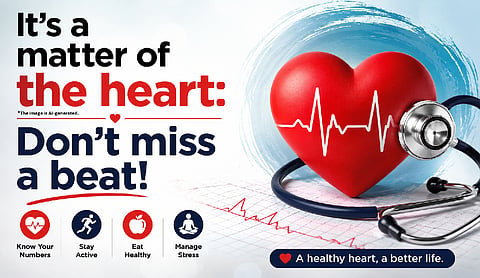
Every September 29, World Heart Day asks the world to listen to the one organ we notice only when it falters. Founded in 2000 by the World Heart Federation with the WHO, the day endures because its message never ages: cardiovascular disease is the planet’s leading killer, claiming nearly 20 million lives a year. More than four in five of those deaths are heart attacks and strokes, and a third strike people younger than 70. This year’s campaign, “Don’t Miss a Beat”, targets the disease’s cruellest feature: it often gives no warning until it is too late.
How did an ailment of old age become an epidemic of the prime of life? Because modern living has industrialised every risk factor. Ultra-processed food, salt, sugar and trans fats have displaced home cooking. Desks have replaced fields. Tobacco persists, air pollution chokes our cities, and sleeplessness is worn as a badge of ambition.
Cardiovascular disease caused 26.6 per cent of all Indian deaths in 2017, up from 15 per cent in 1990. Heart attacks in the thirties and forties, among breadwinners, are at their peak. Kerala, Punjab and Tamil Nadu rank among the top. An estimated 315 million Indians live with hypertension, yet only about 28 per cent know it, and barely one in eight has it under control. Another 136 million have prediabetes. The epidemic is not concealed. We simply are not looking.
The way out is neither exotic nor expensive. First, detect early. Blood pressure, sugar and cholesterol checks must become as routine as a mobile recharge, available at every health and wellness centre. Second, treat cheaply and continuously.
The India Hypertension Control Initiative proves it works: across nine districts, blood pressure control rose from 37 to 48 per cent between 2018-19 and 2023-24, while patients’ out-of-pocket medicine spending fell from 47 to 9 per cent. That model belongs in every district.
As a nation, we have to make choices, healthy choices, that can make India fit again. No doubt yoga can be a great way to get healthy, but it must be accompanied by lifestyle choices, eating right, sleeping right and keeping three culprits, hurry, worry and curry, in check. Then there are so many things in the market that are enough to make us unhealthy. Salt and trans-fat limits, tobacco, alcohol and plenty of processed food need to be curtailed. Besides, cleaner air and daily walks can make all the difference. Moreover, it is very important to prepare for emergencies before they happen. Chest pressure, breathlessness and pain spreading to the jaw or arm demand a hospital, not a home remedy, and CPR should be taught in every school and office. World Heart Day is a reminder that the heart is more than an organ that keeps us alive, it is at the centre of our physical well-being, working silently every moment.