
- HOME
- INDIA
- WORLD
- BUSINESS
- STATES
- LAW & JUSTICE
- ENTERTAINMENT
- SPORTS
- VIEWPOINT
- LIFESTYLE
- TECH
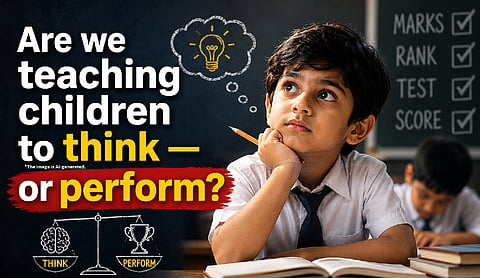
A child delivers a flawless, rehearsed speech and wins loud applause. Another sits quietly, wrestling with a difficult problem, doubting every step until the solution finally emerges. Both represent real academic achievement - yet only one is likely to be photographed, celebrated, and held up as proof of learning. As classrooms grow ever more focused on visible accomplishment, an uncomfortable question follows: are we nurturing thinkers, or simply training performers? Educational institutions worldwide are embracing innovative pedagogy, technology-driven classrooms, and elaborate student activities. These can enrich learning, but they can just as easily disguise its absence. A colourful classroom does not guarantee intellectual growth. An enthusiastic student has not necessarily understood the concept at hand. Even a beautifully executed project says little about whether its creator can explain the reasoning behind it. Presentation has become a proxy for comprehension, and the two are not the same thing.
This traps teachers in an exhausting paradox: they are expected to cultivate critical thinking while demonstrating engagement, with every lesson creative and every activity memorable. But genuine learning rarely photographs well. It looks like patiently untangling a misconception, or letting a student sit with confusion long enough to work through it. Education should welcome creativity and presentation - but never let either substitute for understanding. Real achievement lies not in how impressive a student’s work appears, but in how deeply they grasp it.
A related danger is the growing assumption that learning must always be entertaining. Surrounded by instant information and constant stimulation, children risk losing something essential: the knowledge that intellectual growth demands discomfort. A hard problem may take several failed attempts. A difficult text demands patience. Building an original argument requires uncertainty, reflection, and the willingness to be wrong. These experiences cannot be made entertaining, nor should they be. Learning to persevere through that discomfort builds something more lasting than momentary enjoyment: the confidence to think independently.
School leaders must ask whether their priorities reward genuine understanding or merely impressive outcomes. Parents must accept that learning cannot always be measured in certificates, performances, and public recognition. Teachers deserve the professional freedom to prioritise depth over display, with technology and pedagogy supporting that purpose rather than replacing it with spectacle. The real test of education is not how confidently a child repeats a rehearsed answer, but how thoughtfully they respond to an unfamiliar one - whether they can question an assumption, defend an argument, or recognise a mistake.
These abilities will matter long after the decorations are removed, the competitions forgotten, and the photographs faded. Perhaps the greatest danger facing modern education is not a shortage of information or opportunity, but too little time for children to develop their own thoughts.
A school should be remembered not for how brilliantly its students performed when watched, but for how confidently they learned to think when no one was. Education’s purpose is not to prepare children for applause - it is to prepare them for a world in which they must think for themselves.
The writer is an educator and a columnist; Views presented are personal.