The Makkah triangle and the Iran test
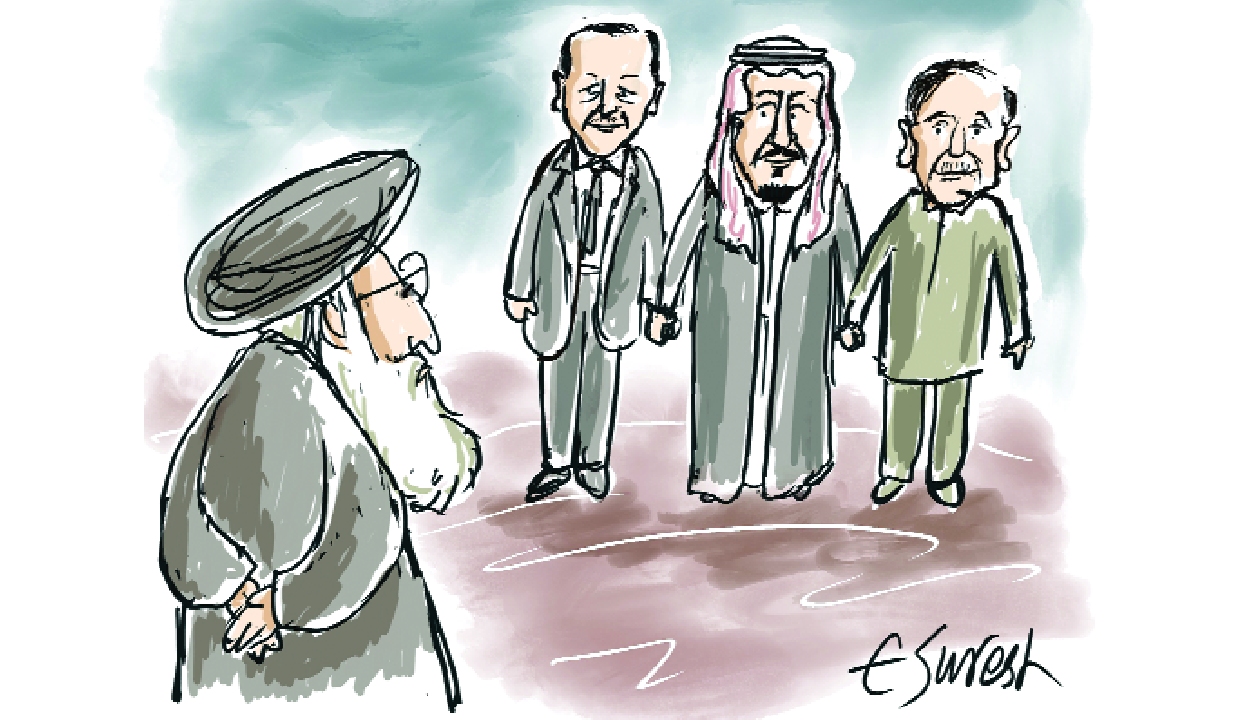
The Makkah Agreement is best understood as an ambitious strategic triangle with enormous potential but incomplete strategic convergence. And Iran sits precisely where those interests collide
The temptation to describe the Makkah Joint Defence Agreement as an “Islamic NATO” is understandable. Signed by Saudi Arabia, Türkiye and Pakistan on August 7, 2026, the agreement declares that an armed attack against one member will be regarded as an attack against all. It brings together Saudi Arabia’s financial and energy power, Türkiye’s formidable conventional military and defence-industrial capabilities, and Pakistan’s nuclear deterrent.
Yet the NATO analogy is premature. The greatest reason is Iran.
Iran represents the ultimate test of whether the Makkah Agreement can evolve from a strategically impressive partnership into a genuinely integrated collective-defence alliance. The problem is that the three members have fundamentally different relationships with Tehran.
For Saudi Arabia, Iran has traditionally been the principal regional strategic competitor. Riyadh remains concerned about Iranian missiles, drones, regional networks and the vulnerability of Gulf energy infrastructure. Türkiye’s relationship with Iran is far more complicated. Ankara and Tehran compete for influence across Syria, Iraq, the Caucasus and the wider Middle East, but also maintain diplomatic and economic ties. Türkiye has generally preferred managed rivalry rather than permanent confrontation, preserving its strategic flexibility. Pakistan’s position is more constrained still. It shares a border with Iran and has strong incentives to maintain workable relations with Tehran, given sectarian tensions (Pakistan hosts the second-largest Shia population in the world). Islamabad must consider its western frontier and the danger of creating another security problem alongside its longstanding confrontation with India.
This creates the fundamental question hanging over the Makkah Agreement: What happens if Iran attacks Saudi Arabia?
On paper, the answer appears straightforward. If an attack on one is an attack on all, an Iranian attack on Saudi Arabia should trigger collective defence. In practice, however, would Pakistan enter a direct war with Iran? Would Türkiye deploy combat forces? Or would the two instead provide intelligence, air-defence support, weapons and diplomatic backing? That distinction matters because the agreement establishes the principle of collective defence without yet possessing NATO’s decades-old command structures, intelligence architecture, interoperability and military planning.
Iran therefore exposes the difference between collective defence as a declaration and collective defence as an operational doctrine.
The problem becomes even greater if “Islamic NATO” is interpreted literally. NATO was built around a relatively clear strategic threat: the then Soviet Union. The Makkah grouping has no equivalent single adversary. Saudi Arabia is primarily concerned with Gulf security; Pakistan remains heavily focused on South Asia and India; Türkiye’s strategic concerns extend across the Middle East, Black Sea, Caucasus, Eastern Mediterranean and NATO. Iran matters to all three, but not in the same way.
An explicitly anti-Iranian alliance could make the pact more militarily coherent but would create serious problems. Pakistan would face complications with its neighbour, Türkiye would lose strategic flexibility, and Saudi Arabia could become locked into permanent confrontation with Tehran. Yet avoiding an Iranian focus creates another problem - weaker credibility in precisely the scenario most likely to test the pact.
There is also a conceptual contradiction. Iran is itself a Muslim-majority country. Calling the arrangement an “Islamic NATO” therefore risks transforming a defensive partnership into the perception of a Saudi-Turkish-Pakistani bloc confronting Iran. The three governments have consequently been careful to describe the agreement as defensive rather than directed against any particular state.
The more the Makkah pact develops into a military bloc, however, the harder it becomes to maintain that ambiguity. Conversely, explicitly defining Iran as the threat would expose the very differences among the three members that the alliance is supposed to overcome.
There are also competing external alignments to consider. Türkiye is a NATO member; Pakistan maintains a particularly close strategic relationship with China; and Saudi Arabia retains deep defence ties with the United States. These relationships are not necessarily incompatible with the Makkah Agreement, but they demonstrate that the three states operate within different strategic ecosystems. A common defence framework must therefore coexist with, rather than replace, their existing alliances and partnerships.
The most realistic future may therefore be a flexible strategic-security framework rather than an Islamic NATO: deeper intelligence-sharing, joint exercises, missile and drone defence, maritime security, interoperability and defence-industrial cooperation, without requiring identical foreign policies. The pact does not need to become ‘NATO’ to be consequential. Its strength lies in combining three complementary forms of power: Saudi financial capacity, Turkish conventional and industrial capability, and Pakistani strategic deterrence. But Iran remains the unavoidable stress test.
If Tehran attacks one member and the other two respond decisively, the Makkah Agreement will gain credibility that no diplomatic declaration can provide. If the members instead revert to separate national calculations, the limitations of the “Islamic NATO” concept will become equally clear.
For now, therefore, the Makkah Agreement is best understood as an ambitious strategic triangle with enormous potential but incomplete strategic convergence. And Iran sits precisely where those interests collide. The ultimate test is therefore brutally simple:
If Iran attacks one, will the other two truly fight? Until that question has a credible answer, “Islamic NATO” describes the pact’s potential and not its reality.
If Tehran attacks one member and the other two respond decisively, the Makkah Agreement will gain credibility that no diplomatic declaration can provide
The writer is a former Lieutenant Governor of the Andaman and Nicobar Islands and Puducherry, and a military veteran; Views presented are personal.