Are we raising winners or kind human beings?
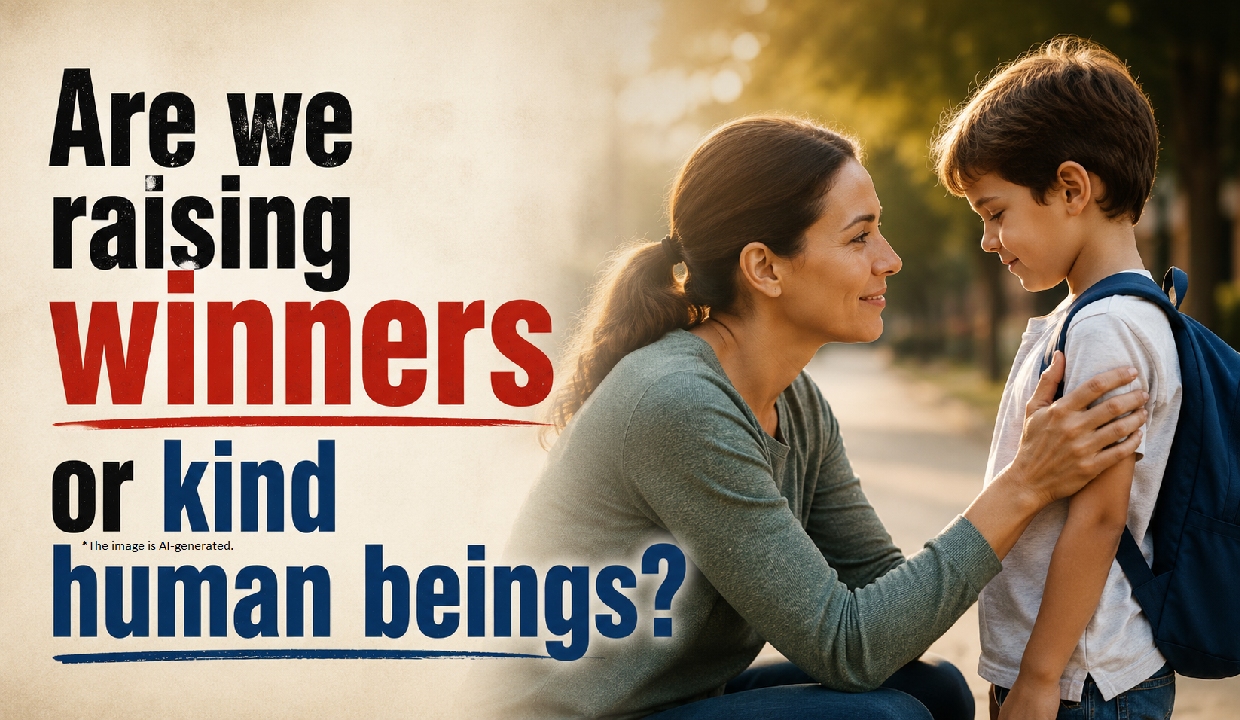
In our relentless pursuit of raising successful children, we have quietly forgotten something essential: the art of generosity. Trophies, grades and rankings dominate childhood today, but rarely do we pause to ask: are we nurturing achievers, or are we nurturing human beings?
A simple story offers a powerful answer. When a child asks another for an apple, the child holding two takes a bite from both. It appears selfish until he offers one and says, “Take this one; it is sweeter.” What looked like greed was actually thoughtfulness. He tested both to give away the better one. This small act captures something profound: true generosity is not about giving what is left over or unwanted. It is about giving with care, warmth and dignity.
Today’s childhood is built almost entirely around achievement. Schools reward the highest scorers, parents stress over every grade, and society celebrates those who finish first. Ambition, of course, has its place, but when children are taught to view every peer as a rival, something quietly breaks inside them. A child who only learns to win may never learn to share the victory.
The absence of generosity does not always look like cruelty. It hides in smaller moments: refusing to share notes, laughing at a classmate’s mistake, or feeling quietly pleased when a peer stumbles. These habits seem minor, but they harden over time. The child who hoards today may become the professional who withholds opportunities tomorrow.
Generosity is not a soft, optional virtue. It is a life skill. It builds relationships, strengthens communities and creates the kind of emotional security that no academic score can provide. When empathy and sharing are nurtured early, they grow into cooperative colleagues, ethical leaders and compassionate citizens.
Social media has made this harder. Children and adults are constantly surrounded by curated images of success, beauty and achievement, fuelling comparison, insecurity and an instinct to guard rather than give. Human connection is slowly becoming transactional, and warmth is increasingly treated as a weakness rather than a strength.
Schools and families must both take responsibility. Education cannot be limited to producing high scorers. A child who excels at mathematics but lacks kindness has received an incomplete education. Equally, parents need to reflect on the messages they send. When achievement is constantly framed as a race against others, children begin to see companions as competitors.
Ambition must be balanced with the understanding that real success means helping others grow alongside you. This lesson extends well into adulthood. Workplaces and communities suffer when people hesitate to share credit, knowledge or opportunity. Many are quick to seek support in difficult times but reluctant to offer it when others begin to rise. A society cannot truly progress when every individual is focused solely on protecting personal interests.
The extra apple, then, is a mirror. It asks us to look honestly at the spirit behind our giving. Do we share only when we have more than enough? Do we help only when it costs us nothing? Do we offer others the sweeter apple, or only the one we no longer want?
The world will always admire sharp minds. But it is sustained, quietly and steadily, by gentler hearts.
The writer is an educator and a councillor; Views presented are personal.