America’s deadly divide over firearms
Traditionally, Republicans are more opposed to gun control laws than the Democrats, owing to differences in cultural identity of respective cadres, geographical psychographics, and also the urban-rural split (or the coastline-hinterland “divide”). The Republican heartland is essentially the white-dominated “redneck” country, where people go hunting and have self-defence traditions.
Therefore, the all-powerful National Rifle Association (NRA) has aligned itself with Republican ranks to pursue its agenda. The Second Amendment to the Constitution is interpreted contrastingly by Republicans and Democrats. The line “A well-regulated Militia, being necessary to the security of a free State, the right of the people to keep and bear Arms, shall not be infringed” - herein, the word “militia” is decoded by Republicans as implying individuals.
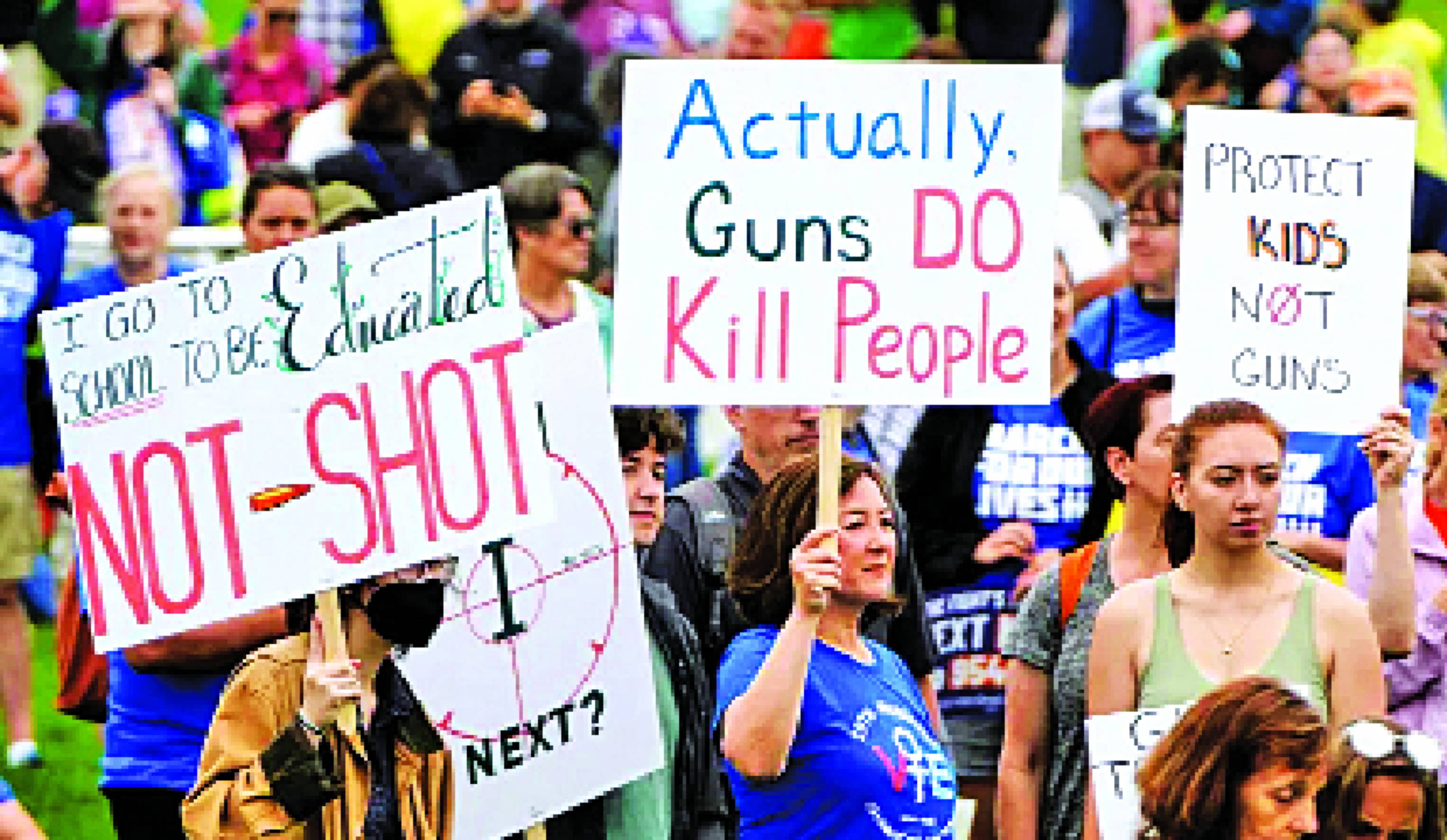
Today, Americans own 46 per cent of the world’s civilian-owned firearms. It has been statistically proven that firearm ownership increases the risk of firearm homicide, suicide, and even impulsive lethality. As per the Centers for Disease Control and Prevention (CDC), this leads to 45,000-48,000 gun-related deaths annually. All counter-arguments that firearms provide safety are humbug, as data show that firearm ownership puts individuals and their families at higher risk of injury and death.
It is well established that bearing weapons tends to trigger aggressive thoughts and actions. So why do Republicans still oppose gun control laws? Besides the interpretation of the Second Amendment, there is also an unmistakable racial undertone to that position, wherein white supremacist/majoritarian groups (core Republican base) are inherently and overwhelmingly opposed to gun laws.
Former President of the United States, Ronald Reagan, was a classic Republican (with his cowboy image), like Donald Trump today. In 1981, an actress-obsessed lunatic shot at President Ronald Reagan to impress the said actress and catch her attention. Ironically, the shooter was a white male who had registered as a Republican earlier.
The shooter’s action was not a political act, but a delusional act driven by psychological impulse. Yet, despite being hit and having a narrow escape after surgery, Reagan did not budge from the core Republican stance. He argued, “It’s a nasty truth, but those who seek to inflict harm are not fazed by gun control laws. I happen to know this from personal experience”.
Most likely, the shrewd politician would have sensed that any strengthening of anti-gun laws would have gone against his political base. However, once out of office and seeing the real-time fate of his Press Secretary, James Brady (left permanently disabled), in the same shootout, Reagan supported the anti-gun Brady Bill, thereby building a bipartisan consensus on the issue. It marked a significant turning point in US gun policy.
The US has had a violent past of presidential assassinations, with figures such as Abraham Lincoln, William McKinley, and JF Kennedy. Many more have survived assassination attempts. Whenever such instances occurred, the deeply partisan issue of gun laws erupted, only to subside thereafter to familiar positions of disagreement between Republicans and Democrats.
The most recent addition to presidential assassination attempts involves the current incumbent, Donald Trump, who has faced multiple attempts on his life. Trump was first fired upon at a Pennsylvania campaign rally in July 2024. Later, in September 2024, Secret Service agents spotted a gunman concealed in the bushes of his golfing club in Florida.
Most recently, at the White House Correspondents’ Association Dinner in Washington, a major security scare was averted as the supposed “lone wolf” could not reach the presidential dais.
But Trump is a 24-hour politician who seizes every opportunity to sharpen his polarising image and invest in personal bravado, as opposed to making restorative changes towards tackling rampant gun misuse in American society. In the Pennsylvania shooting attempt, he struck a gladiator-like fist-pump pose. Now, post the latest attempt, he postured “muscularity” by insisting that he did not want to leave the place and that he “fought like hell to stay, but it was protocol”.
This incident may be political gold for Trump personally to revive his sagging popularity following the unpopular Iran war, but it could also be yet another lost opportunity to make wiser decisions on gun laws.
Trump should show humility and sensitivity on the issue of gun violence by rising above partisan positions if he is to make America — and Americans — truly safe. Already, Trump’s “us-versus-them” narrative has dangerously divided Americans and made many feels deeply isolated, discriminated against, and even targeted. There is a disturbing cause-and-effect relationship that can be established between a tense society and easy access to weapons.
But neither is Trump expected to lower his xenophobic and polarising rhetoric, nor is he expected to draft progressive legislation that rises above partisan positions, even if the same is tantamount to making America safer.
It is important to note that most attacks conducted have not emanated from the societal typographies that have been fearmongered by politicians like Trump. If anything, very often these “lone wolves” hail from sections of society that are encouraged by his policies.
As Trump’s predecessor at the White House, Joe Biden, famously said, “Enough prayers. Time for action”. But it is unlikely that Trump will drive any positive action, despite this incident.