Widening max-min temp gap brings cold wave to Capital
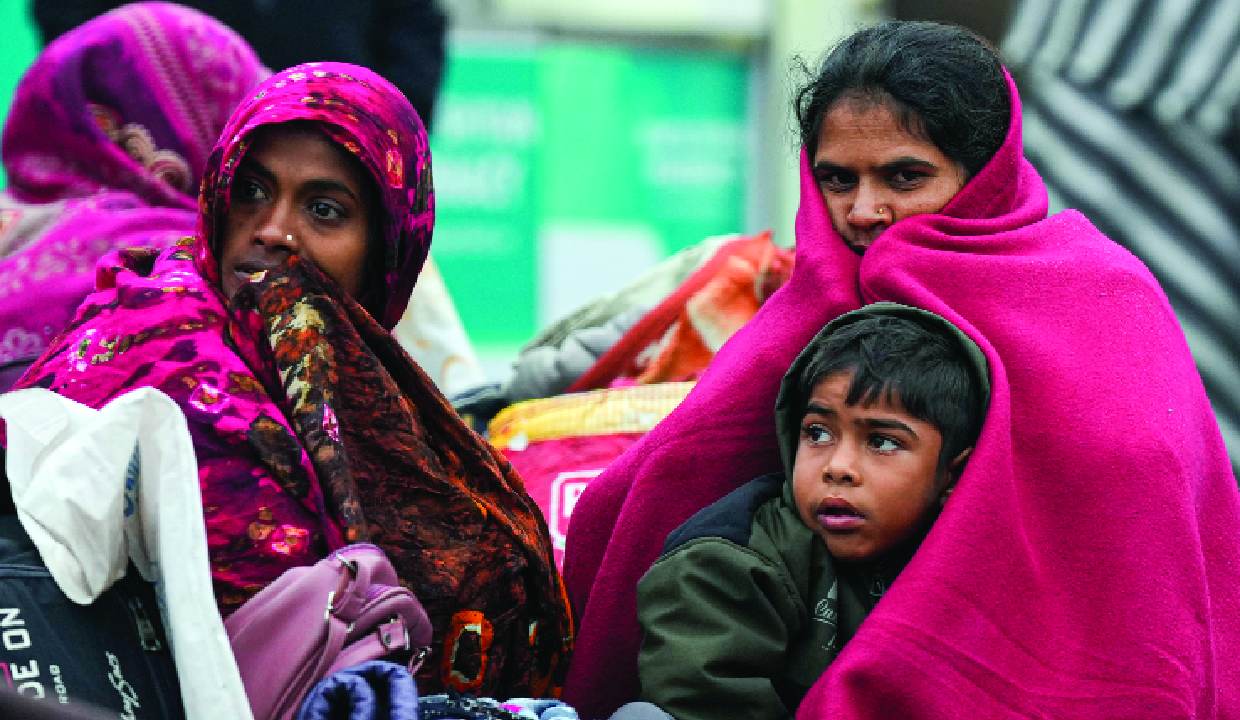
The plummeting gap between the minimum and maximum temperatures has led to cold wave conditions across north India, including the national Capital.
People shivered even during the daytime on Friday with virtually no sunshine, and similar conditions are likely to prevail for the next three to four days, according to the weatherman.
Delhi woke up to another winter morning wrapped in a thick, stubborn blanket of fog—and with it came yet another round of travel disruptions that reminded flyers just how unforgiving north India’s winter skies can be. Add plunging temperatures and persistently poor air quality to the mix, and Delhi-NCR found itself firmly in the grip of a classic cold-wave spell—one that has left both commuters and travellers recalibrating plans.
A ‘yellow’ alert has been issued for Delhi, as dense fog is likely to affect visibility in the national capital on Saturday morning, the India Meteorological Department (IMD) said. The weather office said a cold wave is expected to affect isolated places in the city between January 3 and January 6.
The India Meteorological Department (IMD) said the maximum temperature was recorded at 17.4 degrees Celsius, while the minimum temperature was stood at 9.1 degrees Celsius. The gap between maximum and minimum was just 8 degrees Celsius, which is also led the national capital to shiver. The maximum temperature in the national Capital on Friday settled at 17.4 degrees Celsius, 1.9 degrees below normal, while the minimum temperature was registered at 9.1 degrees Celsius, 2.2 notches above the seasonal average. Station-wise data showed that Lodhi Road recorded a maximum temperature of 17.4 degrees Celsius, followed by 17.2 degrees Celsius in Ayanagar, 14 degrees Celsius in Ridge and 16.4 degrees Celsius in Palam.
The minimum temperature stood at 9 degrees Celsius at Palam and Lodhi Road, followed by 8.7 degrees Celsius at the Ridge and 8.1 degrees Celsius at Ayanagar.
On Saturday, the minimum temperature is expected to be around 7 degrees Celsius and the maximum about 18 degrees Celsius, with dense fog likely in the morning, according to the IMD. It has also predicted a cold wave in isolated pockets of Delhi and Haryana between January 3 and January 6.
A cold wave is declared when the minimum temperature drops by 4.5 degrees Celsius to 6.5 degrees Celsius below the average temperature. January is the coldest month on record for the national Capital.
The average minimum temperature for the month stands at 7.5 degrees Celsius, as against 8.4 degrees Celsius for December. The minimum temperature has dipped below 5 degrees Celsius during the month consistently since January 2011.
During this period, the minimum temperature dropped below 2 degrees Celsius in 2013 (1.9 degrees Celsius), 2021 (1.1 degrees Celsius), and 2023 (1.4 degrees Celsius). The lowest temperature for the month can occur on any day, irrespective of whether it is at the beginning or end of the month.
As visibility dropped across the capital and neighbouring regions, flight schedules at Delhi’s airport took a hit, with airlines pre-emptively cancelling and delaying services to manage the ripple effects of the weather. Safdarjung weather observatory reported the lowest visibility of 800m in shallow fog at 0830 hrs IST and Palam reported the lowest visibility of 1000m in shallow fog at 0800 hrs IST.
Safdarjung logged the lowest visibility of 800 metres between 1.30 am and 2 am on Friday, which later improved to 1,200 metres by 2.30 am. Dense fog at Indira Gandhi International Airport (IGIA) caused widespread disruption to flight operations, with several domestic flights cancelled or delayed. Services operated by IndiGo, SpiceJet and Air India were among the worst affected.
As many as 66 flights were cancelled at the Delhi airport on Friday due to fog and low visibility conditions. Several airlines cancelled 66 flights to and from Delhi due to fog and reduced visibility conditions, a source said. Of them, 32 were arrival flights, and the remaining 34 were departure flights, the source said.
Earlier, the month of December 2025 was colder than normal. The capital city, under persistent dry weather conditions, recorded single-digit minimum temperatures on 27 days during the month. The lowest minimum of 5.6 degrees Celsius was registered on 04th and 05th December 2025.
The last day of the year, 31st December 2025, was the coldest day of this season, with a maximum temperature of 14.2 degrees Celsius, over 6 degrees Celsius below normal.
This was the coldest day of the last four years; earlier, the mercury had plunged to 12.1 degrees Celsius on 26th January 2022.
Incidentally, this also turned out to be the coldest December day of the last six years.
Prior to this, the city had recorded 9.4°C on 31st December 2019.