Why Community Kitchens Must Put People First
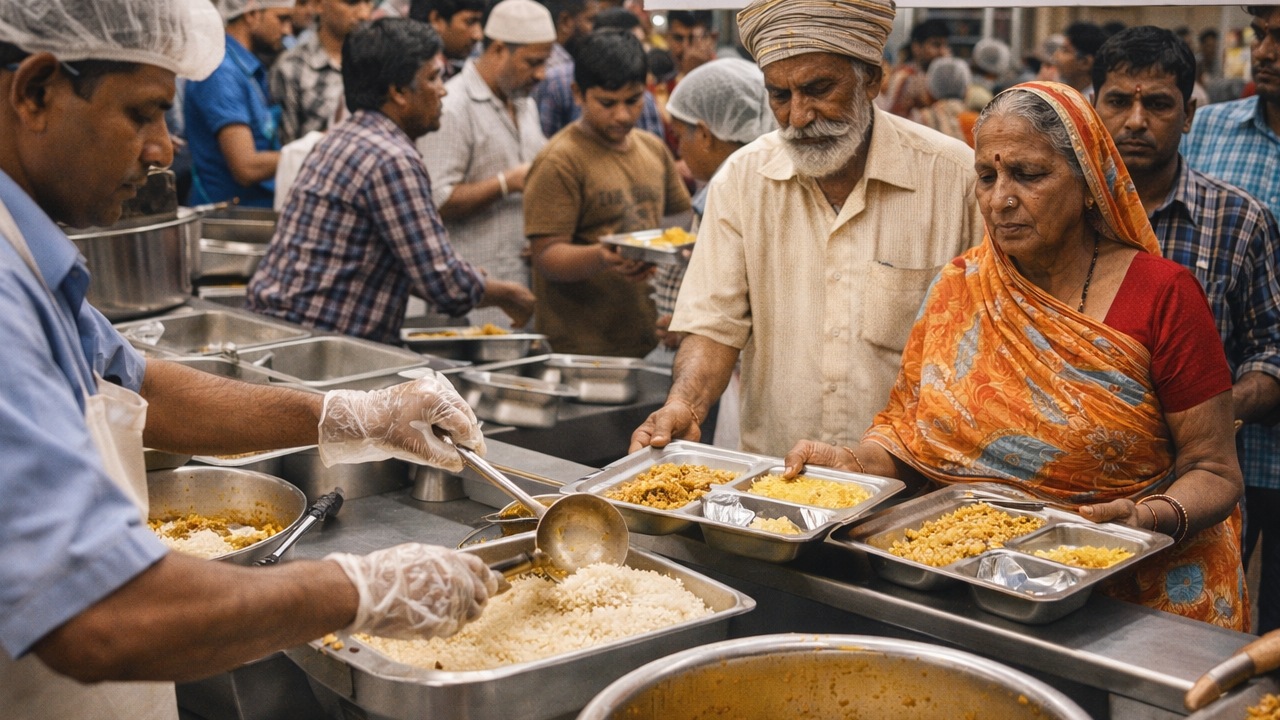
India is among the world’s largest producers of wheat and rice, yet nearly 20 crore people go to bed hungry every night. This stark contradiction is not the result of insufficient agricultural output, but of inefficiencies in supply chains, widespread food wastage and deeply unequal access. In this context, recent initiatives by the Delhi government to establish Atal Canteens mark an important step forward. Providing subsidised meals to daily wage earners, informal workers, migrant families and the elderly is not an act of charity; it is a necessary public intervention. However, the real measure of success of such programmes lies not in their scale or visibility, but in the care with which they are designed and implemented. Based on first-hand experience of running community kitchens in Delhi NCR and Assam over the past two years, it is evident that low-cost canteen models succeed or fail on operational realities that policy frameworks often underestimate.
Systems such as tokens, queues or time slots may appear efficient on paper, but on the ground they often become sites of stress and exclusion. Crowding and “first come, first served” dynamics tend to favour physical agility and assertiveness. For the elderly, children or those uncomfortable navigating disorder, even a basic queue can be intimidating. Without active facilitation and human oversight, access systems risk privileging those who can push forward rather than those who need support the most. Equally critical is menu design and food acceptability. Community kitchens largely serve repeat users. A monotonous menu, even if nutritionally adequate, leads to disengagement and rising food wastage.
When people do not feel connected to the food they are offered, participation declines quietly but steadily. Affordability also carries social complexity. Charging a nominal Rs 5 helps preserve dignity and discourages wastage, yet it can also generate confusion and discomfort. Some beneficiaries question why payment is required at all, while others resent those who can afford market-priced meals using the same facilities. These perceptions cannot be resolved through rigid rules. Kitchens that respond inflexibly risk losing trust. Cultural and religious food preferences present another recurring challenge. On certain days, some communities avoid specific staples or preparations. Kitchens that fail to adapt risk signalling indifference to deeply held practices. Respecting such preferences while maintaining efficiency requires anticipation and flexibility, not standardised menus designed from afar.
Taken together, these challenges underline a simple truth: community kitchens do not falter because of inadequate systems alone, but because of the absence of sensitive mediation at the point of service. Systems cannot interpret context on their own; they require human judgement.This makes frontline staff indispensable. Often undervalued, they are not merely service providers but the moral face of the programme. Their patience and empathy determine whether a kitchen feels transactional or dignified. Alongside this, hygiene, food quality and transparency are essential to sustaining public trust.If low-cost canteen initiatives are to succeed at scale, they must institutionalise learning from the ground. Hunger is not an abstract statistic; it is a daily negotiation shaped by systems that either include or exclude. Community kitchens can build social resilience, but only when people come before processes.
The writer is Founder and President of Wishes and Blessings NGO; views are personal