When politics drowns democracy
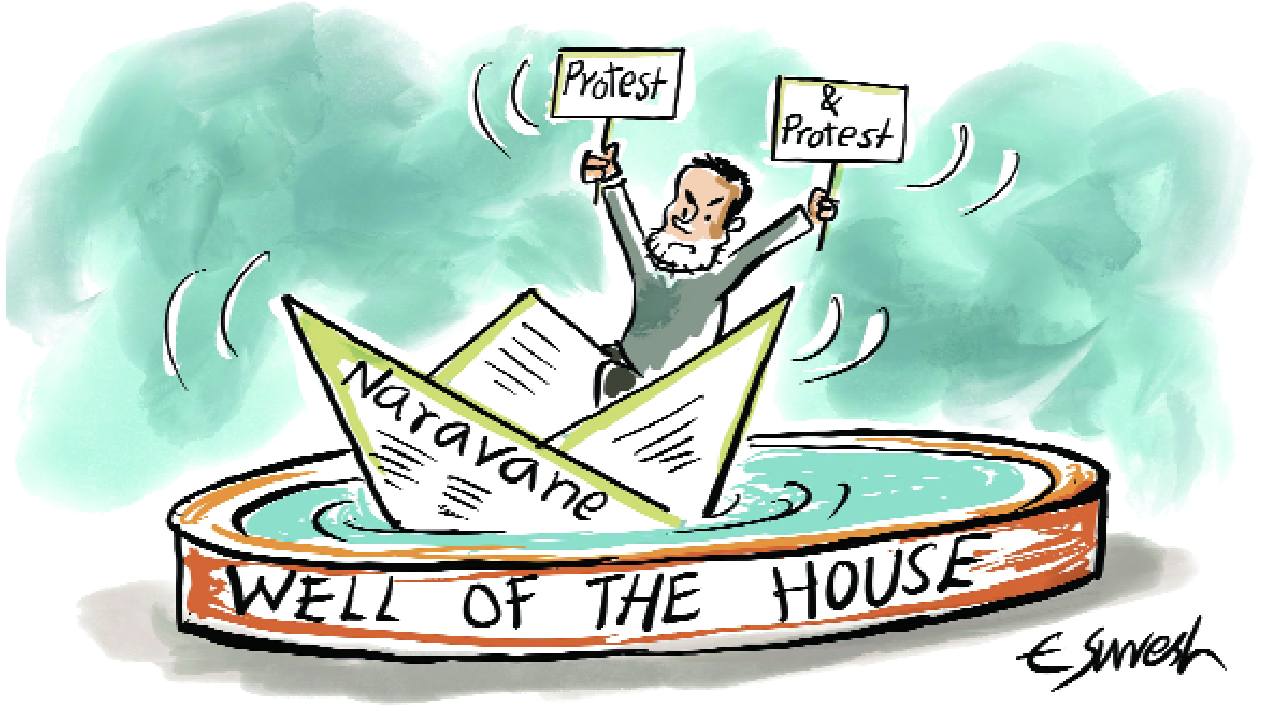
Communication between the Modi government and the Opposition has broken down, as evidenced by the turbulent proceedings in Parliament last week. There have been no back-channel negotiations to resolve the paralysis.
The protests intensified on Monday when Lok Sabha Speaker Om Birla announced that the Leader of the Opposition, Rahul Gandhi, could not read from a magazine containing an excerpt from a book by retired General Naravane, citing parliamentary rules.
This breakdown in dialogue culminated in the Lok Sabha being adjourned for the day last Wednesday, preventing the Prime Minister from delivering his usual reply to the Motion of Thanks to the President’s Address. This was unprecedented in Parliament’s history: the Prime Minister was unable to speak in the Lower House on the President’s Address, underscoring the seriousness of the disruptions.
Opposition Members of Parliament from both Houses protested, especially in the Lok Sabha. These protests led to repeated adjournments of the Lower House, often just minutes after it reconvened. During the protests, members chanted slogans, entered the Well of the House, and held banners and placards in front of the Speaker. They also staged a demonstration outside Parliament.Prime Minister Narendra Modi was unable to enter the House because Opposition women MPs had positioned themselves near his seat in the Lok Sabha.
Speaker Om Birla clarified the following day that he had advised the Prime Minister to avoid the House due to concerns about potential disruptions near his seat. He stated: “When the Prime Minister was scheduled to respond to the President’s Address, I had received indications that some Congress members might attempt to create a disturbance close to the Prime Minister’s chair. Such actions could undermine our democratic traditions. To prevent this, I felt it was necessary to advise the Prime Minister not to attend the House. As the presiding officer, it is my duty to safeguard these traditions.”
Women Members of Parliament obstructed the aisle near the Prime Minister’s seat just before his arrival, highlighting the active role of Opposition women MPs in the disruptions.
In a related development, Rahul Gandhi commented on a memoir by a retired Army chief that has yet to be released. The memoir, written by General Naravane in March 2023, is slated for publication in December. General Naravane has been widely recognised for his integrity.Overall, Parliament faced significant disruption due to repeated adjournments. This turmoil highlights the challenges of maintaining parliamentary decorum and the importance of respectful debate for effective governance. In earlier years, there were several high-quality debates.
The following day, the Prime Minister spoke extensively in the Rajya Sabha about his government’s achievements and various initiatives it had launched. He addressed India’s position in global affairs and its increasing influence on the world stage. The Prime Minister praised his 11 years in office while strongly criticising the Nehru-Gandhi family for their failure to develop the country effectively. The speech resembled an election rally, filled with punchlines.
Members of Parliament often create disturbances to protest and gain media attention. Their actions include rushing to the Well of the House, shouting slogans, holding up signs, and at times even tearing up Bills. This behaviour reflects deep political divisions and a shift towards confrontational politics.
There has been a noticeable increase in time lost to disruptions, as well as in the costs of running Parliament. It costs approximately `2.5 lakh per minute, `1.5 crore per hour, and `9 crore per day of taxpayers’ money, highlighting the financial impact of these disruptions on public resources.
According to NDTV, losses continue to mount even when the Houses are adjourned, with expenses including the operational costs of the high-tech Parliament building, staff salaries, and expenditure on security, among others.Disruptions in Parliament not only hinder government accountability and limit meaningful discussion but also delay the passage of crucial legislation, affecting public welfare and policy implementation. This underscores the urgent need for reform.
Many committees have recommended reforms for Parliament and have emphasised the need for positive change and support for necessary improvements. In a parliamentary democracy, frequent disruptions not only hinder legislative progress but also erode public trust and weaken democratic legitimacy.To address this, electoral reforms are needed to improve the quality of elected representatives. Greater understanding among political parties should also be encouraged, using both formal and informal mechanisms. By increasing public awareness of Parliament’s role and how disruptions harm the public interest, these disturbances can be reduced.
Parliamentary standing committees, such as those in the UK and Canada, have successfully mediated conflicts and improved decorum through structured dialogue and conflict resolution. Such examples can inspire support for similar reforms and demonstrate their effectiveness in strengthening parliamentary functioning. These reforms should be implemented sooner rather than later, with political cooperation playing a crucial role in restoring faith and ensuring the smooth functioning of Parliament. Above all, strong political will is required.
The writer is a popular columnist; views are personal