When language becomes freedom!
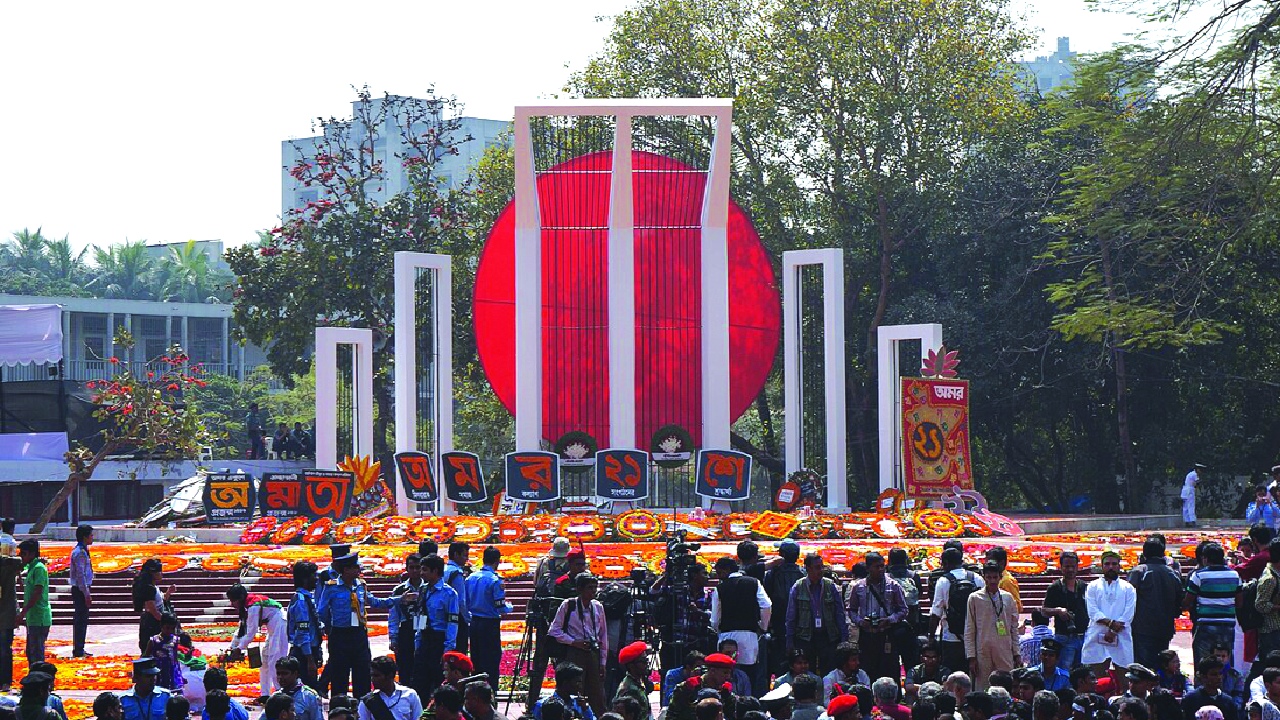
On February 21, the world pauses to remember a truth written in blood and ink — that language is not merely a tool of communication, but the soul of a people. International Mother Language Day is not an abstract cultural celebration. It is rooted in sacrifice, in the streets of what was then East Pakistan, where young students laid down their lives defending the right to speak Bengali. Their resistance shaped not only the destiny of Bangladesh, but also the global conscience on linguistic justice.
The origins of this day trace back to 1952, when Pakistan’s founder, Muhammad Ali Jinnah, declared in 1948 that “Urdu and Urdu alone” would be the state language of Pakistan. It was a decision that ignored demographic reality: the majority of Pakistan’s population spoke Bengali. The imposition of Urdu was seen as cultural domination by West Pakistan over East Pakistan.
On February 21, 1952, students of the University of Dhaka defied Section 144 and marched in protest. Police opened fire. Several students were killed. Their martyrdom became the seed of the Bengali Language Movement, which later nourished the liberation struggle of 1971, when the Mukti Bahini - Bangladesh’s liberation fighters - took up arms for political and cultural freedom.
Language was at the heart of that struggle. The fight was not merely about vocabulary; it was about dignity, identity, and the right to exist as a distinct people. In recognition of this sacrifice, UNESCO declared February 21 as International Mother Language Day in 1999. Today, the Shaheed Minar in Dhaka stands not just as a monument to fallen students but as a global symbol of linguistic rights.
The Bengali Language Movement teaches a timeless lesson: unity cannot be built on linguistic uniformity. Diversity is not a weakness but a strength. This principle resonates deeply in India, a country often described as a linguistic civilisation rather than a monolithic nation-state. India officially recognises 22 languages in its Eighth Schedule, yet it is home to hundreds of languages and thousands of dialects.
Scholars generally classify Indian languages into four major families: Indo-Aryan, Dravidian, Tibeto-Burman, and Austroasiatic. Indo-Aryan languages such as Hindi, Bengali, Marathi, and Punjabi dominate northern and central India. Dravidian languages - Tamil, Telugu, Kannada, and Malayalam - flourish in the south. Tibeto-Burman languages are spoken across the northeastern hills, while Austroasiatic tongues survive among tribal communities in central and eastern India.
This mosaic is not accidental; it is the cumulative result of millennia of migration, interaction, and coexistence. India’s post-independence leaders understood that linguistic aspirations could not be ignored. The linguistic reorganisation of states in 1956 was a landmark in democratic accommodation. States like Tamil Nadu, Maharashtra, and Gujarat emerged on linguistic lines, not as acts of division, but as acknowledgments of cultural identity within the framework of national unity. The formula was simple yet profound: respect diversity to preserve unity.
But linguistic harmony has never been automatic. Colonial India witnessed its own battles over language. In 1878, the British passed the Vernacular Press Act to curb Indian-language newspapers that criticised colonial rule. English publications were spared, but vernacular presses were targeted. The Act revealed the colonial anxiety that native languages could mobilise political resistance. And they did. Newspapers in Bengali, Marathi, Urdu, and Tamil became platforms for nationalist awakening. Language became liberation’s ally.
Even today, the vernacular press remains the lifeblood of Indian democracy. While English media often dominates elite discourse, regional newspapers and television channels shape public opinion in rural and semi-urban India.
Globally, however, the story is not always hopeful. UNESCO estimates that nearly 40 per cent of the world’s 7,000 languages are endangered. India, despite its linguistic wealth, is not immune. Many tribal languages in the Andaman Islands, Arunachal Pradesh, and central India have already disappeared, taking with them unique worldviews, oral traditions, and ecological knowledge.
When a language dies, an entire intellectual universe vanishes. Vocabulary encodes culture; grammar reflects patterns of thought; proverbs carry ancestral wisdom. Extinction is not merely linguistic - it is civilisational.
This is why mother language education is vital. Children learn concepts best in the language they speak at home. Studies consistently show that primary education in the mother tongue improves comprehension, retention, and cognitive development. The National Education Policy 2020 in India emphasises teaching in the mother tongue at least until Grade 5, reflecting global pedagogical consensus. This approach is not parochial; it is practical and humane.
Consider Tamil, often described as one of the world’s oldest continuously used classical languages. Tamil boasts a literary tradition spanning over two millennia, from Sangam poetry to modern novels. Its antiquity is not merely a matter of pride for Tamils; it is a testament to India’s civilisational depth.
Likewise, Sanskrit, though no longer widely spoken as a mother tongue, continues to influence philosophy, ritual, and vocabulary across the subcontinent. Both languages illustrate different models of linguistic endurance - one thriving as a living vernacular, the other preserved as a liturgical and scholarly medium.
Across the border in Bangladesh, the memory of the language martyrs remains vibrant. The Mukti Bahini fighters of 1971 did not forget that their liberation struggle began with the assertion of Bengali identity. International Mother Language Day, therefore, is also a tribute to them. It reminds us that cultural rights are inseparable from political freedom.
In a world increasingly dominated by global languages such as English, Mandarin, and Spanish, smaller languages often feel pressured to retreat. Yet multilingualism need not be a zero-sum game. One can be proficient in English for global mobility while remaining rooted in one’s mother tongue for cultural continuity. The challenge is not choosing one over the other, but ensuring that globalisation does not become homogenisation.
India’s strength lies in its ability to say “unity in diversity” not as a slogan but as lived reality. Walk through a railway station, and you hear announcements in multiple languages. Look at Indian currency notes, and you see denominations printed in numerous scripts. Watch parliamentary debates, and members speak in different tongues, relying on simultaneous translation. Diversity is institutionalised, not merely tolerated.
For in the lullabies of our mothers, in the idioms of our villages, in the poetry of our ancestors, lies a truth no decree can erase: a people live as long as their language lives. And when we honour our mother tongue, we honour not only our past but also our future.
The writer is Professor at Centre for South Asian Studies, School of International Studies & Social Sciences Pondicherry Central University; views are personal