When Kerala serves abundance on a banana leaf
Some festivals are remembered through a ritual, others through a procession, a prayer or a song. Onam is remembered through all of these, but perhaps nowhere is its meaning expressed more completely than on a banana leaf. A sadya does not celebrate abundance by piling luxury upon luxury. It brings together rice, vegetables, pulses, coconut, curd, spices, jaggery and plantain in a meal where every preparation has its place. Its deeper grammar is striking: prosperity without waste, diversity without disorder, and abundance made meaningful through sharing. In 2026, Thiruvonam, the principal day of Onam, falls on Wednesday, 26 August, when families across Kerala and Malayali communities around the world gather to welcome a festival that is at once mythic, agricultural, social and deeply culinary.
The best-known story of Onam centres on Mahabali, the generous asura king whose reign Kerala’s cultural memory associates with prosperity, equality and the absence of want. According to the tradition, Vishnu appeared before him as Vamana and asked for three paces of land. When Vamana assumed a cosmic form, two steps encompassed the worlds, and Mahabali, unable to offer a third measure of land, offered his own head. His humility earned him the privilege of returning to visit his people once every year. Yet in Kerala’s imagination, Onam is not merely the homecoming of a beloved king. It is also the symbolic return of an ethical idea. Mahabali is remembered not simply for power or splendour, but for the quality of the realm over which he presided, a society imagined as free from deprivation, discrimination and injustice, and governed with generosity and concern for its people.
The Mahabali story has travelled through different textual, theological and regional traditions, and its interpretation has never been entirely singular. Kerala’s celebration, however, has come to place particular emphasis on Mahabali’s generosity, the prosperity of his realm, his humility before Vamana and the affection that binds ruler and people. The enduring appeal of the legend therefore lies not only in nostalgia for a golden age, but in the moral questions it keeps alive: What makes prosperity meaningful? What does good governance owe to those it serves? What is abundance worth if it is not widely shared? Onam turns those questions into lived culture, and the sadya gives them perhaps their most tangible form.
That cultural meaning extends well beyond the dining leaf. The ten-day season begins with Atham, when pookkalams start appearing at homes and gradually grow more elaborate as Thiruvonam approaches. Athachamayam at Thripunithura marks the opening of the festive season with a public procession of folk arts, music and pageantry, while boat races, Pulikali, dances, games, new clothes and family gatherings transform Onam from a household observance into a wider social celebration. Over time, it has also become a cultural season shared widely by Malayalis across religious and social communities. Homes, neighbourhoods and public spaces participate in different ways, but hospitality, reunion and collective celebration remain central to its emotional character.
Onam is equally shaped by Kerala’s agricultural calendar. It arrives in Chingam after the intensity of the monsoon months, carrying associations of harvest, renewal and replenished fields. The traditional sadya reflects this ecology. Rice, gourds, tubers, plantains, pulses, coconut, curry leaves, chillies and seasonal vegetables connect the feast to paddy fields, homestead gardens and coconut groves. Long before words such as local, seasonal and sustainable became part of modern food-policy vocabulary, the traditional sadya embodied much of that logic. A banana leaf could serve as the plate and return naturally to the soil, while culinary abundance depended less on imported luxury than on the diversity of what the landscape could produce. The feast therefore celebrates not only plenty, but the intelligence of using many ingredients in distinct ways and wasting as little of their potential as possible.
The architecture of the sadya begins with that banana leaf. Traditionally laid with its tapering end towards the diner’s left, it is not filled at random. Smaller accompaniments occupy customary positions before rice is served on the lower portion, creating deliberate contrasts in colour, texture, temperature and intensity. Crisp meets soft, dry meets creamy, sweet answers sour, and mild preparations sit beside pungent or fiery ones. This alternation allows the diner to move through the meal rather than experience every flavour at once. At communal sadyas, rows of guests are also served the same style of meal and hospitality. That should not be romanticised as proof that social differences disappear at the table, but the image of people eating together from the same kind of leaf has acquired a powerful democratic symbolism within Onam’s moral imagination.
The opening tastes are concentrated and lively. Upperi, thin slices of firm Nendran plantain fried until crisp, brings salt and crunch.
Beside it may sit Sharkara Varatti, thicker plantain pieces coated in jaggery and seasoned with dry ginger and spices, turning the same fruit into something sweet and aromatic. Puli Inji, or inji curry, pushes the palate elsewhere, with fresh ginger cooked in tamarind and jaggery until hot, sour and sweet meet in the same spoonful. Mango or lime pickles add another acidic edge, while Pappadam supplies brittle texture and a savoury counterpoint. These are small servings, but they establish the principle that will govern everything that follows: contrast without confusion.
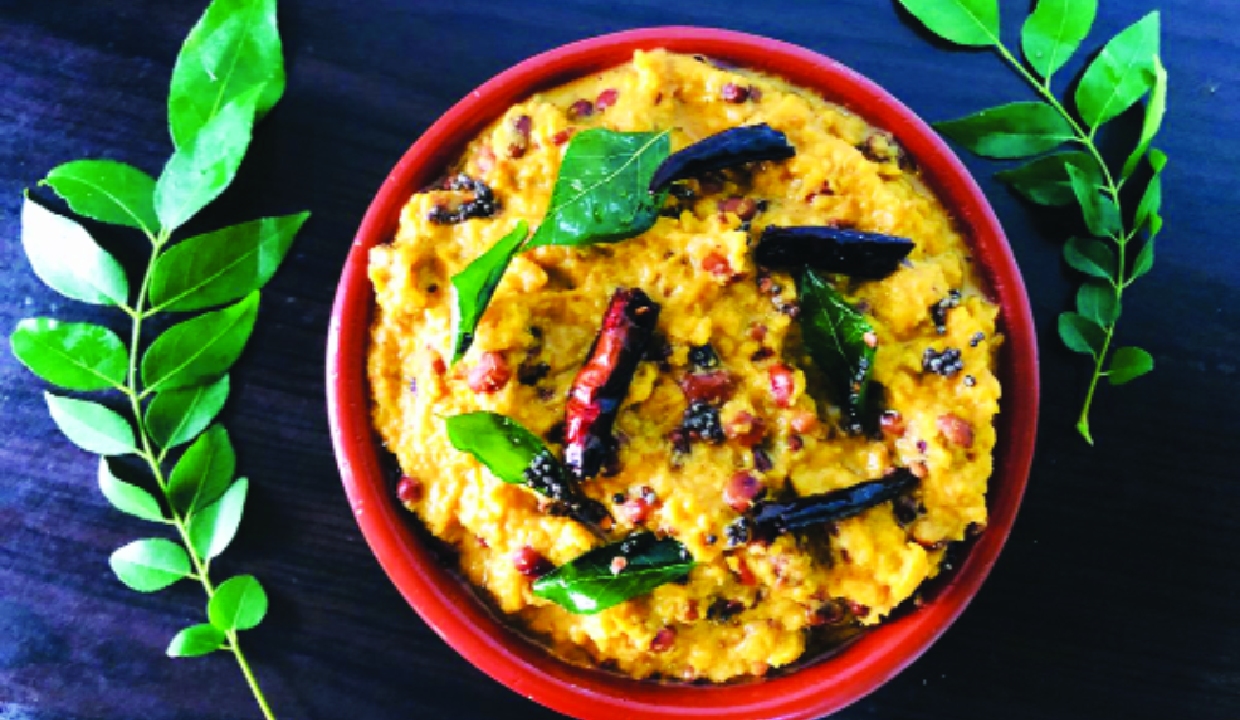
From these sharp openers, the meal moves into one of Kerala cuisine’s great themes, the transformation of coconut. Avial combines raw plantain, yam, ash gourd, drumstick, beans and other vegetables in a thick mixture of coconut and green chilli, often sharpened with curd and finished with coconut oil and curry leaves. Olan does almost the opposite. Ash gourd is gently cooked with cowpeas in coconut milk to produce a pale, restrained preparation whose subtlety becomes important beside stronger curries. Thoran transforms coconut again, combining grated coconut with finely cut vegetables such as cabbage, beans or beetroot in a relatively dry preparation tempered with mustard seeds and curry leaves.
Erissery commonly brings pumpkin, yam or plantain together with pulses and coconut, sometimes finished with roasted coconut for greater depth, while Kootu Curry may combine black chickpeas, yam, plantain and coconut in a thicker preparation. Kaalan introduces curd, coconut and raw plantain or elephant foot yam in a preparation that is tangier and more concentrated. Vellarikka Kichadi, usually made with cucumber, coconut and curd, offers a cooler counterpoint, while Pachadi can bring sweetness into the same family through pineapple, ripe mango or pumpkin. Together these dishes show that diversity in a sadya does not come from unrelated ingredients competing for attention. Many share the same pantry, yet technique gives each a distinct identity while allowing it to contribute to a harmonious whole.
Only after these accompaniments gather does rice establish the centre of the leaf. Kerala’s parboiled red rice, often known as Matta rice, provides a firm foundation for successive gravies. Parippu, a mellow lentil preparation, is commonly eaten first with rice and ghee. Sambar follows in many traditions with lentils, vegetables, tamarind and spices. Pulissery, made with curd and coconut and sometimes fruit or vegetables, introduces a gently sour note, while Rasam is thinner, pepperier and more sharply aromatic. Serving practices vary by district and household, but the principle remains recognisable. Dense preparations give way to lighter ones, and the rice becomes the canvas through which the diner experiences changes in richness, sourness, heat and texture.
Then sweetness takes command, but even here Onam resists a single ending. Ada Pradhaman, one of the feast’s great classics, simmers rice ada with jaggery and coconut milk until it develops a deep caramel richness. Palada Pradhaman uses the same rice ada but cooks it slowly with milk and sugar, creating a paler, creamier dessert. Parippu Pradhaman replaces rice ada with lentils cooked in jaggery and coconut milk, while Pazham Pradhaman draws sweetness from ripe Nendran banana. Pal Payasam turns rice, milk and sugar into a slow-cooked pudding, and Semiya Payasam uses vermicelli, milk, sugar and cardamom, often with cashews and raisins. In parts of southern Kerala, milk-based payasams may be eaten with Boli, a thin sweet flatbread filled with a smooth lentil and sugar mixture, while ripe Pazham may also be eaten with payasam. Dessert, like the rest of the sadya, is therefore an exploration of variation within a familiar set of ingredients.
Beverages remain less elaborate than the food, and that simplicity is part of the meal’s character. Sambharam, or seasoned buttermilk, may be flavoured with ginger, green chilli, curry leaves and salt, providing a refreshing conclusion after the many courses. Plain moru or buttermilk may also be served, while water remains the essential accompaniment throughout. Tea, coffee and juices may appear in contemporary family gatherings before or after the feast, but the traditional sadya does not depend on an extensive beverage ritual. Its sense of balance is achieved primarily through the foods themselves.
Nor should Onasadya be presented as one rigid menu repeated identically across Kerala. The conventional sadya is vegetarian, but preparations, sequences and the prominence of dishes such as erissery, kaalan, pulissery, kootu curry and particular payasams vary by region and household. Wider Onam food traditions can also differ among communities, and in parts of northern Kerala some celebratory meals may include meat or seafood outside the classic vegetarian sadya. These variations are not deviations from a single pure model. They are reminders that living food traditions survive precisely because communities preserve a shared structure while allowing local taste and memory to shape it.
The deeper significance of the sadya therefore lies not in the impressive number of dishes but in what the meal teaches about abundance. No single preparation has to dominate the leaf. Each retains its own identity, yet contributes to a larger harmony. The same is true of Onam’s social imagination. Prosperity acquires meaning when it is shared, hospitality acquires meaning when it includes others, and plenty becomes culturally valuable when it strengthens rather than separates a community. The banana leaf makes that principle visible. It is filled generously, but with order, proportion and purpose.
That is why preserving Onam cuisine requires more than preserving recipes. Future generations must inherit the methods and feelings that surround them: how vegetables are cut for avial, how long kaalan is reduced, how coconut changes when grated, ground, pressed into milk or used as oil, how jaggery transforms rice ada into pradhaman, how the leaf is laid, how guests are served, and why families gather to cook together. They should also inherit the excitement of Thiruvonam morning, the making of pookkalams, the sounds of celebration, the fragrance of coconut oil and curry leaves, the anticipation of payasam and the feeling of coming home that Onam carries for so many Malayalis.
As families continue to cook together, communities continue to gather and culinary knowledge continues to pass from one generation to the next, Onam will remain more than a remembered festival. It will remain Kerala’s living affirmation that abundance is not measured only by how much one possesses, but by how generously one shares it. To pass down the sadya is therefore to pass down more than food. It is to pass down agricultural memory, cooking skill, hospitality, cultural identity and an ethical imagination in which prosperity finds its fullest meaning when it is joined by justice, humility and generosity.