Re-organisation of a party built on organisational strength
Re-organisation of the BJP central team has become a major topic of discussion nationally, and rightly so. No other political party has such a structured organisation where workers begin work from booth level to get a chance to move from local to national politics by sheer dint of their hard work on the field. Lately, there have been many horizontal entries because of the new corporate culture in Indian politics, so there are many newcomers who get a chance to enter at middle or even higher level, but most of them too have to prove their mettle and their malleability in the organizational ethos they have adopted, or they fall slowly by the sidelines.
Organisation is the major strength of BJP. It is the life breath of BJP that saw its rise from two MPs to being the most dominant force. Due to cycles of elections every few months, the urgency of coming to power in most states saw the much vaunted organisation to stay in the back stage and it seemed like being pre-dominantly run by ministers and powerful political leaders. The recent reshuffle is a long due process undertaken now. By all means, it is a major overhaul. Many established actors have gone backstage, replaced by new faces and erstwhile proven and time tested stars who seemed to have been on the way out.
Many analysts are stuck with average age of the new team. However, NDTV has put up some interesting graphics to show that while above 60 years leadership moved out, some experienced stars of 50-60 age group have come back, while the younger leaders have been given responsibilities. So, the average doesn’t reflect the true nature of this change. The party starts with the advantage of the youngest party President ever in BJP history. The recalibration also shows that he has been given some freehand in putting his team together. He has not shied away from the fact that absence of experienced mature leaders saw the organisation become weak in some area where personalities had become power centres by themselves, and slowly losing connect with the field karyakartas. This is a positive development.
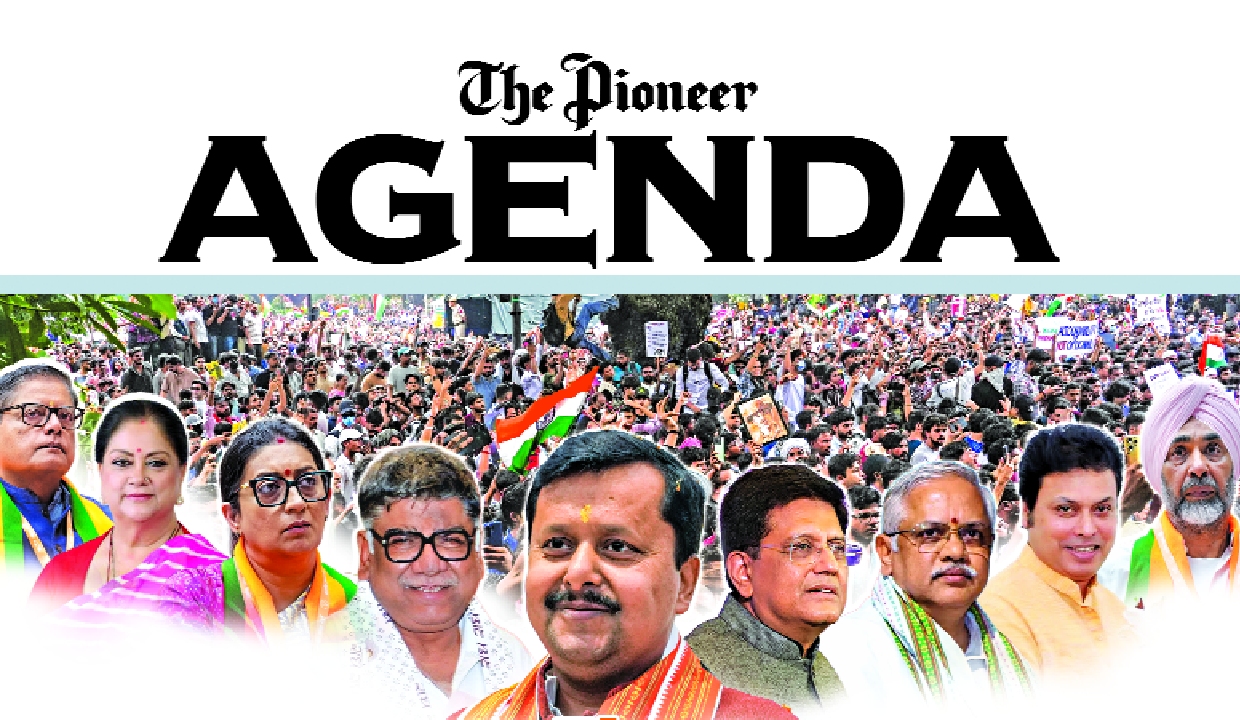
The reshuffle shows that BJP leadership keeps a keen tab on the performance of its karyakartas. No karyakarta is forgotten or discarded as many speculate when changes take place. Smriti Irani has, of course, proven to be queen of comebacks with sterling performance in West Bengal and her unique gift of communicating precisely in multiple languages. Communication has been one of the weak points in BJP for some years, with Modi ji and Amit Shah doing the heavy lifting.
Vinod Tawde, once pushed out of Maharashtra was brought to Delhi where he worked silently but solidly to rise again in prominence as a very important organiser. Ram Madhav with his proven skills at negotiating with tough opposition, turning many foes into friends, his knowledge of foreign affairs has seen him back. Biplab Deb a rising star from north east, after some days on the bench, so to say, finds himself at the top.
Bringing in Piyush Goyal, a veteran and key minister in Modi cabinet back as treasurer shows the seriousness of the exercise. Not many have commented on BL Santhosh’s continuation at the top of the organisational pyramid. He is the most experienced organiser in BJP now with minutest knowledge of the organisation and people in every corner of Bharat. He will be very important for Nitin Nabin to run the organisation smoothly.
Rajasthan is in serious trouble due to inexperience of the CM, while Vijayaraje Scindia sulked on the sidelines. She has been rehabilitated, strengthening Rajasthan at organisational level. If the CM were to seek her guidance, he can improve on his governance score card.
An important feature of this re-organisation is space given to 'outsiders' meaning those who came to BJP from other political parties. Anil Antony stands out as a person who worked silently at the organisational level for some time before being brought into centre. I wish more of such articulate and good talents were accommodated too. Sandeep Pathak finds a place with his excellent achievements in fields outside politics. Bringing very late entrant Rohan Gupta is a surprise promotion, but BJP surely knows his importance.
Rising number of women is a great signal that BJP walks to talk. 33% is not just a political rhetoric but a commitment. That ratio is not yet 33% shows the difficulty in getting enough talent, yet, among women. A challenge well accepted. The social balancing of different communities has been well maintained, reiterating the talent and commitment of social engineering of BJP in every aspect of governance and organisation. Absence of organizational secretaries in many states, induction of outsiders in important positions shows the changing organizational priorities of BJP.
One area of concern could be lack of enough representation to the southern states. There is enough talent. BJP is serious about making strong headway into South, but it is not reflected in the composition of the team. Karnataka is the only strong state, the beach head of BJP in southern part of Bharat, but the organisation there is nothing to write home about. Various fronts do have many faces from southern region, who will find it difficult to communicate with the strong northern party workers.
The biggest change that attracted lot of attention was removal of much loved and hated Amit Malaviya from the critical post of IT Cell head. But I am sure he is not going anywhere far. His services will be used in strategic areas. He set up a formidable machinery in social media. However, over last few years, Congress seemed to have stolen a march over BJP in social media space. A political analyst S Nagarajan notes that there is a sense of digital fatigue and public friction has set in among netizens due to hyper-aggressive, polarizing online rhetoric. I think, IT Cell behaved in a flat footed manner during critical political challenges. Debacle of communication and anticipating the mood of youth during CJP protests was a signal that IT cell had lost its mojo. Media cell too has seen serious changes. Despite a big panel of spokespersons, very few spokespersons get to appear on national media. Among the panelists there is preponderance of new comers from other parties. To me, the major failure of media and IT Cell was blocking of communication and feedback mechanism. Ministers can be excused for being very busy. But a department set up specifically for communicating with people cannot operate within closed networks. It is hoped that the new team will relearn the quality of BJP of keeping all channels open to again become the dominant force as it was from 2014 to 2019-20.
Nitin Nabin has shown that he can create a navin (new) organizational mood. One can say that he mishandled only the opening over (by-elections in his own stronghold), but he definitely recovered well and is batting with focus and patience for a long haul.
Ratan Sharda is a well known TV panelist and has authored several books. He has been a member of the RSS since his childhood days. He is a founding member of Vishwa Adhyayan Kendra, Mumbai