Pitru Paksha: The Cuisine That Keeps Ancestral Memory Alive
What does a family cook for someone who is no longer sitting at the table? Few observances in India answer that question as intimately as Pitru Paksha. Here, food is not prepared for spectacle, indulgence or celebration. It is cooked as remembrance. A bowl of kheer may recall a parent’s favourite sweet, a particular vegetable may reproduce the way a grandmother once made it, and rice shaped by hand may become an offering to generations whose names still live within the family. In Pitru Paksha, the kitchen becomes one of the places where memory is given form.
In 2026, Pitru Paksha begins on Sunday, 27 September, with Pratipada Shraddha, and concludes on Saturday, 10 October, with Sarva Pitru Amavasya. Purnima Shraddha falls a day earlier, on 26 September, which explains why the beginning is sometimes shown differently in calendars. The fortnight is devoted to remembering departed ancestors through Shraddha, tarpan, pind daan, charity and the offering of food. Rather than following one fixed ceremony across India, families generally observe the tithi associated with an ancestor’s passing, while Sarva Pitru Amavasya provides an occasion to remember ancestors collectively.
Observed across much of India, Pitru Paksha takes different forms according to region and community, from pind daan traditions in Bihar and Uttar Pradesh and Mahalaya observances in Bengal to distinctive Shraddha meals in Maharashtra and ancestral rites across southern India. The roots of the observance lie in the Hindu idea of acknowledging the debt owed to those who came before us. Sacred traditions connect Pitru Paksha with several stories, including that of Karna, whose legendary generosity in life had centred on gold and wealth rather than food. After death, he is said to have realised the importance of offering nourishment in memory of one’s ancestors. The story gave anna daan, the giving of food, an enduring place in the cultural imagination surrounding Shraddha. Gaya in Bihar became one of the most important centres for these rites, particularly around the Falgu River and Vishnupad Temple, and tradition also associates the city with Rama and Sita performing ancestral rites for King Dasharatha.
That history helps explain why the cuisine of Pitru Paksha cannot be separated from the ritual itself. In many homes, the food is freshly prepared, vegetarian and sattvic, although the precise rules vary considerably by region, community and family. Onion and garlic are commonly omitted. Some households also avoid particular pulses, vegetables or seasonings, while the same ingredients may appear in another region’s Shraddha meal. What matters is that the food is prepared deliberately, offered before it is eaten and often shared with Brahmins, guests or people in need. In many traditions portions are also set aside for cows, dogs and crows, with the crow carrying a particularly strong association with the ancestors.
At the centre of the ritual are pindas, usually formed from cooked rice or barley and combined, according to tradition, with ingredients such as black sesame, ghee, milk or honey. These compact offerings are not everyday food. Their importance lies in what they represent. The hand that shapes the rice is linking an ordinary grain, one of India’s most fundamental foods, with lineage and remembrance. Black sesame, too, appears repeatedly in ancestral rites, particularly in tarpan, where water and sesame are offered with prayers for the departed. Food in Pitru Paksha therefore begins not with appetite but with meaning.
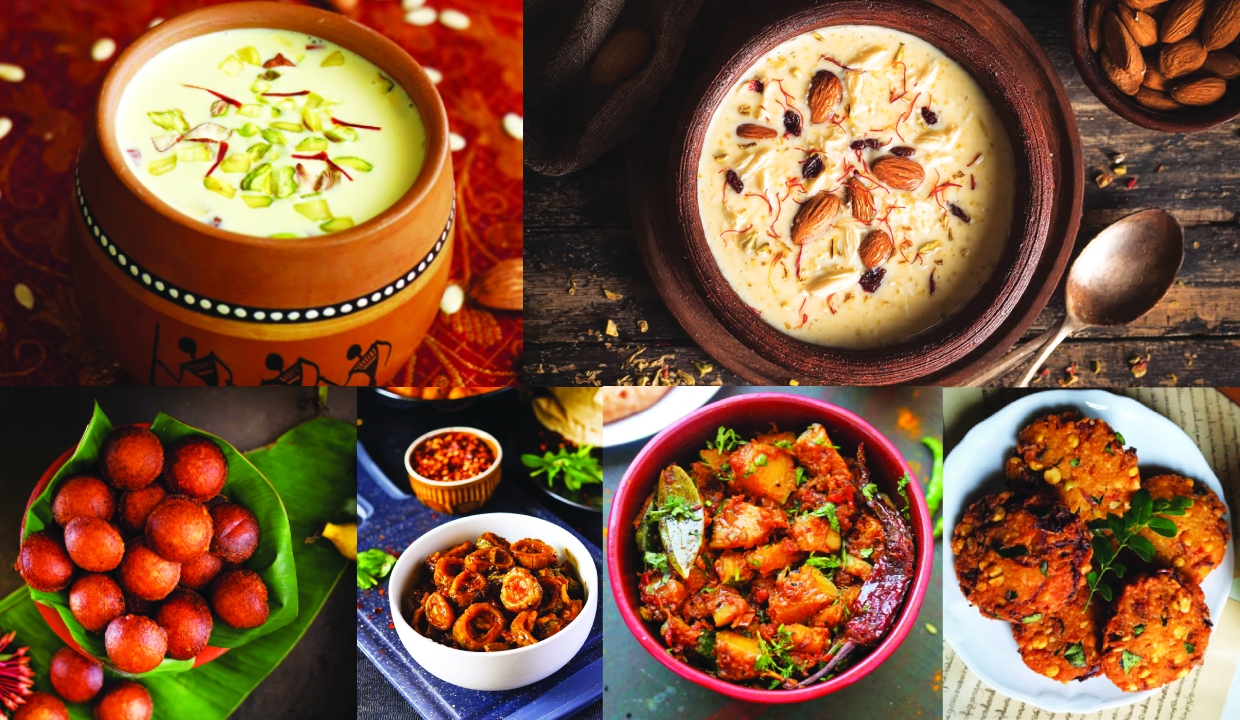
Once the ritual offering moves into the Shraddha meal, chawal ki kheer is among the most enduring preparations. Rice is simmered slowly in milk until the grains soften and the liquid thickens, then gently sweetened and perfumed, often with cardamom. It is familiar across India, but within Shraddha its simplicity acquires a different purpose. Maharashtra has its own tandalachi kheer, again built around rice and milk but belonging to a distinct ritual thali and household tradition.
Alongside kheer, lapsi gives the sweet side of the meal a very different texture. Broken wheat is patiently roasted and cooked with ghee and jaggery or sugar until the grains swell and become soft without losing their character. Its inclusion in traditional accounts of Shraddha food is significant because it reminds us that ancestral cuisine was never dependent on elaborate confectionery. Grain, ghee and sweetness were enough to make an offering worthy of the occasion. In parts of North India, pua performs a similar role. Flour is mixed into a lightly sweet batter, sometimes enriched with fennel or milk, and fried into soft-edged discs. Some families make malpua, its richer cousin, particularly where it belongs to an inherited family tradition.
The sweets can extend further without becoming excessive. Atta halwa, made by roasting wheat flour patiently in ghee before adding hot water and sugar, brings the aroma of toasted grain to the meal. Til-gud laddoo, where sesame and jaggery are bound together, draws on an ingredient already associated with ancestral ritual. In Maharashtra, puran poli and god shevaya, sweet vermicelli cooked with milk or jaggery depending on household practice, may also find a place in a Mahalaya Shraddha meal. The choice is not always governed by a universal rule. In many families, the most meaningful sweet is simply the one the departed person loved. A favourite recipe then becomes part of the ritual vocabulary of remembrance.
The savoury half of the meal is often even more revealing because it follows the produce, climate and habits of different regions. Kaddu ki khatti-meethi sabzi is a familiar Shraddha preparation in parts of North India, with pumpkin cooked until tender and balanced with gentle sourness and sweetness. Rather than relying on onion and garlic for depth, the dish draws flavour from the vegetable itself and from a restrained use of spices. Arbi ki sukhi sabzi works in much the same spirit. Colocasia is boiled or fried until its edges take colour, then seasoned so that its earthy character remains central.
Seasonal gourds and vegetables broaden the plate. Turai ki sabzi, made from ridge gourd, is soft and lightly spiced, while lauki ki sabzi turns bottle gourd into a gentle accompaniment rather than an aggressively seasoned curry. Kacche kele ki sabzi, prepared from raw banana, provides a firmer, starchier element and is especially useful in kitchens avoiding the usual dependence on potatoes. Suran or jimikand ki sabzi brings yet another texture, its dense flesh cooked carefully until tender. Parwal ki sabzi, using pointed gourd, and gawar phali, made from cluster beans, extend the meal further into the seasonal vegetable repertoire. Pumpkin and guar in particular have long appeared in descriptions of Shraddha food, showing how strongly the observance remains tied to relatively humble produce.
Travel west and the same idea of remembrance produces a rather different plate. A Maharashtrian Shraddha meal may include lal bhoplyachi bhaji, a preparation of red pumpkin, beside gawarichi bhaji made from cluster beans. Karlyachi bhaji, using bitter gourd, brings deliberate bitterness into a meal otherwise full of mild flavours, while methichi bhaji contributes the fragrance and slight bitterness of fenugreek leaves. Bhendichi bhaji, prepared from okra, may also be part of the spread. These are not dishes selected because they conform to a modern idea of festive luxury. Their importance comes from continuity, from being cooked because this is how the family’s Shraddha meal has been made before.
Maharashtra also gives the observance several preparations that immediately make the thali more distinctive. Patvadi, made by cooking seasoned gram flour into a thick mixture, setting it and cutting it into pieces, adds substance without depending on elaborate ingredients. Aluchi vadi layers colocasia leaves with a spiced gram-flour paste before rolling, steaming and slicing them. Depending on household practice, the pieces may be served steamed or given a further tempering. Amsulachi chutney, built around kokum and jaggery, creates a sharp sweet-sour counterpoint, while mirchiche panchamrut combines chilli with sourness, sweetness and spice into a concentrated accompaniment. Even the word panchamrut can mean different preparations in different ritual contexts, which is why family knowledge remains essential to understanding what appears on a particular Shraddha leaf.
Fried foods also appear in several regional traditions, although they are far from uniform. Maharashtrian meals may include chana dal vada, urad dal vada or traditional bharda vada, crisp outside and softer within, while some North Indian families prepare their own forms of vada or phulori. This is precisely where Pitru Paksha resists simplification. Some traditions avoid particular pulses that others incorporate into ancestral meals. Neither practice needs to be treated as the national rule. The contrast is a reminder that ancestral food follows inherited custom, and that the authority of the household kitchen can be as important as the recipe itself.
Further south, the same ancestral logic enters a rice-based ritual vocabulary. In Telugu and other South Indian Pitru Karma traditions, gaarelu or vada may be prepared for naivedyam, while payasam supplies the sweet element and dadhyodanam, seasoned curd rice, may accompany rice and simple vegetable preparations. These should not be treated as a standard menu for every southern household, but their presence shows how ancestral cuisine adapts to regional staples without losing its central grammar: freshly prepared food, offering before eating and remembrance through feeding.
Beverages are similarly restrained. Pitru Paksha does not possess a pan-Indian festive drink comparable to thandai at Holi or the elaborate milk drinks associated with some other observances. Water is the most significant liquid because of tarpan, where water offered with sesame carries ritual meaning. At the meal itself, households may serve milk, chaas or buttermilk, or occasionally a simple seasonal drink according to regional custom and the rules followed by the family. In some homes, even a departed relative’s preferred everyday drink may become part of remembrance. The absence of an elaborate beverage tradition is meaningful in itself. This is cuisine shaped by purpose rather than display.
After the food has been offered and shared, the meal returns to the living. That sequence matters. Feeding others, giving food in charity and preparing a meal for Brahmins or invited guests have traditionally formed part of Shraddha because remembrance is expressed through nourishment. The kitchen therefore connects ritual with social responsibility. Food prepared for those who have died ultimately feeds those who are present, transforming memory into an act of generosity.
That may be why Pitru Paksha cuisine deserves to be preserved with particular care. It is easy to record the name of a dish. It is harder to preserve why a certain vegetable was always cooked on Shraddha day, how a pua batter should fall from the spoon, when the kheer has reduced enough, why sesame enters the offering, which recipe belonged to a grandmother, or which sweet a father always asked for. These are details that disappear quietly when nobody learns them.
Passing this cuisine to the next generation therefore means more than handing down recipes. It means inviting children and young adults into the kitchen, telling them whose food is being prepared and why, showing them how the offering is arranged, and allowing them to understand that remembrance can live through taste as surely as it lives through photographs and stories. Pitru Paksha asks the living to look backwards, but its traditions survive only when they are carried forward. If every family teaches one more generation how its ancestral meal is made, the kitchen will continue to do what it has done for centuries: keep memory at the table, even when those we remember can no longer sit beside us.
The writer is Secretary, Cuisine India Society; Views presented are personal.