A hand that heals: Beyond self, beyond ego
Rashtrakavi Maithili Sharan Gupta aptly observes in his poem,”Life becomes miserable, when we live only for ourselves.” Today, those words seem more relevant than ever. Constant self-thinking, excessive indulgence in social media, and digital distractions are quietly distancing people from one another. Connections are becoming superficial, and genuine human bonds are weakening. In such a situation, when difficulties arise, a troubling question emerges: whom does one turn to for help?
The answer is, charity begins at home. We are all human beings; we should take initiative. Specifically, in this modern age, the value of extending a helping hand becomes vital. Offering support is not merely a social formality; it reflects our deepest moral and spiritual identity. When one chooses to uplift another, one rises above narrow self-interest and steps into the realm of genuine human greatness.
Helping others is, at its core, humanity in action. It is the silent acknowledgment that we are all interconnected, that the suffering of one diminishes the whole, and the upliftment of one strengthens society.
As Mahatma Gandhi said, “The best way to find yourself is to lose yourself in the service of others.” When we extend support without expectation, we do not diminish ourselves; rather, we discover a deeper purpose and a more meaningful existence.
However, genuine service demands a shift in perspective, a readiness to notice the needs around us and respond with sincerity. Often, opportunities to assist are not dramatic or heroic; they are quiet and subtle. Offering food to someone hungry, listening patiently to a troubled mind, teaching a child who lacks access to education, or simply speaking words of encouragement to someone on the verge of giving up- these are all powerful expressions of care.
This spirit is not limited to assisting fellow human beings alone. It extends beyond, to birds seeking water in the scorching summer, to animals in distress, and to every form of life that shares this planet with us. Protecting injured creatures reflects a broader understanding of coexistence. Such sensitivity reflects not weakness, but an evolved consciousness. It nurtures empathy and reminds us that kindness should not be selective.
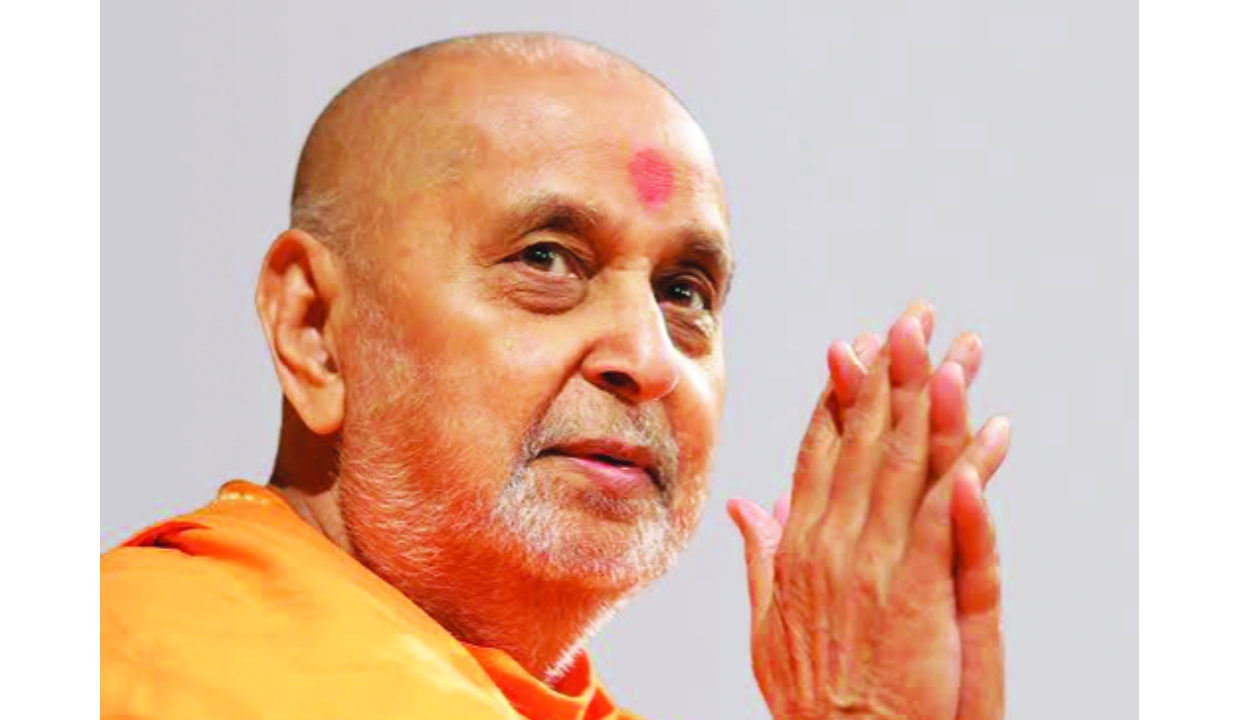
For many years, there was insufficient rainfall, and ultimately, in 1987, the Saurashtra region of Gujarat was declared a famine-affected area. At a time when the land was parched, crops had failed, and both people and animals were struggling for survival, Pramukh Swami Maharaj did not remain a distant observer. Moved by deep compassion, he inspired and organized large-scale relief efforts.
Under his guidance, food and water were distributed to affected villages, ensuring that no one was left helpless. But his concern did not stop with human suffering. Special arrangements were made for cattle camps where thousands of animals were fed and cared for. Water facilities were created for birds, who silently endure the harshness of such calamities. His vision of service was inclusive; it embraced every living being.
What made this service truly remarkable was the spirit behind it. There was no trace of ego, no desire for recognition, and no sense of superiority. Every act was performed with genuine sympathy and love, as if serving God through all forms of life. He often emphasized that true service should be done humbly, without expecting anything in return.
This incident stands as a living example of what it means to offer a helping hand in the highest sense, not just responding to visible suffering, but doing so with a pure heart, free from pride, and filled with universal compassion. For him, service was not an obligation but a natural expression of devotion. Of course, true divinity emerges in the act of helping others when one forgets,”I am the one helping.” The moment the ego of doership dissolves, service becomes sacred. When every act is offered to please God rather than to glorify oneself, compassion flows without expectation, recognition, or pride. Such selfless seva does more than ease another’s suffering; it purifies the one who serves.
Deepak Jhaveri, a reporter for the India Post in the United States, once interviewed Pramukh Swami Maharaj. He asked, “Don’t you ever tire from the constant travel and doing all this humanitarian work across the globe?”
Swamiji replied, “It is God’s work. I don’t believe that I am doing anything. It is all due to the Guru’s blessings and God’s inspiration. You only feel the burden on your head if you try to carry a pot of water. If you swim in the ocean, thousands of gallons of water are above your head, but you don’t feel a thing.”
Pramukh Swami Maharaj’s life taught the world that compassion reaches its highest form when service is offered without the slightest trace of ego. Where the ‘I’ ends, true seva begins. Long after words are forgotten, this single act of kindness continues to echo in grateful hearts, inspiring humanity to care again.