The last rolling memory of the City of Joy
Which is the only city in India where trams still run? It is Kolkata. But that is not its only distinction. It is also the only city in Asia where an electric tram service, born in the 19th century, still survives on active tracks. On February 24, 2026, Kolkata celebrated 153 years of its tramways - a system that began on February 24, 1873, when horse-drawn carriages clattered along iron rails between Sealdah and Armenian Ghat Street. Those early trams moved at a humble three miles per hour, introduced during the tenure of Lord Ripon. What started as a slow, horse-pulled novelty would go on to become one of the defining features of the city. As a Malayali traveller stepping onto the streets of Kolkata, I did not see the tram merely as a mode of transport. I saw it as a moving museum, a breathing relic of India's layered urban history. The tram here is not just steel and wire; it is sentiment and memory. In 1902, under the supervision of the Calcutta Tramways Company, electric trams began running between Esplanade and Kidderpore, and between Esplanade and Kalighat. The city's face changed forever. The tram network expanded steadily, connecting Kolkata and Howrah - twin cities divided by the Hooghly yet bound by commerce and culture.
The growth of Howrah as one of India's busiest railway complexes owed something to this silent, steady connector. At its peak, Kolkata's trams operated along 25 routes. Today, barely six remain. Around 15,000 commuters still depend on them, choosing this cheapest and most environmentally friendly form of transport over the city's chaotic traffic. There was a time when trams were not unique to Kolkata. Madras, Bombay, Baroda, Nasik, Kanpur, and Patna - all had their tramlines. In 1895, India's first electric tram ran in Madras. Between 1930 and 1970, tram services flourished across these cities. But gradually, one by one, they shut down - victims of financial losses, epidemics, falling passenger numbers, and the rising dominance of motor vehicles.
Even Kerala had a tramway. The Cochin State Forest Tramway operated from 1907 to 1963, transporting teak and timber from the forests of Parambikulam to Chalakudy. It was an industrial tram, not a passenger service, but it remains part of our forgotten transport history. Bombay electrified its tram system in 1907 under the Bombay Electric Supply and Tramways Company (BEST). Delhi had trams until 1963; Bombay until 1964.Madras ended its service in 1953 after bankruptcy. Patna became the first Indian city to close its tram service as early as 1903. Nasik shut down in 1933 following famine and plague.
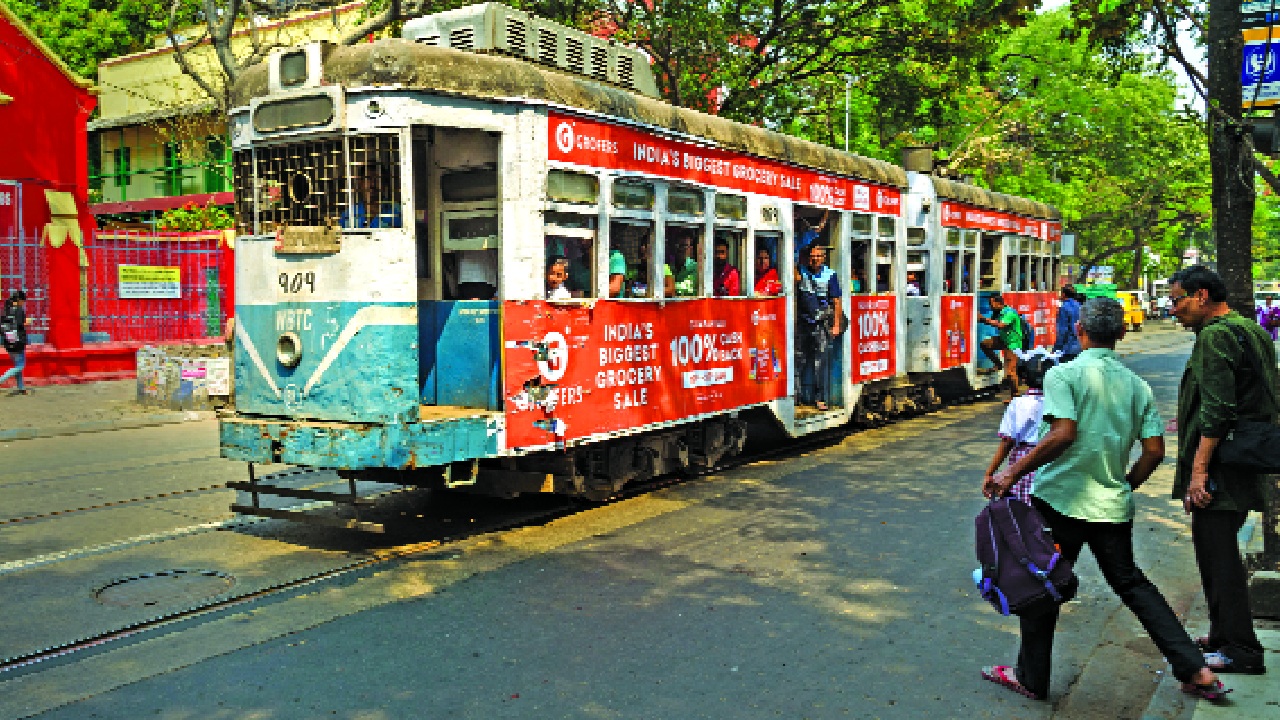
Today, Kolkata stands alone. The tram service is now directly managed by the West Bengal Transport Corporation. Yet it survives in what can only be described as a prolonged gasp between life and death. Critics argue that tramlines obstruct modernisation, occupy valuable road space, and slow down traffic on already congested roads. Many tracks have been covered with tar because removing them entirely would be too expensive. In some places, the rails peek through the asphalt like faint palm lines - reminders of a destiny the city once embraced.
When I visited the Gariahat tram depot, it felt like walking into an abandoned ancestral home. Rusted tracks, blue-and-white tramcars resting in silence, and a haunting stillness told stories of a glorious past. In the 1980s, traveling by tram in Kolkata was a dignified experience - slow, breezy, and affordable. Today, those same carriages appear like relics awaiting judgment. Kolkata was once called the City of Joy - a phrase immortalised by Dominique Lapierre and later popularised globally.
Now, many whisper a different description. After decades of political turbulence, industrial stagnation, and what critics call ideological rigidity, the city seems trapped in a cycle of economic fatigue. Youth are leaving in large numbers - migrating to Bengaluru, Hyderabad, Pune, even abroad - in search of opportunity. The tram's fading blue paint mirrors the fading confidence of a generation.
As a Malayali, I cannot help but compare Kolkata's tram story with Kerala's own transport debates. In our cities, we rush toward flyovers, metro rails, and highways. We rarely pause to preserve heritage mobility. In Kolkata, modernisation has often meant erasing tracks rather than integrating them. Yet, when I boarded a tram from Esplanade, something magical happened. The vehicle moved gently, almost meditatively. Unlike buses that roar or taxis that weave aggressively, the tram glided with restraint. It allowed me to observe the city - colonial facades, old bookstores, tea stalls, street debates - at human speed. The tram does not hurry. It remembers. On its 153rd anniversary, the state transport department organised "Tramjatra," attracting tram enthusiasts even from Germany and Australia. That global affection contrasts sharply with local apathy. For outsiders, Kolkata's tram is romance. For many residents, it is an inconvenience. But perhaps the tram's slow pace is precisely what this restless century needs. In an era of climate crisis, electric public transport from the 19th century seems surprisingly futuristic. Long before sustainability became fashionable, Kolkata's trams were already eco-friendly. The deeper question is not whether trams slow traffic. It is whether a city that erases its memory can sustain its soul.
Kolkata's tram is more than transport. It is testimony to colonial engineering, to post-independence optimism, to socialist planning, to decline, and to resilience.
The dark shade of the tram cars reflects a darker narrative of West Bengal's political and economic journey. But within that darkness lies continuity. As I stepped off the tram near Howrah, watching the wires crisscross the grey sky, I felt both nostalgia and unease.
The tram survives, but barely. The city breathes, but heavily. If the tram stops someday, it will not merely mark the end of a transport system. It will signal the silencing of a 153-year-old conversation between steel tracks and human footsteps. Kolkata may no longer be the City of Joy in the way it once was. But as long as a tram bell rings somewhere between Sealdah and Esplanade, history still moves - slowly, stubbornly, and beautifully - through its streets.
The writer is Professor at Centre for South Asian Studies, School of International Studies & Social Sciences Pondicherry Central University; views are personal