The case for more high-speed rail
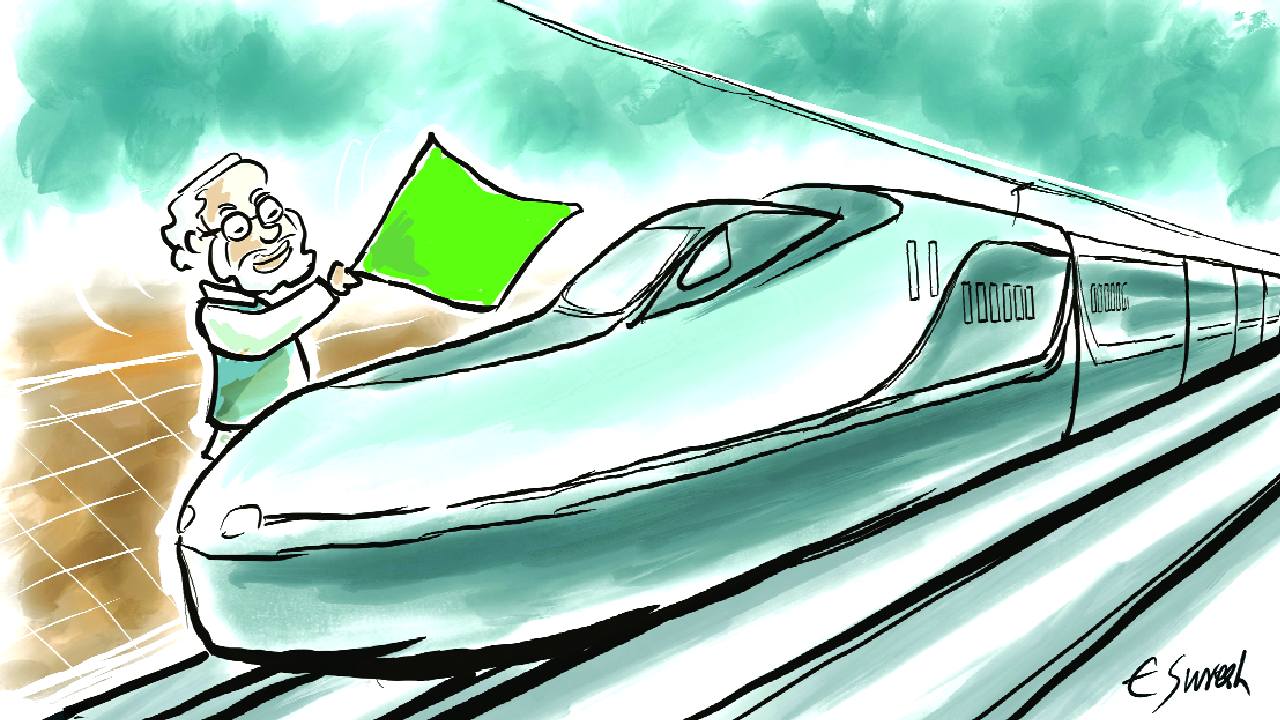
One of Nirmala Sitharaman’s most interesting announcements during her Budget speech was the proposal to build several more high-speed rail (HSR) corridors across the country in addition to the existing under-construction Mumbai-Ahmedabad high-speed rail corridor. The new corridors, namely Mumbai-Pune, Pune-Hyderabad, Hyderabad-Chennai, Chennai-Bengaluru, Bengaluru-Hyderabad, Delhi-Varanasi and Varanasi-Siliguri, will have a massive capital expenditure outlay of INR 2.78 lakh crore for almost 4,000 kilometres of dedicated high-speed rail track and trainsets.
There have been some very valid questions asked about this massive capital outlay, given that it will take over a decade, although work on these corridors ought to go a lot faster than the time taken on the first corridor, as civil and railway engineers gain experience. Last year, while driving between Surat and Baroda, sections of the Mumbai-Ahmedabad corridor were clearly nearing completion. Any visitor to Mumbai’s Bandra Kurla Complex (BKC) can see the construction of the massive new station complex underway.
These huge capital outlays for high-speed rail can transform India because they will make connectivity far better. The recent day-long traffic jam on the overcrowded Mumbai-Pune Expressway was proof that there is an urgent need for better connectivity solutions across India. A high-speed train between two of India’s most important cities, while challenging due to the Western Ghats, will dramatically bring down traffic on the Expressway.
Existing railway infrastructure is already overburdened, and while the Dedicated Freight Corridors (DFC) have created space for passenger lines, the huge growth in domestic aviation is an indication that there is a need to create more HSR and Regional Rapid Transit Systems (RRTS) lines across India, such as the proposed line connecting northern and southern Kerala and the dense network of lines emanating from Delhi.
The proposed triangular connection between Bengaluru, Chennai and Hyderabad, with an onward connection to Pune, potentially has the ability to transform India’s information technology sector. The three cities are all within a quick three-hour high-speed train journey — Chennai to Bengaluru can have a journey time of just over an hour. Right now, there are on average 11-12 flights between the two cities, and countless buses and cars traverse as well, especially given the distant location of Bengaluru airport. If the train is extended to Mysuru, the potential is limitless.There are valid questions to be asked about the huge expenditure, especially if one considers that it will take years to be profitable.
But just like Metro systems in major cities and the RRTS, the point is not just the profitability of the train system itself but the added economic potential as a result of the trains. Once the web of RRTS trains around Delhi-NCR is built, it has the potential to supercharge the entire NCR. In fact, I feel the RRTS systems should expand to Chandigarh and Jaipur as well. The adoption of HSR will also help in better utilisation of flights, as Indian airports and airspace are already crowded. This has been the case in France and Germany, where HSR has dramatically cut down domestic short-range flights, as HSR trains usually serve city-centre stations, thus cutting overall travel times, as most airports are far from city centres.
High-speed rail will also help India in meeting her carbon reduction commitments. Indian Railways has done a stellar job of electrifying the network, with all but a few stretches in the hills electrified by now. HSR will not only dramatically reduce flights but on sections like Mumbai-Pune it will reduce road traffic significantly. Why get stuck in a traffic jam and spend six hours in a cramped car when you can travel easily on board a train and reach your destination in just over an hour? That said, building tunnels and viaducts through the Western Ghats will be an immense engineering challenge. However, the construction of the Chenab Rail Bridge in Reasi has proven that Indian Railways civil engineers can deal with the challenges thrown at them.
India should not, however, fall into a trap of overbuilding HSR like China has right now, with over 50,000 kilometres of route length. HSR routes have to be viable from a passenger perspective and also show economic potential for the areas connected. At the same time, India should learn from China and start making its own high-speed rail equipment and trains, as the Chinese have taken the best systems and technologies from Japan and Germany and are making their own designs. Other skills in construction, especially tunnels and viaducts, will also be imbibed by Indian engineers. As India’s economy grows, possibly turbocharged by HSR, more routes should be built, and regular rail infrastructure should be improved as well.
The first HSR on Mumbai-Ahmedabad will be based on Japan’s new E10 Shinkansen, a modern version of their E5 train, and it was heartening to see videos posted on YouTube of the first batch of Indian loco pilots from the National High Speed Rail Corporation Limited learning to operate these trains. The opening of the first stretches of the Mumbai-Ahmedabad HSR next year will be a major moment of pride for India.
The writer is Director and the Publisher of The Pioneer