The age of thinking machines
Across the long span of human history, only a few inventions have fundamentally reshaped civilisation. Fire pushed back darkness, the wheel conquered distance, agriculture stabilised societies, iron transformed labour and warfare, and ships linked continents. The printing press loosened elite control over knowledge, electricity redefined daily life, oil powered modern industry, and computers, along with the internet, rewired communication and economies. To this rare lineage, the 21st century has added artificial intelligence — an innovation unlike any before it, because it
does not merely extend human strength or speed but begins to imitate the most basic human faculty: thinking.
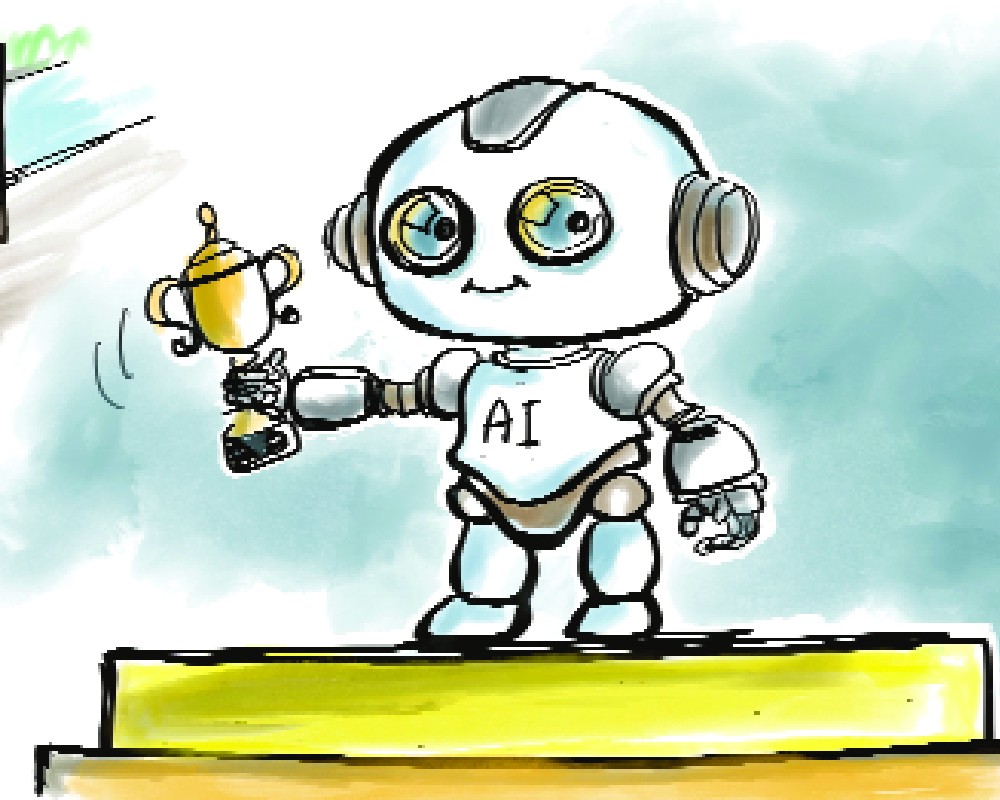
It is therefore deeply symbolic that Time magazine chose the “Architects of AI” as its Person of the Year for 2025. By honouring a collective rather than a single individual, the magazine acknowledged that artificial intelligence is a global achievement, not the triumph of one mind or one nation. Declaring that 2025 was the year when AI’s power “roared into view”, Time captured a point of no return.
The age of thinking machines has arrived, and it is already reshaping the foundations of modern life. Since its inception in 1927, Time’s Person of the Year has never been about celebration alone. It has chronicled influence-forces that define their era for better or worse. From Franklin D Roosevelt to transformative movements, scientists, and political leaders, the cover has reflected shifts in global power. Indians have appeared only rarely: Mahatma Gandhi in 1930, during the moral peak of India’s freedom struggle, and later Prime Minister Narendra Modi, reflecting India’s growing economic and diplomatic weight. That scarcity highlights how exceptional true global influence remains. The selection of the Architects of AI signals more than a technological milestone; it marks the beginning of a new epoch.
Artificial intelligence is rapidly becoming the invisible infrastructure of civilisation, shaping economies, redefining warfare, influencing culture, and altering how states project power. In this moment of transition, India finds itself at a uniquely consequential crossroads. India today is not merely a large nation-state. It is the world’s largest democracy, the most influential voice of the Global South, and the largest English-speaking society on the planet. Its demographic scale, technological ambition, and diplomatic reach place it in a position few countries have occupied at the birth of a new technological order.
As AI redraws global hierarchies, India has an unprecedented opportunity to shape not only markets and platforms, but also values, rules, and ethical norms. In recent years, India has demonstrated how technology can be deployed as a public good. Digital public infrastructure-universal digital identity, instant payments, and affordable connectivity — has transformed governance and inclusion at massive scale. Building on this experience, India now sees a broader responsibility: the possibility of anchoring an AI alliance for the Global South. At a time when advanced AI systems are controlled by a handful of corporations and countries, such an initiative is not merely strategic but moral. Without deliberate action, billions risk exclusion from the most powerful technology of the century. India’s vision rests on a simple principle: intelligence, like knowledge, must not become the privilege of a few.
For developing nations across Africa, Asia, Latin America, and the Pacific, AI offers a chance to leapfrog stages of development-improving agriculture, healthcare, education, disaster management, and governance. India’s diplomatic credibility, built through vaccine diplomacy, humanitarian assistance, and bridge-building, gives it the trust needed to convene such a coalition.
There is also a hard strategic logic behind India’s ambition. With the world’s largest pool of young talent, millions of engineers and coders, and deep integration into global technology supply chains, India enjoys a rare human-capital advantage. English, the dominant language of global AI development, provides a natural bridge between the Global North and the Global South. This combination allows India to absorb cutting-edge innovation while exporting software solutions and governance models.
On the ground, India’s AI ecosystem is already vibrant. Cities such as Bengaluru, Hyderabad, Pune, and Chennai have become hubs of experimentation. Start-ups are building generative AI tools in Indian languages, breaking long-standing barriers to information access. AI-driven diagnostics are reaching rural clinics, personalised tutors are entering classrooms, and predictive analytics are helping farmers navigate climate uncertainty. Few countries possess India’s capacity to scale innovation to millions-a decisive advantage in shaping AI’s real-world impact.
The AI revolution is also transforming work and human identity. Tasks are increasingly automated, offices are becoming hybrid spaces, and AI systems now assist with analysis, creativity, and research. Humans are shifting from execution to supervision, from repetition to reasoning. Productivity is rising, but so is the urgency for reskilling and lifelong learning. For India’s youthful population, this transformation holds enormous promise-provided education and policy emphasise judgement, ethics, creativity, and empathy, qualities machines cannot replicate.
Geopolitically, AI is fast emerging as a new arena of competition, comparable to nuclear technology or space exploration in earlier eras. Here, India’s approach stands apart. Rather than viewing AI solely as a tool of dominance, India frames it as a shared resource for human progress. Many nations of the Global South look to India not for dependence, but for partnership-collaboration that respects sovereignty and promotes shared growth. An India-led AI alliance could one day rival the historical significance of the Non-Aligned Movement or India’s recent G20 leadership.
Time’s recognition of the Architects of AI ultimately underscores a deeper truth: the future will be shaped less by borders and weapons, and more by intelligence, innovation, and values. Humanity stands at a once-in-a-century turning point, comparable to the Industrial Revolution or the birth of the internet. The AI age is no longer approaching — it is accelerating. And India, with its demographic strength, technological confidence, and ethical vision, is prepared not just to participate, but to lead this transformation with responsibility and hope.
The writer is a Professor at the Centre for South Asian Studies, School of International Studies and Social Sciences, Pondicherry Central University; views are personal