Self protecting Bharat for growth
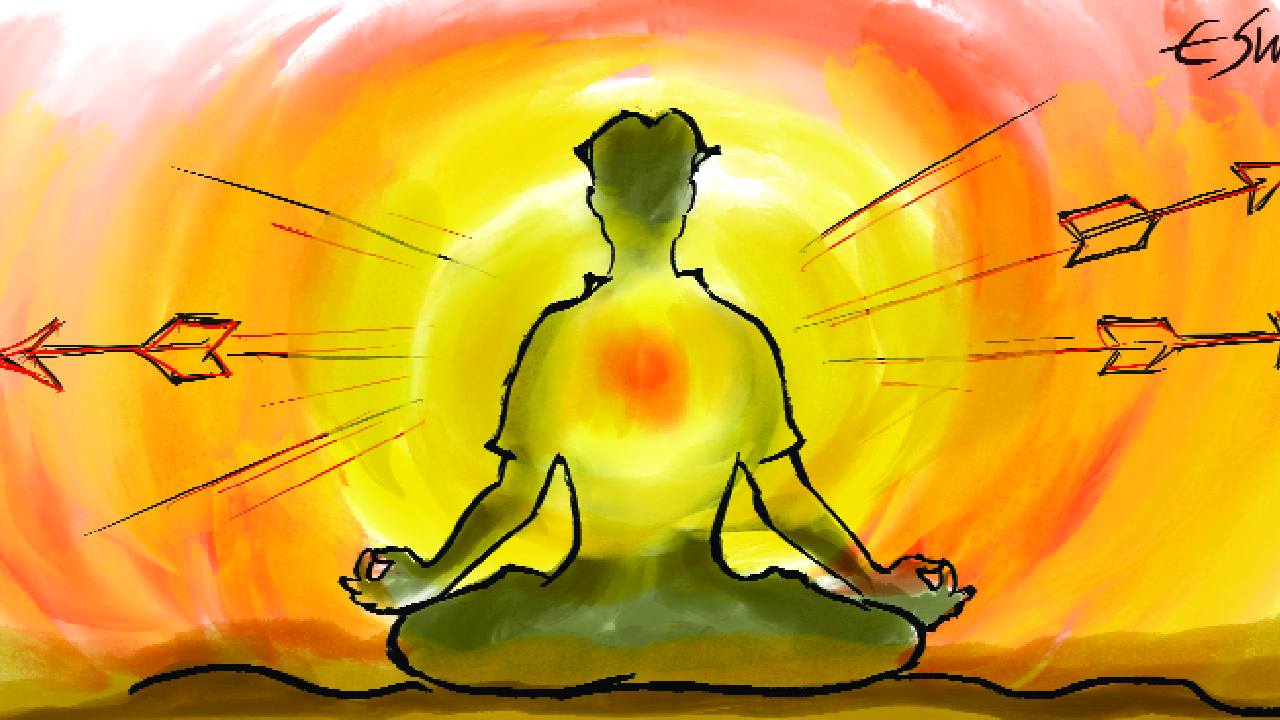
Addressing the opening ceremony of the Viksit Bharat Young Leaders’ Dialogue in Delhi, the National Security Adviser of India underlined the centrality of strong leadership and the need for Bharat to remain inspired by the powerful sentiment of self-protection. He also stressed the timeless values of discipline and perseverance.
The sentiment of self-protection is found in the Dharma Shastras like the Manusmriti. Several sages, thinkers and teachers such as Manu, Brihaspati, Ushanasa and Bharadvaja considered self-preservation to be the fundamental duty of an individual. The right to self-defence was extended even to Brahmins (priests) and Vaishyas (traders), who were normally dissuaded from bearing weapons. In times of extreme danger, emergency or calamity, or when the social order was collapsing, they were allowed to take up arms to protect themselves or the vulnerable.
Kautilya, in his Arthashastra, emphasises self-defence as a fundamental principle for individuals and the state, the argument being that a person’s first duty is to preserve himself, as a dead person cannot fulfil the goals of Dharma (righteousness) or Artha (prosperity). While individuals had the right to defend themselves, the Arthashastra also repeatedly stressed that the primary duty of the king was to protect the population. A good king ensured that the “Law of the Fishes” (Matsya Nyaya, whereby the powerful devour the weak) did not prevail.
The Bhagavad Gita (2.31–35, 4.7–8) urges Arjuna to fight as a duty to uphold Dharma against the aggressors. It places self-defence as part of the cosmic order. Its philosophy is not about personal aggression but acting in accordance with righteous duty. Therefore, Lord Krishna convinces Arjuna not to think in terms of annihilating his kith and kin but to fight to save Dharma and punish the aggressors by defeating them. Accordingly, Operation Sindoor was Bharat’s Dharma Yuddha. In several ancient Indian treatises, wars are justified for self-defence and the protection of territory or the kingdom. Hence, the National Security Adviser’s advice,
anchored in self-protection, echoes the enduring wisdom of ancient Bharat, and must be followed in letter and spirit.
Regarding his guidance on the timeless value of discipline and perseverance, the concept of Indriya Nigraha is crucial in ancient Indian thought. It is found across texts such as the Mahabharata, the Arthashastra and Buddhist and Jain literature, to name a few. In ancient Indian literature, this is not described as the suppression of the senses (which is perceived as harmful), but rather as their conscious regulation to ensure that they serve the intellect rather than enslave it. Mastery over the senses was seen as the core of all discipline, as every threat to discipline comes from a sensory trigger. The Katha Upanishad employs the metaphor of a chariot to describe the complex human mind. It explains that if the intellect (charioteer) is infirm and the mind (reins) is loose, the senses (horses) become ‘dangerous’ and unmanageable, dragging the individual away from the desired goal. However, if the intellect is firm and the mind is under control, the senses behave like ‘trained horses’ that obey the commands of the driver, leading the chariot to the correct destination.
In the Bhagavad Gita, Krishna discourses to Arjuna that the senses are so strong and impetuous that they forcibly carry away the mind even of a determined person who is striving to control them. The only way to discipline is through practice and detachment. He states, “O mighty-armed one, it is undoubtedly very difficult to curb the restless mind, but it is possible by constant practice and by detachment.”
Ancient Indian wisdom underscores discipline and perseverance as essential virtues for spiritual and moral growth. These values are prominently featured in our scriptures such as the Vedic literature, Manusmriti and the Gita. In Chapter 17 on Shraddha-Traya-Vibhaga Yoga, the Bhagavad Gita discusses how discipline (referred to as Tapa) should be applied to one’s daily life routines. Tapa of the body (Shariram) involves purity, which had to be maintained through physical cleanliness. It includes straightforwardness in speech and conduct. Another component is non-violence (Ahimsa) and showing respect to elders and teachers. It foregrounds engaging the body for productive, disciplined action rather than indulging in sensory pleasure.
Dhriti can be understood as the psychological strength required to remain steady in one’s path despite difficulties and hurdles. It is a vital concept that exists in the ancient Indian textual tradition. The Manusmriti mentions Dhriti as the first of the ten pillars of Dharma. It is defined as the patience to endure difficulties without deviating from one’s duty or goal. Sattvika (ie pure) Dhriti is the highest form of resolve. It is the unwavering firmness and sense of commitment by which one controls the mind, the force of life (Prana) and the five senses through Yoga. It is characterised by self-discipline and an emphasis on spiritual growth.
In a verse in the Gita, Shri Krishna enumerates the virtues of a Sattvik Karta, ie a doer functioning under the influence of Sattva (the essence of goodness). Such an individual is said to be devoid of all forms of attachment. He does not possess any ego. He is also endowed with firm determination and enthusiasm to achieve his aim and remains unbothered by success and failure.
Hence, the eternal values of discipline and perseverance are a sine qua non for building a strong Bharat. This was proved ably when, during the COVID-19 pandemic, 140 crore indomitable Indians voluntarily complied with lockdown measures, while in some Western democracies, the army had to be drafted to enforce them. The process of building a strong nation is a long-term project sustained by two major pillars: discipline and perseverance. While talent and resources lend the necessary raw materials, these two virtues can be understood as the engine that propels sustainable progress. Discipline in the work environment is directly related to growth. Perseverance is the ability of people to remain committed to long-term goals despite economic slumps, natural disasters or global vicissitudes.
Let self-protection secure our sovereignty, discipline channel our energies productively, and perseverance propel Bharat towards progress, prosperity, growth and development by 2047. With unflinching resolve, we shall achieve a Viksit Bharat that honours its civilisational inheritance while confidently confronting and conquering the contemporary challenges of uncertain global times.
The writer is the Director, Bharat Ki Soch. He is a retired IPS and has served as Chairman of Haryana Public Service Commission, DG - ITBP, DG - NDRF and Commissioner of Police, Kolkata; views are personal