Rethinking the Aryan narrative and colonial historiography
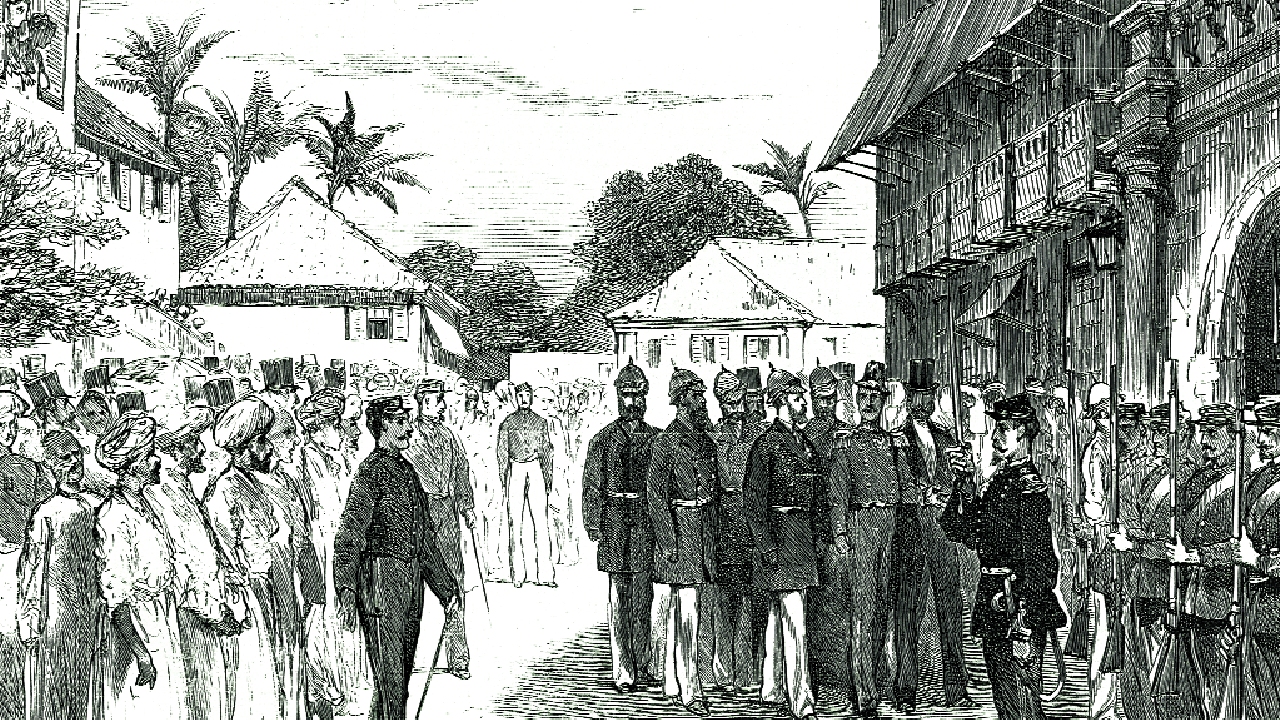
Indian historiography is largely the legacy of British colonial rule. The imprint of Western social sciences was so strong on the Indian psyche that our subcontinent found it impossible to break away from the old methodologies of interpreting Indian society. It suited the colonials to recreate just such an Indian past that provided them with a suitable justification to rule. They devoted their energy and attention to finding fault lines in the Indian social fabric, their investigation going back to early times.
The British sculpted the ‘Two-Nation Doctrine’ and then gave it to Jinnah to precipitate India’s partition. This doctrine also triumphed in J&K. The problem still festers. The colonial education policy, enunciated bluntly by Thomas Babbington Macaulay, created more cracks and divisions. They also sought to forcibly separate and isolate the hills and forest people from the inhabitants of the plains in India, thus creating a hiatus between ‘us’ and ‘them’. The hallmark trait of the communities of ‘Bharat’, their diversity in terms of language, linguistic characteristics, ecological environment and physical traits, instead of being hailed, was used to create rifts.
The British came up with the Aryan invasion theory. The Aryan stereotype was a tall, comparatively fair-skinned, tough and aggressive character who rode through the north-western passes in his horse-drawn chariot, overwhelming the sedentary indigenous non-Aryans of India. The Aryan invasion got commonly interpreted as a process of fusion of Aryan and non-Aryan elements over time.
The early racial history of India is difficult to construct because skeletal remains are rarely found, owing to the ancient custom of cremation. Knowledge of this period of the Indian subcontinent depends largely on the evidence provided through language and literature, studied in the light of archaeology. In fact, there is enough proof that points towards a Dravidian influence on Vedic Sanskrit, not only on its phonology and vocabulary (of the earlier stratum of Vedic literature) but also on its sentence structure. The racial and linguistic situation in the northwest at the dawn of history was complex. The simplistic interpretation of tall, fair charioteer Aryans bringing civilisation to a land of insignificant dark-skinned people has now stood completely debunked, as revealed by archaeology and linguistics. The term ‘Arya’ in Pali canons and in Dravidian languages has been there for long and has been used as a respectful form of address.
The Rig Veda is the oldest collection of hymns, crucial to the understanding of the early Vedic era. The Vedas are thought to have been composed by the Aryans. It was long believed that the Aryans had played a major role in civilising the Indian subcontinent. Aryans were also considered to represent a linguistic group speaking Indo-European languages. Colonial historians saw them as different from the non-Aryan Harappans of the preceding period.
Two types of sources are available, as previously noted, to study the early Vedic period, namely literary and archaeological. The four Vedas represent the oral tradition of their times. Since the hymns were meant to be recited, learnt and transmitted orally, they were not written down when they were first composed. For this reason, they cannot be dated precisely. There is no substantial archaeological proof of large-scale migration of people from Central or Western Asia into the Indian subcontinent around 1500 BCE. There is also no archaeological proof of the claim that the Aryans destroyed the Harappan civilisation and laid the foundation of a new one. The Rig Veda does refer to hostilities and wars between different groups, but the so-called clashes between Aryan and non-Aryan communities are not evidenced in archaeology. Since the Rig Veda is the first compilation of hymns, its importance as a historical document is immense. It offers perspectives on aspects of traditional civilisation not provided through archaeology. Glimpses of the economy, social and political organisation, belief systems and kinship can be gleaned from Vedic literature.
The Aryan ‘came, conquered and built India’ narrative was a wrong theoretical construct, serving the ulterior motives of the colonisers by establishing that the first colonisers were the Aryans who had come all the way from the ‘Steppe’ in Central Asia. This was used to justify the second colonisation by the Europeans. Europe and the north Indian groups got conveniently linked to each other through Indo-European languages. These north Indian groups were the ‘Indo-Aryans’. The Asiatic Society of Bengal, a colonial research institution on Orientalism, desperately tried to identify common strands that would link India with the West. India was neatly sectioned into Aryan and Non-Aryan. For the British, who claimed that they were the custodians of high civilisation, all Indians, particularly those living in forests and hills, represented the primitive, indigenous and backward. In giving identity to the subject Indians, they used criteria that suited them.
Researchers, on the contrary, have systematically unveiled striking similarities between the early metaphysical ideas central to Eastern and Western philosophies. Key philosophical paradigms such as monism, reincarnation in India and Egypt, and early pluralism in Greece and India indicate how trade, migration and imperialism allowed these ideas to circulate and intermingle freely throughout India, Greece and the Near East. Studies based on early historical, philosophical, spiritual and Buddhist texts from 600 BCE till the era of Aristotelian thought illustrate this. The British, to justify imperialism, successfully tied race with language, specifically the Indo-European categorisation of Sanskrit, and through it sought to associate many other Indian languages. In the nineteenth and twentieth centuries, language was regarded as linked to race. And if the language of classical Indian literature was of the same family as the literatures of the white-skinned colonisers, then an ambiguity entered the equation: “Does the racial justification for colonialism apply to India, or doesn’t it?” If Sanskrit was an Indo-European language, its original speakers, the “Aryans”, must have been more or less white people. To Romantic Orientalists such as Friedrich Schlegel and Arthur Schopenhauer, this meant that the Indo-Europeans had dominated the development of civilisations, both East and West. But to another group, the inference that the Indo-Aryans were more or less white people had a different, more ominous implication. It meant that the racial justification for imperialism was not even needed.
Nineteenth-century studies of culture and philology placed the languages of the Western colonisers at the top. These were regarded as the languages of natural conquerors. The languages of the colonised, in contrast, were the languages of naturally slavish peoples, who were born to be conquered. The discovery that Sanskrit was Indo-European shockingly controverted that assumption. The language of slaves turned out to be the language of the masters. We all know that the Vedas are the earliest documents in any Indo-European language. Therefore, among the most important language families, Sanskrit emerged as the oldest one. Though India was admitted belatedly to the ranks of the masters, it actually had a claim to priority there.
What transpired during the rule of the East India Company and thereafter the British Crown reads like a litany of mischief, bent on creating tensions within Indian society, which had long remained stable. Colonial Indian historiography was one such major tool or weapon. It will do us immense good to be aware of their deliberate policies. It is incumbent that India’s narrative is now based on empirical studies rooted in civilisational sources rather than copied from Western experience and pasted onto the Indian context.
The writer is a former cultural secretary, Government of India and an Advisor at Bharat Ki Soch Foundation; views are personal