The bill the planet has been paying for you
Every summer, India gets hotter. We speak of the heat the way we speak of traffic: as an ambient condition, unfortunate but accepted, something to be endured rather than examined. What we have not seriously asked is where the heat is coming from, and whether the answer implicates us more directly than we are willing to admit.
This April, nearly every city on the list of the worlds hundred hottest was Indian. Varanasi is burning at forty-four degrees. Prayagraj, which we call a seat of the divine, is a furnace. We call these cities Dev Bhoomi, sacred ground. What we do not ask is what it means that the sacred ground is on fire, and who precisely lit the match.
The standard account of why the planet is heating runs through science, and the science is correct as far as it goes. That account is accurate. It is also, by itself, almost entirely useless, because it tells us what is happening without telling us why the human species keeps doing it when the consequences are this legible. What produced the atmosphere's problem is older and less visible: a consistent human refusal to count the full cost of wanting things.
Consider what a litre of petrol actually is. It is the compressed residue of organic matter that took a hundred million years to form under specific geological conditions that cannot be replicated, accelerated, or substituted. We priced it. We said it costs a hundred rupees per litre after accounting for extraction cost, refining, distribution, and a modest tax.
What the price does not include, and has never included, is the cost of making the thing in the first place, because the planet made it for free, across geological time, and sent no invoice. This is not economics; it is a sophisticated form of theft, with the ledger arranged so that the victim cannot file a claim.
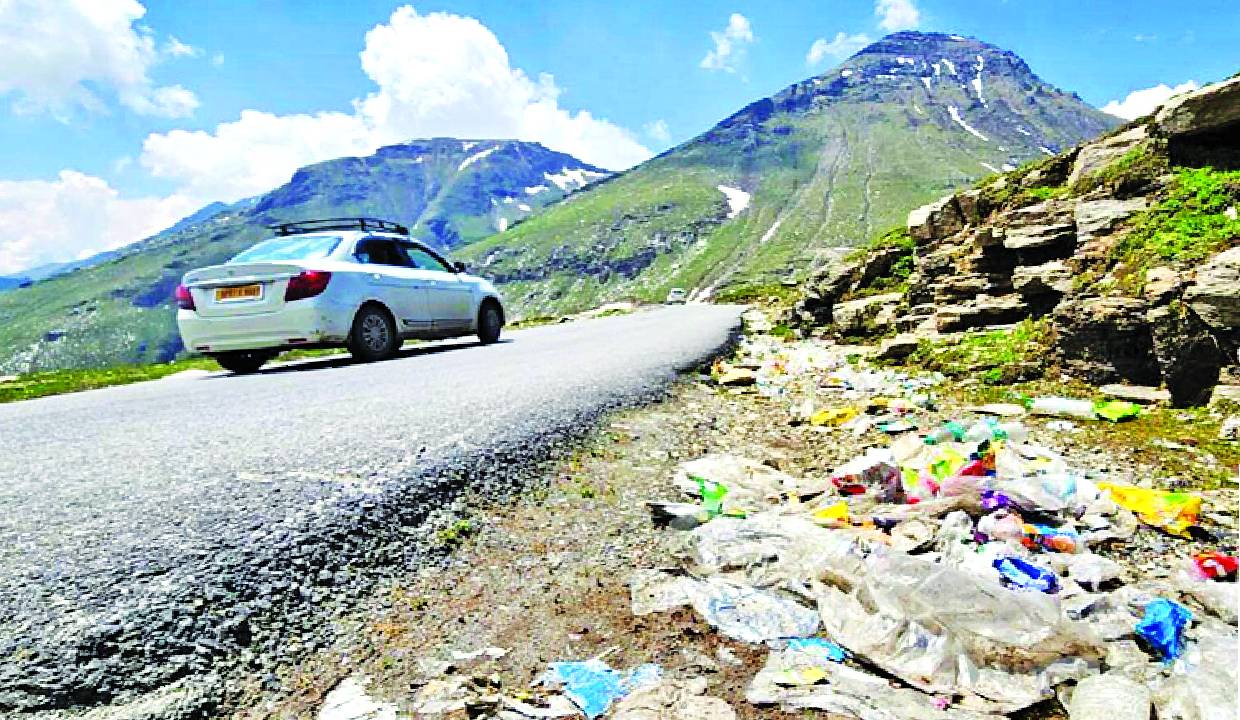
The forty- or fifty-rupee Maggi that we get in the mountains follows the same structure at a domestic scale. The plastic in that packet will remain in the mountain ecosystem for centuries. The ecological damage of a single packet, fully priced across its lifecycle, runs to thousands of rupees. But the damage lands in the mountain's account, not the consumers. The consumer pays fifty rupees and walks away feeling that the transaction is complete. It is not complete, and will never be complete, because the mountain cannot present a bill.
There is a useful analogy here, drawn not from theory but from a history this country knows well.
Britain occupied India for close to two centuries and extracted what economists now estimate at forty-five trillion dollars in resources and labour through trade arrangements that were structured as commerce but functioned as organised looting.
The British citizen of the 1900s was among the wealthiest people on earth. He paid low prices for imported goods and understood his prosperity as the reward of industry and national character. What he did not include in his accounting was the cost to the entity from which his prosperity was drawn. India's ruination did not appear in his balance sheet.
The arrangement did not end with Independence; it merely changed coordinates. Natural capital - the aggregate of forests, rivers, fisheries, aquifers, topsoil, and the atmospheric stability that makes agriculture possible — has been drawn down at a rate the WWF's Living Planet Index captures in one figure: a 73 per cent average decline in monitored wildlife populations since 1970.
The GDP figures for those same five decades show consistent growth. Both statistics are accurate, and their combination reveals the deception: we consumed the capital and recorded the consumption as revenue. Any accountant shown this methodology would call it fraud. We call it the global economy.
Once the pricing problem is visible, the inadequacy of every currently fashionable response becomes equally visible, because every response is designed to address the symptom rather than the structure.
Every significant improvement in fuel efficiency over the last century has been followed by an increase in total fuel consumption, not a decrease, because cheaper operation lowers the threshold for use and makes the market for vehicles larger. The electric vehicle is positioned as the resolution of this problem, but it operates by the same logic.
It reduces per-vehicle emissions by a meaningful margin — the improvement is real — and then makes electric mobility morally comfortable and economically cheaper, which accelerates the aspiration to vehicle ownership. This pattern, first observed in coal engines by the economist William Stanley Jevons in 1865, holds across every domain where a more efficient instrument has been offered to an unchanged ego. The ego does not self-limit through efficiency; efficiency has always been the ego's instrument, never its corrective.
The costs we are not paying in our lifetimes are landing in a column we do not look at: the column belonging to the children who will be alive when this arrangement reaches its terminus. The children currently in school in Delhi, Lucknow, or Kanpur are not going to inherit a recovering system. We have eaten the past, and we are now eating the future.
The answer that this generation tried - that it brought green technology and signed accords and held conferences - will not be accepted, because the children will see that the trying was a way of avoiding the stopping.
The person who has seen, even once, that the forest and the river and the mountain are not outside himself but are the condition of his own existence finds that the urge to consume them cheaply has nowhere to lodge, not because he has become virtuous, but because the structure that made the exploitation feel consequence-free has been briefly interrupted. In that interruption, the actual cost of the fifty-rupee packet becomes visible. The carbon credit no longer satisfies him.
The electric vehicle no longer satisfies him. None of these were ever going to satisfy him, but until the boundary moved, he could not see why. Everything else will remain a more sophisticated version of the same ledger, with the planet's losses buried in a column that the market has agreed not to open, and a generation of children growing up to inherit the reckoning their parents preferred not to have. The bill is arriving. It has the date and the address correct. The only remaining question is whether it is opened.
Leave a Comment
Comments (11)
you are on the path to destroy ours existence, we need to look at our non sense and the person who will guide us to do this only and live is acharya prashant. let us come togather and help acharya ji to complete and ours future mission. join geeta session...
We keep waiting for a 'green' invention to save us, but as Acharya Ji points out, the instrument isn't the problem, the ego is. Until we address the internal urge to consume, we will just use electric cars and solar panels to continue the same pattern of exploitation. True sustainability has to start with self-knowledge. We have eaten the past, and we are now eating the future. The bill is finally arriving, and the next generation will be the ones forced to pay it.
We need to reduce our consumption,accept degrowth,and produce no more babies.
बिना आत्म ज्ञान का इंसान ऐसे ही करेंगे ।
Consumption = carbon