Sixteen deaths a day: Every dowry death shames entire Indian society
The recent incidents involving the death of model Twisha Sharma in Bhopal and Deepika Nagar in Greater Noida, which are being allegedly described as the dowry deaths, have once again brought the issue of continuity of dowry system in India in public discussion. Irrespective of the veracity of the causes of these deaths, it is so unfortunate, as we stand at a juncture of civilisational peak, that we still hear of dowry deaths that result from dowry related harassment. As per NCRB data, India recorded 5,737 dowry deaths in 2024, translating to about 16 women losing their lives every single day. Every conscientious citizen is naturally shaken to know this death ratio and is compelled to ask the question that why is it that the civilised society still has to hear of, and bear with, the dowry deaths?
At a point of time when India boasts of becoming a Vishva Guru and claims of being the fastest growing economy making all round development, how pernicious is it to have the phenomena of dowry death existing in this country. How farcical it is for a country to make such tall claims when it, rather than ensuring respect and security, miserably fails to protect its own daughters. Indian society very pompously boasts of empowerment, security and respect for women, and posits to be place where girls are worshipped and treated as deities. However, shamefully, we still have the retrograde practice of dowry prevailing among almost all the communities throughout the nook and corner of this country.
Though laws and machinery exist to prevent and control the menace of dowry in India, but that has largely remained ineffective in stopping or eradicating the social evil of dowry which continues and is widely pervasive in India. Indian laws such as the Dowry Prohibition Act, 1961 and the Bharatiya Nyaya Sanhita, 2023 contain necessary provisions to check the menace of Dowry. Bharatiya Nyaya Sanhita, 2023 in its Section 80 (formerly Section 304B of the Indian Penal Code) applies specifically to cases of dowry death occurring within seven years of marriage while other provisions of law such as Section 85 of the Bharatiya Nyaya Sanhita (formerly Section 498A IPC) continue to provide protection against cruelty and harassment for dowry demands irrespective of the duration of marriage. The Dowry Prohibition Act, 1961 prohibits and penalizes giving or taking of dowry so as to safeguard women against dowry harassment. Bharatiya Nagarik Suraksha Sanhita (BNSS), 2023 provides for speedy investigation and trial of criminal cases including Dowry related cases.
The government has already directed that the dowry related cases must be adjudicated expeditiously to avoid further harassment of the women and has even appointed the dowry prohibition officers, and keeps issuing advisories to all States/UTs from time to time to effectively deal with, and for proper enforcement of law and convictions in, women related crimes. Further, Bureau of Police Research & Development, conducts training programmes for personnel of criminal justice system including investigation officers, prosecution officers and medical officers etc. to deal with crime against women effectively and sensitively.
Hower, unfortunately, despite such comprehensive legal measures, the evil of dowry continues to exist in Indian society, and leads to frequent conflicts and disputes that sometime result in dowry deaths as well. This state of affairs signifies that the solution to this problem cannot be provided merely by legal measures, rather the solution must be sought elsewhere as well. Thus, tackling this problem requires not only making strong laws and ensuring their effective implementation but also simultaneously educating and sensitising people against this evil practice.
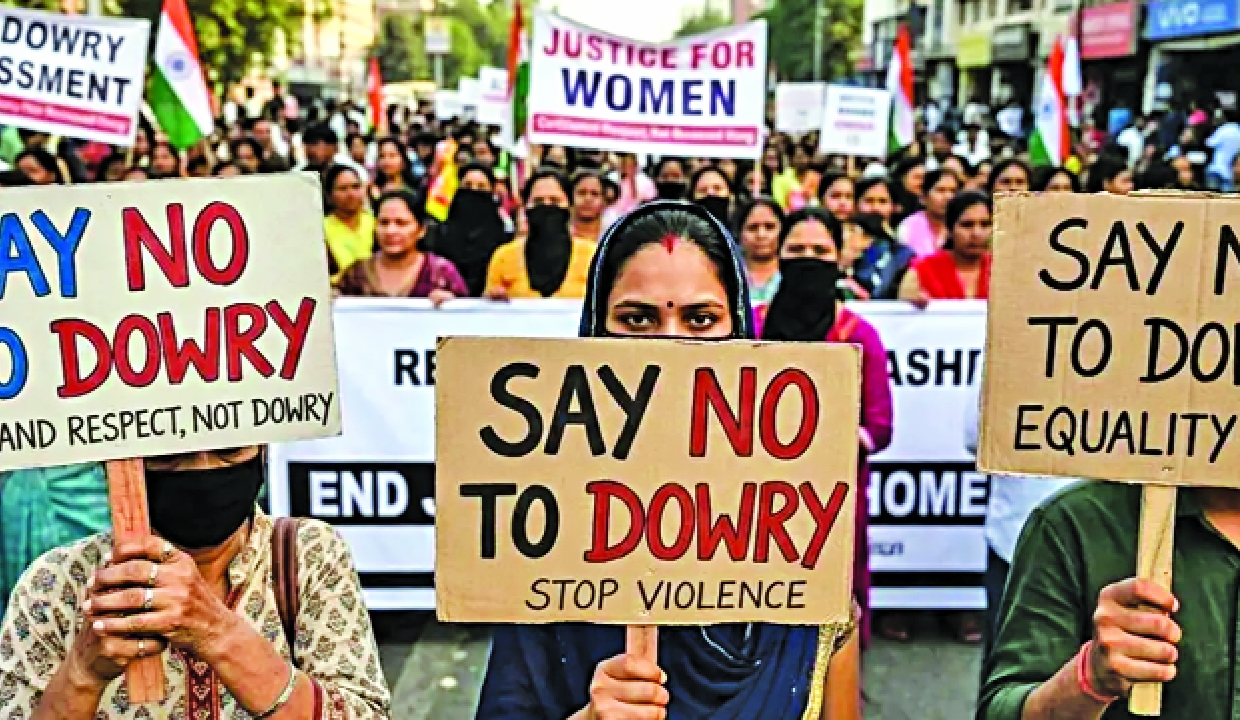
The voices against dowry must emerge from within the society in the form of strong public opinion to fulfil the gap between law and public policy in this regard. Thus, there is pressing need to educate and sensitise the society about the ill effects of practicing the dowry system. The presence of dowry system is not in the interest of the society and it creates a distrust in the institution of marriage, the ill effects of which have already started appearing through delayed, broken or no marriages.
In this scenario, members of the civil society should come forward voluntarily and stop giving and taking dowry in marriages of their children. The families must educate their children, especially, their sons against the dowry system and encourage them to be self-dependent. Boys should be taught to have high self-esteem, who should consider taking dowry as an inferior and insulting practice. Men and women in the families across all the communities must become part of a mass campaign for giving up the bad practice of dowry. The government must run campaigns against giving and accepting dowry in any form in the marriages. Even civil society should run #QuitDowry campaign through social media so that it turns into a mass movement and people, especially, the youth of this country start treating dowry as a degrading practice.
This movement shall succeed the day when dowry shall come to be treated as amounting to beggary and accepting it shall be considered as receiving alms. As the circumstances that led to the origin of dowry system do not any longer exist in this country, so there is no justification of its continuation at present. Dowry death is a curse for, and a darkest blot on, the whole civilised society as well as the state. It impinges upon the capacity of the state to protect the members of half of its population. Dowry death is not just a horrendous crime but also a matter of gravest concern and shame for the whole society.
However, if even a single dowry death does not shake the conscience of the society, then it severely reflects on the poor value system of members of society, and also adversely impinges on the values that the society is going to pass on to its future generations. The state and the society need to seriously start thinking about curbing this menace and should take meaningful, effective and foolproof measures to eradicate the social evil of dowry from the Indian society, completely.
The writer is Associate Professor, Faculty of Law, University of Delhi; Views presented are personal.