From Anaimangalam to Leiden: Reclaiming a civilisation’s memory
A thousand-year-old Tamil inscription reveals advanced governance, global diplomacy, and a legacy now being reclaimed
The recent engagement between India and the Netherlands has once again drawn attention to one of the most remarkable historical records of Tamil civilisation, the celebrated Leiden Plates. Their renewed prominence reflects not only the depth of India’s civilisational past but also the growing efforts in recent years, under the leadership of Narendra Modi, to reclaim and reassert India’s cultural legacy on the global stage.
What appears at first glance to be a set of copper plates is, in reality, a deeply layered civilisational document. It is a record of diplomacy, governance, cultural exchange and administrative sophistication that places the Tamil people at the heart of an interconnected medieval world. In an age where history is often fragmented into regional narratives, the story of the Anaimangalam copper plates reminds us that Tamil civilisation was never isolated. It was outward-looking, confident and globally engaged.
The origins of these plates lie in a fascinating chapter of early transnational interaction between South India and Southeast Asia. Mara Vijayottunga Varman, the ruler of the Srivijaya Empire, who ruled Sumatra, present-day Indonesia, sought the support of the great Chola emperor Rajaraja Chola I to establish a Buddhist vihara in his empire.
This request itself is significant. It reflects the recognition of the Chola Empire not merely as a regional power, but as a civilisational force capable of extending patronage beyond its territorial boundaries. It also underscores the existence of deep maritime links between Tamilakam and Southeast Asia, facilitated by trade routes, cultural exchanges and shared religious networks.
Based on friendship, Rajaraja Chola provided land and support, enabling the construction of the Chudamani Vihara at Nagapattinam. This act was not simply a gesture of generosity. It was a carefully considered diplomatic and cultural investment, strengthening ties between two powerful regions of the ancient world.
Nagapattinam, during this period, functioned as a vibrant port city and a meeting point of civilisations. Merchants, monks, scholars and travellers moved through its shores, carrying with them ideas, goods and traditions. The establishment of the Chudamani Vihara there further elevated its status as a centre of spiritual and intellectual exchange.
To administer this vihara, the village of Anaimangalam was granted as a donation. This historically significant Chudamani Vihara, where Buddhist monks from Sri Lanka visited daily for worship, was later demolished on the orders of Governor Francis Napier, who accepted the request of French missionaries. The Napier Bridge in Coovum is named after him.
The grant of the village of Anaimangalam for the administration of the vihara was inscribed on copper plates by the son of Rajaraja Chola, the great emperor Rajendra Chola I. This act of inscription was not merely ceremonial. It was a formalisation of governance, a legal record that ensured continuity, accountability and clarity across generations.
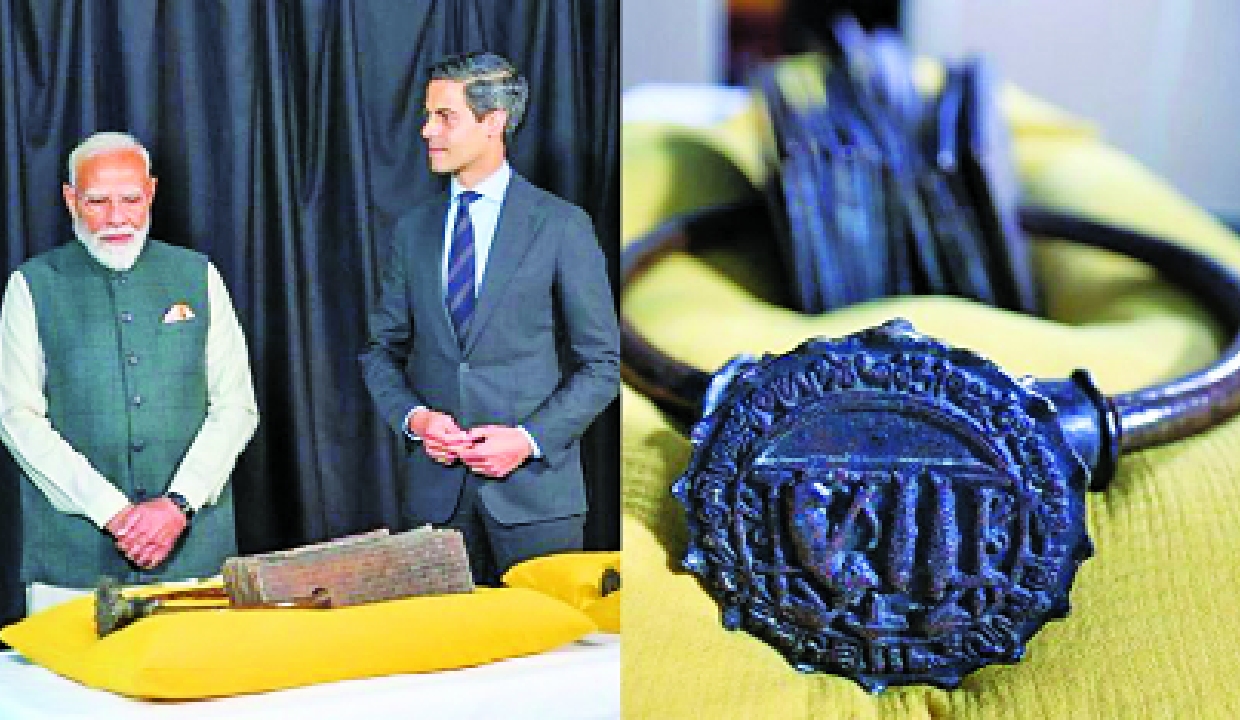
These are the renowned Anaimangalam copper plates, the original name by which they were known, a unique historical identity of the Tamil people. Over time, due to colonial displacement and archival practices, they came to be widely referred to as the Leiden Plates. Yet, restoring their original identity is itself an act of reclaiming history.
These inscriptions, written in both Tamil and Sanskrit, vividly explain the artistic excellence, scientific knowledge and land measurement systems of the Tamils. One of the most remarkable aspects of these plates is the detailed recording of land survey methodologies. They reflect a structured and scientific approach to land administration, including precise demarcation, categorisation of land types, irrigation considerations, taxation frameworks and revenue assignments.
The sophistication of these systems is striking. Land was not merely distributed; it was measured, classified and documented with a precision that ensured fairness and sustainability. Boundaries were clearly defined, responsibilities were assigned and revenue mechanisms were established in a transparent manner. Long before the emergence of modern cadastral systems, the Chola administration had already institutionalised a highly advanced and transparent model of governance rooted in measurement, accountability and documentation.
Beyond administration, the plates also illuminate the social and cultural fabric of the time. They record endowments, institutional management, rights of stakeholders and the integration of religion, economy and governance. They demonstrate how temples and viharas were not isolated religious spaces, but dynamic institutions that interacted with society at multiple levels.
The bilingual nature of the inscriptions demonstrates both regional rootedness and civilisational outreach, combining Tamil precision with Sanskrit formality. This dual-language approach ensured that the message was both locally grounded and widely intelligible across different cultural spheres of the time. During the period when the Dutch exercised control over parts of the region, these copper plates were taken away and later placed at Leiden University in the Netherlands, where they came to be widely known as the Leiden Plates. This movement of artefacts during colonial times was not uncommon, but it resulted in the displacement of historical memory from its native context.
For decades, such artefacts remained in foreign institutions, studied and preserved, yet physically distant from the people whose history they embodied. The question of their return was often entangled in legal complexities, diplomatic sensitivities and institutional inertia.
Today, these plates have been handed over to Narendra Modi ji during his visit to the Netherlands. This stands as a testament to his leadership and global stature. It is also a reflection of a changing global environment where nations are increasingly willing to acknowledge historical imbalances and take steps towards restitution.
Such a moment does not occur in isolation. Institutions and nations do not part with historically held artefacts easily. It requires a rare combination of diplomatic trust, moral legitimacy and sustained engagement at the highest level. In the present era, it is undeniable that Narendra Modi ji’s personality, his global credibility and his unwavering emphasis on civilisational pride have made such outcomes possible. His leadership has transformed cultural restitution from a passive demand into an active diplomatic achievement.
This transformation is visible across multiple instances. Artefacts that once seemed permanently lost to foreign collections are now being identified, negotiated for and returned. Each such return carries symbolic weight, reinforcing the idea that history is not static, and that rightful ownership and cultural memory matter. This is not an isolated instance. Across the world, several heritage artefacts connected to Indian civilisation, including those of Tamil origin, have begun to return or be acknowledged with renewed respect. These efforts signal a larger shift in how the world perceives India, not merely as a modern political entity, but as an ancient and continuous civilisation reclaiming its voice.
Another significant moment that deserves attention is the Prime Minister’s address in the Ethiopian Parliament, where he drew a thoughtful comparison between the monolithic rock-hewn churches of Ethiopia and the ancient stone temples of Tamil Nadu. This observation carries deeper civilisational implications.
It opens up fresh perspectives on early architectural knowledge systems and interconnected human histories. The ability to carve entire structures out of single rock formations is a feat that demands an advanced understanding of geometry, engineering and material behaviour. By drawing parallels between Ethiopia and Tamil Nadu, the Prime Minister highlighted the possibility that ancient civilisations, though geographically distant, may have developed comparable technological and artistic capabilities.
Such comparisons challenge long-held academic assumptions and invite a re-examination of conventional theories, including simplistic interpretations of the Out of Africa narrative, by highlighting the possibility of parallel advancements and cultural exchanges across ancient civilisations.
When viewed together, these developments represent more than symbolic victories. They mark the re-emergence of a civilisational consciousness that had long been fragmented by colonial narratives and historical displacements.
They also raise an important question for contemporary India. Reclaiming artefacts is only the first step. The greater responsibility lies in studying them, preserving them and integrating them into public knowledge systems. Institutions, scholars and society at large must engage with these materials not as relics of the past, but as sources of insight for the present and future.
The Anaimangalam copper plates, in particular, offer valuable lessons in governance. At a time when land disputes, administrative inefficiencies and documentation challenges persist, these thousand-year-old records demonstrate the importance of clarity, precision and accountability. They remind us that good governance is not a modern invention, but a deeply rooted tradition in Indian civilisation.
They also reaffirm the global outlook of Tamil society. The interaction between the Chola Empire and the Srivijaya kingdom illustrates a model of engagement based on mutual respect, cultural exchange and shared growth. It is a model that remains relevant even today in an increasingly interconnected world. The Anaimangalam copper plates are not merely artefacts. They are evidence of a society that understood governance, measurement, diplomacy and cultural exchange at a level far ahead of its time. They represent a people who documented, administered and engaged with the world with clarity and confidence.
History was taken away, renamed and archived elsewhere. Today, it is being reclaimed, restored and rightfully remembered as our own.
The writer is a State Secretary of Tamil Nadu BJP and the founder of Project TamilAI and Science Saga; Views presented are personal.