Urja Atmanirbharta: Why India must accelerate the CBG revolution
Prime Minister Narendra Modi, addressing a rally in Hyderabad on May 10, made an extraordinary appeal: skip buying gold for weddings this year. Defer that overseas holiday and work from home as much as possible. The fact that a sitting PM is asking ordinary citizens to alter personal decisions because the national balance sheet is under strain is deeply concerning. And when a leader of Modi's stature makes that kind of appeal, the underlying economics must be genuinely alarming.
India imports nearly 88% of its crude oil and 60% of its LPG, and the overwhelming bulk of it flows through the 33-kilometre-wide Strait of Hormuz. Since early March 2026, that strait has been effectively blocked following the escalation of the US-Israel conflict with Iran. The consequences for India have been swift and severe: LPG supplies fell to more than 40% of normal capacity, the Essential Commodities Act was invoked, commercial kitchens in Mumbai shuttered, hotels in Bengaluru received barely 10% of their gas allocations, and the rupee came under sustained depreciation pressure. The economics of this crisis have been brutal so far, with every $10 rise in crude oil prices adding $13-14 billion to India's annual oil import bill. As the Brent crude prices touched $130 per barrel at the peak of the crisis, India has been haemorrhaging foreign exchange at a rate that no amount of RBI intervention can fully neutralise. Thus, PM's appeal to reduce gold imports (a massive dollar drain), comes under this scenario. The messaging is clear: the import bill is now structurally unsustainable, and the government is urgently searching for room to breathe.
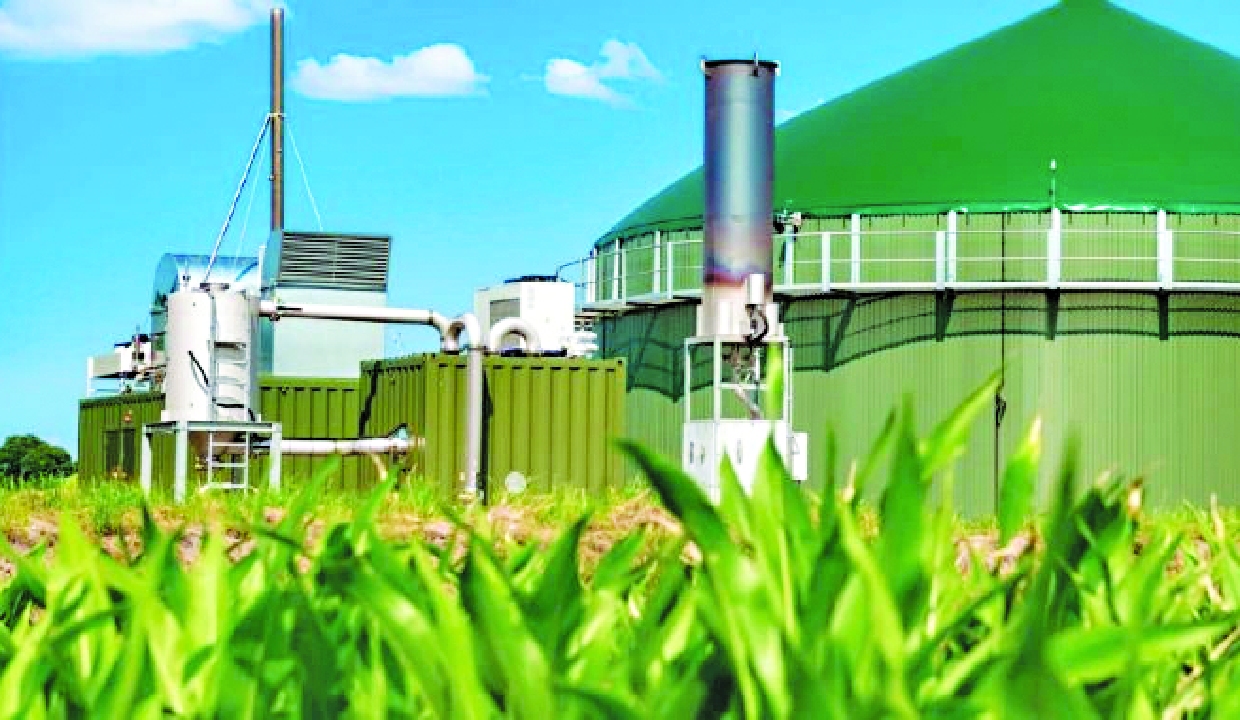
As T.S Eliot famously quoted, "Home is where one starts", and so in this case, the search must begin closer to home as well. India has, largely untapped, one of the largest natural biogas reserves in the world. Agricultural residues from paddy, wheat, and sugarcane up to 500 million tonnes annually; cattle dung from 300 million bovines, municipal solid waste from a rapidly urbanising population of 1.4 billion and tonnes of food processing waste from one of the world's largest agro-economies, a huge scale of waste, but when fed into anaerobic digesters, they produce biogas. This biogas, when purified and compressed, becomes Compressed Biogas (CBG), chemically identical to CNG, compatible with existing gas pipelines, buses, industrial boilers, and domestic PNG connections.
India's technical potential for CBG production is estimated at up to 90 billion cubic metre equivalents annually. To put that in perspective: India's total LNG import dependence of 27-29 million tonnes per annum could be substantially offset if even a fraction of this potential were realised. CBG carries zero geopolitical risk, as its feedstock grows in Indian fields, not in the Gulf. Yet as of late 2025, India had barely 130 operational CBG plants, against a SATAT programme target of 5,000. Despite the resource availability, policy execution is a problem, and now the Hormuz crisis has made the cost of that underperformance visible in hard-dollar terms.
What makes CBG scale-up so compelling is that it is a convergence of several of India's most pressing developmental needs. Firstly, every tonne of CBG that displaces imported LNG or LPG is a dollar that stays inside India's reserves. At current import prices and crisis-level crude, that is a significant macro relief. A CBG sector at even 30% of its potential could take measurable pressure off the current account deficit.
Second, is the farmer's dividend. CBG's primary feedstocks, such as paddy straw, cattle dung, and press mud from sugar mills, are either wasted or actively destructive today. Stubble burning across Punjab and Haryana each October chokes Delhi with smog. Converting that residue into CBG feedstock creates a new income stream for farmers, a new industrial anchor for rural districts, and an end to one of India's most politically intractable environmental crises in a single stroke.
Third, the slurry produced as a byproduct of CBG digestion is a rich, slow-release bio-fertiliser, a direct substitute for imported urea. The Hormuz crisis has already pushed global urea prices up by 50% since the Gulf states account for nearly a third of world production. A mature CBG sector would produce fermented organic manure at scale, closing a loop that currently runs from Indian agriculture to Gulf fertiliser plants and back again at enormous dollar cost, ensuring food security.
While there is a policy in place, the gap between the policy and the plant needs to be urgently bridged. Amidst the blending mandate and actually getting the molecule to the pipeline, India has already lost a decade, and of course, a lot of dollars. What India needs now is to set out existing programmes to work at the pace the crisis demands. This means mapping the available feedstocks to categorise which ones are suitable for CBG production; investing in making feedstock aggregation, supply chain and storage; clear instructions on mandates, clearances, subsidies, implementation mechanisms, which are lacking currently due to multiple ministries; and lastly treating CBG not just as a peripheral green initiative but as a core supply-chain imperative. It also means state governments, enacting their own CBG policies with real Viability Gap Funding. And it means the blending mandate is being enforced with the same rigour as the ethanol blending targets have been pursued.
With no major Assembly elections due until early 2027, the Centre has a rare five-to-six-month runway to take decisions that are economically necessary but short-term painful. Fuel price adjustments, investment in supply-side infrastructure, and acceleration of CBG commissioning are easier when the electoral calendar provides breathing room.
The Hormuz crisis, for all its enormous costs, has done one useful thing: it has made the price of India's energy dependency impossible to ignore. The PM has acknowledged the problem publicly, in the plainest possible language. The next step must move from restraint, asking citizens to do less, to acceleration, asking the state to build faster. Every methane molecule that rises from India's fields and reaches the atmosphere is a failure of both policy and imagination. Every one that reaches a gas pipeline is a dollar saved, a farmer paid, and a degree of sovereignty reclaimed, in true sense Urja Atmanirbharta (energy self-reliance) attained!
Dr Akanksha Jain is a research consultant at the Centre for Climate Change and Energy Transition (CCET) at Chintan Research Foundation (CRF); Views presented are personal.