The bill the planet has been paying for you
Every summer, India gets hotter. This has been true for long enough that it has begun to feel like a law of nature rather than a consequence of anything, the way monsoons come and droughts deepen and hill stations fill with the annual migration of those who can afford to leave. We speak of the heat the way we speak of traffic: as an ambient condition, unfortunate but accepted, something to be endured rather than examined. What we have not seriously asked is where the heat is coming from, and whether the answer implicates us more directly than we are willing to admit.
This April, nearly every city on the list of the world's hundred hottest was Indian. On certain days the figure was the entire hundred. Varanasi is burning at forty-four degrees. Prayagraj, which we call a seat of the divine, is a furnace. Simultaneously, the Char Dham yatra has begun, and hundreds of thousands of vehicles are winding up the roads toward Gangotri and Kedarnath, carrying pilgrims and tourists and the merely restless, each one of them eating, discarding, emitting, turning the Himalayas into an extension of the plains they left behind. We call these cities devbhoomi, sacred ground. What we do not ask is what it means that the sacred ground is on fire, and who precisely lit the match.
The standard account of why the planet is heating runs through science, and the science is correct as far as it goes: excess carbon dioxide and its equivalent greenhouse gases accumulate in the atmosphere, trap excess heat that would otherwise radiate back into space, and the concentrated warmth produces the now-familiar cascade of consequences, floods, droughts, glacier retreat, marine acidification, and a brutally simple arithmetic in which every fraction of a degree makes the next fraction easier to reach. That account is accurate. It is also, by itself, almost entirely useless, because it tells us what is happening without telling us why the human species keeps doing it when the consequences are this legible. The science ends at the atmosphere. What produced the atmosphere's problem is older and less visible: a consistent human refusal to count the full cost of wanting things. That refusal has a structure, and the structure is economic before it is psychological, though it is both.
The Fraud in the Price Tag
The answer most consistently avoided is this: everything is priced incorrectly, and has been for as long as industrial civilisation has existed.
Consider what a litre of petrol actually is. It is the compressed residue of organic matter that took a hundred million years to form under specific geological conditions that cannot be replicated, accelerated, or substituted. That process happened once, over timescales the human imagination cannot sincerely hold. We extracted the majority of the accessible reserves in under two hundred years, with the bulk of the extraction occurring in the last fifty. And then we priced it. We said it costs a hundred rupees per litre, or six dollars a gallon, or whatever the market settled on after accounting for extraction cost, refining, distribution, and a modest tax. What the price did not include, and has never included, is the cost of making the thing in the first place, because the planet made it for free, across geological time, and sent no invoice. So we collected the resource at the extraction cost and called the difference profit, called the consumption affordable, called the scale of it development. This is not economics; it is a sophisticated form of theft with the ledger arranged so that the victim cannot file a claim.
The same structure operates at every scale. Consider a company that runs its operations at the edge of a forest, clearing what it needs, drawing from the watershed as though the watershed were an asset on its own balance sheet, and dumping what it produces into the air and soil. At the end of the year, it records a profit. The profit is real in the accounting; what is missing is the corresponding entry, the column that would record the damage done to produce it. A company that earns a thousand rupees in profit while inflicting a hundred thousand rupees of ecological damage has not earned a thousand rupees; it has lost ninety-nine thousand, with the loss arranged to fall on an entity that sends no invoice and attends no board meeting. Every corporate earnings report conceals this entry. Every GDP growth figure relies upon concealing it. Recent research on the world's publicly listed companies in 2021 alone places their unpriced environmental cost at roughly $3.71 trillion, equivalent to more than four percent of global GDP, none of which appears on any balance sheet because the column for it has never been drawn.
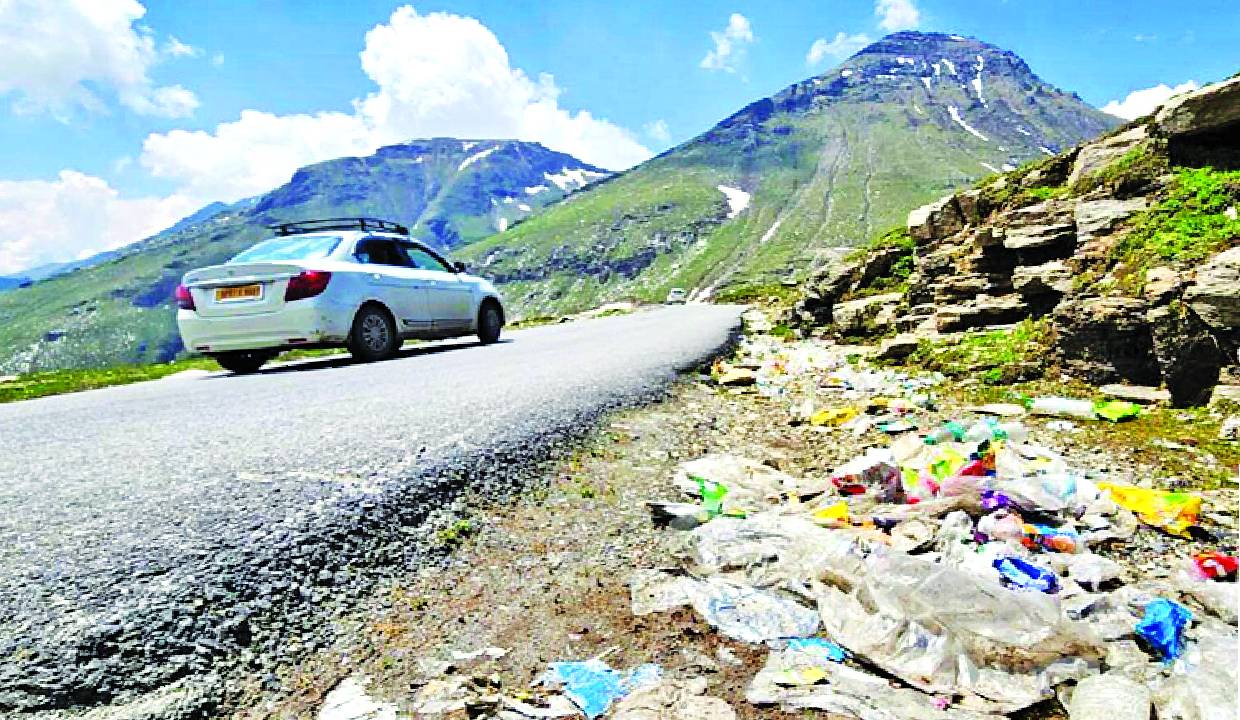
The forty or fifty-rupee Maggi that we get on the mountains is the same structure at domestic scale. The plastic in that packet will remain in the mountain ecosystem for centuries. The ecological damage of a single packet, fully priced across its lifecycle, runs to thousands of rupees. But the damage lands in the mountain's account, not the consumer's. The consumer pays fifty rupees and walks away feeling that the transaction is complete. It is not complete, and will never be complete, because the mountain cannot present a bill, and the market has been organised specifically to ensure that no one presents one on its behalf.
The food on our plates runs on the same principle. Recent estimates from the United Nations and the Rockefeller Foundation place the true environmental cost of the global food system at roughly $29 trillion annually, against a market price of around $9 trillion. The food is sold at one-third of what it costs the planet to produce. Energy is subsidised. Fertiliser is subsidised. Animal-flesh products are particularly heavily subsidised, in nearly every country that produces them. None of these subsidies is being paid by some other set of human beings to whom the burden has been transferred. They are being paid by forests, aquifers, soil, and atmospheric stability, none of which can withhold supply or raise rates, and all of which are being drawn down at a velocity that the accounting system was designed not to record.
This is why consumption is high: not because human beings are uniquely depraved, not because this generation is more careless than previous ones, but because the price signal systematically lies. When the real cost of an activity is hidden from the person undertaking it, that person will undertake more of it than they would if they saw the full figure. This is not a moral observation; it is basic economic logic, applied to an entity, the natural world, that has been deliberately kept off the books.
The Colonial Accounting
There is a useful analogy here, drawn not from theory but from a history this country knows well.
Britain occupied India for close to two centuries and extracted what economists now estimate at forty-five trillion dollars in resources and labour, at current exchange rates, through trade arrangements that were structured as commerce and functioned as organised looting. Indigo, cotton, jute, spices, timber, the enormous surplus of Bengal's weavers and Bihar's farmers and the plains of Punjab: all of it moved outward, while a narrative of civilisational improvement moved inward. The British citizen of 1900s was among the wealthiest people on earth. He paid low prices for imported goods, wore inexpensive cotton, drank cheap tea, and understood his prosperity as the reward of industry and national character. What he did not include in his accounting was the cost to the entity from which his prosperity was drawn. India's ruination did not appear in his balance sheet. Britain and India were, in his moral arithmetic, two separate entities, and the damage to one was simply not a charge against the other.
The arrangement did not end with Independence; it merely changed coordinates. Walk into any Apple store in Manhattan or Munich and pick up a device that retails for a thousand dollars. The components were assembled in Shenzhen and Chennai, the rare earths were dug out of Congolese soil by labour that bears no resemblance to anything called employment, the assembly hours were logged in dormitories where the workers earn in a year what the consumer earns in a fortnight, and the device's environmental footprint was assigned to whichever territory had the weakest enforcement. If the labour at every stage had been priced at the rate the citizens of Manhattan or Munich would demand for themselves, the device would not cost a thousand dollars; it would cost two and a half thousand, and the household that currently owns three of its cousins would own one. The cheapness is not the result of efficient logistics or design genius. It is the result of arrangements that keep the producing geographies poor enough to keep the consuming geographies stocked. The colonial structure has been redrawn on a different map; the consumer at its terminal end is still under the impression that he has earned what he holds.
The logic of the arrangement, then and now, is identical to the logic governing humanity's relationship with the natural world. Economists who have attempted to account for the last two hundred years of industrial progress have reached a deeply uncomfortable conclusion: roughly one-third of what we call progress can be attributed to human ingenuity, genuine innovation, the organisation of labour, and the real accumulation of knowledge. The remaining two-thirds is the product of two things: the exploitation of colonised peoples and territories, and the extraction of natural capital that belonged to no one in particular and was therefore charged to no one at all. We counted both as income, and neither was income. One was looting, and the other was selling the inheritance.
Natural capital, the aggregate of forests, rivers, fisheries, aquifers, topsoil, and the atmospheric stability that makes agriculture possible, has been drawn down at a rate the WWF's Living Planet Index captures in one figure: a 73 percent average decline in monitored wildlife populations since 1970, wildlife being among the most reliable proxies for the health of the systems that sustain all life. The GDP figures for those same five decades show consistent growth. Both statistics are accurate, and their combination reveals the deception: we consumed the capital and recorded the consumption as revenue. Any accountant shown this methodology would call it fraud. We call it the global economy. Selling the family silver, in any other context, is what one calls a household that has run out of every other option; we are doing it as a species while celebrating the receipts.
The Same Hand That Refuses to Strike Its Own
There is a feature of the colonial story that is worth pausing on, because it shows the precise mechanism by which the accounting becomes possible.
The British supervisor at a Calcutta jute factory could whip a Bengali worker into longer hours and call it productivity. He could not, and would not, whip a fellow Briton, because such an act would register, in his moral apparatus, as violence against a person. The Bengali was not, in the same sense, a person to him. The British administrator could ship opium into Chinese ports for two generations, knowing precisely what addiction does to families, and continue the trade as commerce. He would not have done the same thing to the children of his own household. The British corporation could clear forests in territories it had decided were available for clearing. It could not have proposed to clear the woodland behind its director's country house. The same human being, capable of restraint and decency in one direction, was capable of unbroken cruelty in another, and the boundary between the two was the boundary between what he counted as himself and what he counted as not himself.
This is the engine. This is what made the accounting feel honest to him. The damage was real, was visible, was even reported in his own newspapers, and yet did not register as damage to him, because the entity sustaining the damage had been categorised, in some pre-rational layer of his self-understanding, as outside the territory in which his moral arithmetic operated. The cruelty was not invisible. The cruelty's relevance to him was invisible, and that is a different and more durable form of concealment.
The ordinary consumer of today operates by precisely the same mechanism, with the boundary redrawn one position outward. He would not burn down a tree in his own front yard to heat his living room; he is comfortable purchasing furniture made from a forest he has never seen and will not visit. He would not pour industrial effluent into the well from which his children drink; he is comfortable wearing fast fashion produced beside a river that has been declared dead. He would not, faced with the prospect, set fire to his own lungs; he watched, on a screen, the Amazon burn for weeks, and ordered another delivery the same evening. The pattern is not callousness, exactly. It is the same selective vision the Briton of 1900 brought to his ledger: the harm is acknowledged in principle and subtracted from the relevant column in practice, because the column in question has been drawn around a self that does not include the forest, the river, or the species being subtracted.
What we are seeing in the climate data is the bill arriving for an arrangement that has run on this selective vision for two hundred years. We are not getting richer. We are spending down a natural inheritance accumulated over geological time, entering the draw-down in the growth column, and refusing to note the corresponding reduction in assets. The net position is deteriorating, and the growth figure is a fiction. Selling one's mother's saris and calling the proceeds a salary is a known indicator of household ruin; we are doing it at planetary scale and printing the receipts as quarterly results.
There is one further consequence of this accounting failure that deserves to be named, because it is frequently mistaken for an argument against the crisis. When economists warn that unchecked climate change will inflict severe losses on global GDP, they present this as a reason to act. India alone is projected to lose roughly $150 billion in productivity annually to extreme heat, with potential GDP losses approaching nine percent by mid-century if no intervention is mounted. What such projections quietly assume is that GDP growth, the very metric being defended, is a thing worth defending. They are not examining the obvious: GDP growth, pursued as the central objective of modern economies, is the engine producing the crisis. To protect the metric that drove the destruction by pointing to the destruction's cost is not a solution; it is the justification for accelerating the thing that needs to stop.
The Deceptions Called Solutions
Once the pricing problem is visible, the inadequacy of every currently fashionable response becomes equally visible, because every response is designed to address the symptom rather than the structure.
Carbon credit markets, to take the most prominent example, are an accounting manoeuvre rather than an environmental intervention. The theory is that if a company offsets its emissions by funding a carbon sequestration project elsewhere, the net atmospheric impact is neutral. The practice is that the sequestration projects are routinely overvalued, the additionality of their carbon capture is routinely unverified, and the company's actual emissions continue unchanged. This is not a failure of implementation that better regulation would correct; it is what happens when an accounting trick is substituted for a behavioural change. The ledger looks cleaner; the atmosphere receives the same quantity of carbon it would have received in the absence of the scheme. We have proposed, in effect, to clean the planet using a machine that itself runs on the same fuel, and announced this as innovation.
The automobile industry offers a more revealing example, because its history is long enough to show the pattern clearly. Every significant improvement in fuel efficiency over the last century has been followed by an increase in total fuel consumption, not a decrease, because cheaper operation lowered the threshold for use, expanded the range of applications, and made the market for vehicles larger. A study of a hundred years of automotive efficiency improvements shows the same result each time: the per-vehicle emissions fell, the number of vehicles rose faster, and total emissions increased. The electric vehicle is positioned as the resolution of this problem, but it operates by the same logic. It reduces per-vehicle emissions by a meaningful margin, the improvement is real, and then it makes electric mobility morally comfortable and economically cheaper, which accelerates the aspiration to vehicle ownership in every market that has not yet reached saturation. India currently has roughly thirty-four cars per thousand people; the United States has more than 850. That gap is understood, by every party with an interest in understanding it, as a market opportunity. The EV makes the closure of that gap environmentally presentable. Whether it makes it environmentally sustainable depends entirely on a second variable that the EV cannot address: total fleet size, which is driven not by the efficiency of any battery but by the ego's demand to insulate itself, to arrive, to make its separateness legible to the world in steel and motion. Subsidise the EV, lower the cost per kilometre, and the household that had one car parks three. The efficiency gain is consumed by the appetite it was supposed to constrain.
This pattern, observed first in coal engines by the economist William Stanley Jevons in 1865, holds across every domain where a more efficient instrument has been offered to an unchanged ego. The ego does not self-limit through efficiency; efficiency was always the ego's instrument, never its corrective. Lower the cost of consumption and the ego will consume more, because the wanting was the engine, and the engine has not been touched.
The structural limit of pricing reform, much discussed in policy circles, is also worth naming directly. Pricing is set by governments, and democratic governments cannot price meaningfully against the wishes of their own electorates. A government that imposed the actual ecological cost of food, fuel, and air travel on its citizens would face the next election as a cautionary tale. This is not a flaw in any particular leader; it is a structural fact about systems in which the cost-bearer and the vote-caster are the same person. Eco-taxes, fair pricing, green labelling, all of these belong in the toolkit. None of them constitutes the answer, because the answer requires a kind of restraint that a vote-seeking government cannot install in a population that has not already chosen it.
There is a driver of emissions that the debate avoids even more consistently than any of these, because naming it plainly requires confronting something that no government, no religion, and no development economist will willingly address. Every human being, simply by existing, is a unit of emission, not by moral failing but by the plain physics of living: food must be grown, water must be lifted, energy must be generated, and space must be cleared. Conservative ecological estimates place the planet's sustainable carrying capacity, at current consumption norms, at three to four billion people. The more demanding estimates place it lower still, at two to two and a half billion. The current population is over eight billion, more than double the absorbable load by the generous estimate, and the projection points toward ten to eleven billion before any peak. No green technology operates on a denominator this large and produces a sustainable quotient.
The reason the population question is avoided is not that it is unanswerable; it is that the answer touches a culture that very few people are prepared to examine. Population growth runs on appetite, not on decision. Ask any couple why they had children and the honest answer, stripped of the standard pieties, will involve some combination of romance, social expectation, and the unexamined assumption that this is what life is for. The romance industry, the entire cultural apparatus of films, songs, weddings, and the mythology of finding the one, terminates almost without exception at the maternity ward. Romantic love, as the surrounding culture has defined it, is the antechamber to reproduction; the courtship is the drumroll, and the demographic outcome is the fall of the drumstick. None of this is examined because the examination would require asking what love actually is, a question this culture has been arranged to avoid. If parents had been required to see the full ecological bill of bringing a child into the present arrangement, including the food, water, energy, raw materials, land, and atmospheric burden the child would draw across a lifetime, demographic patterns would have looked different. The bill was not presented. The planet absorbed the cost. The maternity ward kept its lights on.
There is also, in current discourse, a fantasy worth dispatching briefly. The idea that the species can extract itself from the consequences of its arrangement on this planet by relocating to another one, Mars usually, or some moon further out, is presented as ambition and is in fact panic. You did not arrive here from elsewhere. You arose from this soil; your body is the local water and the local minerals reorganised into a temporary configuration, and the same configuration is what sustains your seeing, including the seeing that imagines an exit. There is no exit, because there is no separable you to exit. The fantasy is what the colonial Briton would have called a final solution dressed in the vocabulary of innovation: when the territory you have occupied is sufficiently exhausted, find a new one. The territory in this case is a planet, and the new territory does not exist, and the imagination that finds the proposal serious is the same imagination that found burning the Amazon a reasonable price for cheap beef.
Reduce the population to one person and the logic is identical. The person driving a heavy vehicle up a mountain road he does not love, to a ridge he will photograph and leave dirtier, is not a villain in the ordinary sense but something more uncomfortable: a person who has never been required to see the full account. He knows what he paid at the toll booth; he does not know what the mountain paid for his arrival. He knows what the Maggi cost; he does not know what the mountain will spend, over the next century, absorbing the packet. The gap between those two sets of figures is not an informational gap; it is a gap in the ego's willingness to count things that it has categorised as outside itself, as belonging to another ledger entirely.
This is not a historical personality flaw; it is the operating logic of the ego as such, the insistence on a boundary between self and other that makes exploitation feel consequence-free, because the consequence falls on something the ego has already categorised as not itself. His pleasure and the mountain's degradation occupy different columns in an accounting that he did not design and has never been asked to revise. Underneath the colonial accounting, underneath the corporate accounting, underneath the demographic accounting, runs the same philosophical error, older than industry and older than commerce: the conviction that the perceiver is fundamentally separate from the perceived, that the self is one thing and the world another, and that the suffering of the second is therefore not a charge against the welfare of the first. Every dualistic philosophy that has been authoritatively taught, in nearly every culture, has reinforced this conviction. It is not a small philosophical preference. It is the metaphysical permission slip on which every act of organised exploitation, from the jute factory to the petrol pump, has been signed.
Stealing From the People Who Will Inherit This
There is one further dimension of the theft that has so far been left out of the accounting, and it is the most uncomfortable one to name.
We have been speaking as though the cost of mispriced consumption is being borne by the planet, by other species, by the ecological systems we have decided we can draw on. All of this is true. But the planet is also a temporal entity, not only a spatial one, and the costs we are not paying in our lifetimes are landing in a column we do not look at: the column belonging to the children who will be alive when this arrangement reaches its terminus. Carbon thresholds that climate models projected for 2030 are now being reached in 2028. The systems are unwinding faster than the conservative projections allowed. The children currently in school in Delhi or Lucknow or Kanpur are not going to inherit a recovering system; they are going to inherit, on present trajectories, a system whose recovery their generation will have to negotiate, with resources we will have spent in their absence and on their behalf without consulting them.
We are not only living off the inheritance our ancestors left us in the form of forests and aquifers and atmospheric stability. We are living off the future our descendants would otherwise have inherited. We have eaten the past, and we are now eating the future. The household analogy, again, is exact: a man who has sold the silver his grandparents accumulated and is now selling, in advance, the labour his grandchildren have not yet performed, while complaining at the family table that times are difficult, is not a person his lineage will remember kindly. The curses that will land on this generation, when its children are old enough to understand what has been done in their names, will be deserved and will be specific, and the answer that this generation tried, that it brought green technology and signed accords and held conferences, will not be accepted, because the children will see, with the clarity all inheritors see, that the trying was a way of avoiding the stopping.
What Actually Has to Change
The mountains are on fire and India's cities are furnaces. The bill for two centuries of mispriced consumption is arriving in a form no government can tax and no court can adjudicate, on a schedule that runs ahead of every published forecast. The question that remains is a simple one, though not an easy one: whether the person who drove up to the hills, ate the Maggi, and tossed the packet into the ravine is willing, at any point, to reckon with the distance between what he paid and what it cost. Not as a matter of guilt, which is merely the ego examining itself and finding itself wanting, which changes nothing; but as a matter of honest seeing.
The traditions that have addressed this most clearly have not done so as poetry. When Buddha is said to have offered his own thigh in place of a lamb being taken to slaughter, the story is not a moral fable; it is a precise demonstration of what the dissolution of the boundary actually involves. If you and the lamb are not separate, then the loss of the lamb is your loss, and the negotiation is no longer between a butcher and his trade but between the butcher and a body that recognises itself in what is being cut. Saint Kabir and Bulleh Shah and the long line of poets who taught what they taught were not running a sentimental enterprise. They were pointing at the same recognition, in a different register: that the kind of love capable of restraining the human appetite is not the love that says I love the hills, they are good for boys and girls, that arranges weddings against scenic backdrops while the scenic backdrop dies, that takes the hills as the object of a brief romantic experience to be filmed and uploaded. That love is appetite wearing a costume. The love the saints pointed at is what remains when the costume comes off, and what remains, when it remains, has the property that it cannot exploit what it has recognised, in the way that you cannot bring yourself to loot what you have come to know is your own body.
The person who has seen, even once, that the forest and the river and the mountain are not outside himself but are the condition of his own existence, finds that the urge to consume them cheaply has nowhere to lodge, not because he has become virtuous, but because the structure that made the exploitation feel consequence-free has been briefly interrupted, and in that interruption, the actual cost of the fifty-rupee packet becomes visible. The carbon credit no longer satisfies him. The electric vehicle no longer satisfies him. The Mars exit no longer satisfies him. None of these were ever going to satisfy him, but until the boundary moved, he could not see why.
Everything else will remain a more sophisticated version of the same ledger, with the planet's losses buried in a column that the market has agreed not to open, the producing geographies kept poor enough to keep the consuming geographies stocked, the atmosphere absorbing the difference, and a generation of children growing up to inherit the reckoning their parents preferred not to have. The bill is arriving. It has the date and the address correct. The only remaining question is whether it is opened.
Acharya Prashant is a philosopher and author whose work centres on self-inquiry and its application to contemporary life
Leave a Comment
Comments (22)
Carbon Emission is dependent on us what I do to change, it is in our hand, what we see the nature, mountains are free but we are in bondage, to make disturb the eco- system, with our mind.
Nice article
Thank you Acharya Prashant ji 🙏
Nature has its own rule.
Acharya Prashant really help me to understand hard and hidden truth simply with facts.The article shows that the real environmental crisis is not just about climate, it’s about human consciousness. We ignore the true cost of our consumption, while the planet silently pays for it. What drives this is the ego, a false identity that sees itself as separate from nature. In trying to fill this inner emptiness, we keep exploiting the Earth. Real change will not come from systems alone, but from self-awareness. When we look within and act with compassion, responsible living becomes natural and only then can we truly protect the planet.