AAP’s shift: From common man roots to elite drift
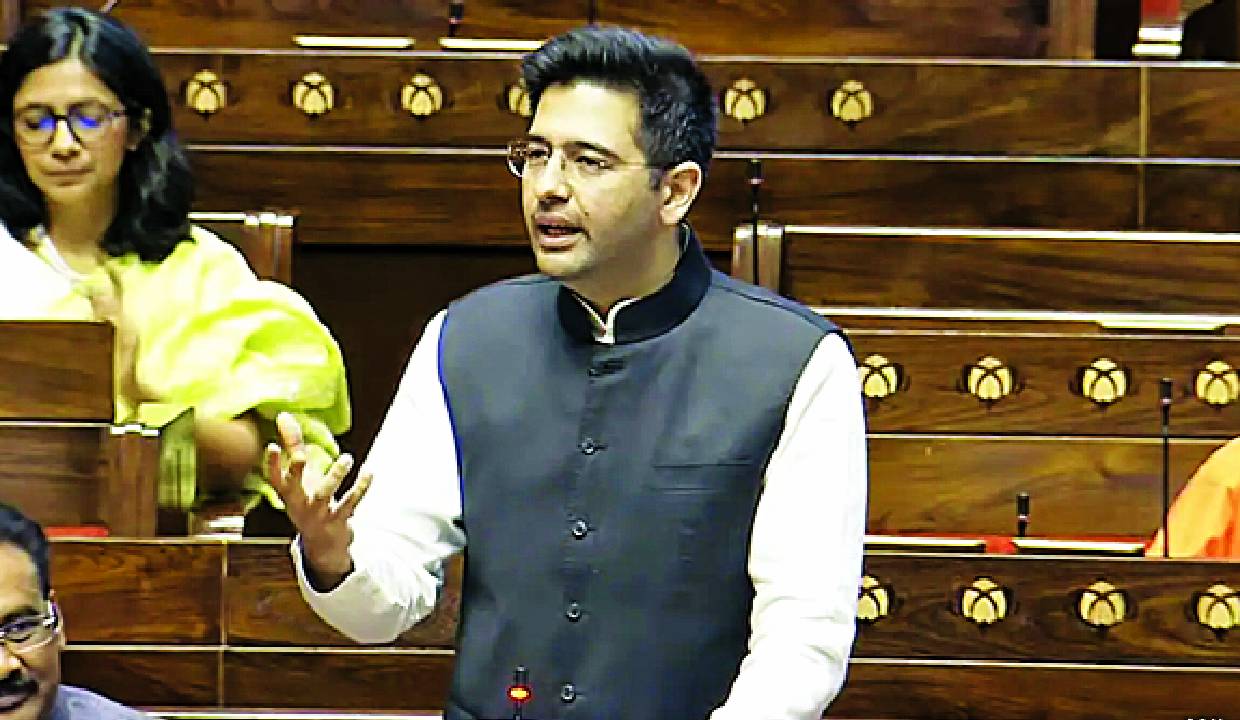
The recent exit of seven members from the Aam Aadmi Party (AAP) to align with the ruling dispensation has drawn sharp attention - not only nationally but within the party’s leadership. Yet, given their socio-economic profiles, the development may be less surprising than it appears.
A majority come from highly privileged or resource-rich backgrounds: Ashok Kumar Mittal, Rajendra Gupta, and Vikramjit Singh Sahney are linked with substantial wealth; Harbhajan Singh is associated with the financially powerful Board of Control for Cricket in India; and Raghav Chadha has strong connections across corporate and Bollywood circles.
The remaining figures - Swati Maliwal and Sandeep Pathak - have held significant internal influence within the party. Taken together, this group reflects a convergence of wealth, influence, and elite networks - raising a broader question about how such trajectories align with AAP’s original common citizen ethos. Seen through the lens of their privileged and rich backgrounds, these moves appear less unexpected; in this context, even figures like Sandeep Pathak seem drawn towards the orbit of such privileged networks and their pursuit of prosperity.
The Aam Aadmi Party (AAP) emerged as one of the most compelling political experiments in post-liberalisation India. Born out of the India Against Corruption movement, it promised to disrupt entrenched political hierarchies by placing the “common citizen” at the centre of governance.
Its appeal lay not merely in policy, but in identity - it sought to redefine politics as a space were ordinary individuals, rather than entrenched elites, could shape public life. This moral and political positioning distinguished it sharply from traditional parties and created a sense of credibility and hope among voters disillusioned with conventional power structures.
The early success of the Aam Aadmi Party rested on a simple idea: politics should not be driven by pedigree, wealth, or inherited influence. It aimed to create space for volunteers, grassroots activists, first-time entrants, and honest professionals - marking a clear break from parties shaped by dynasties and elite networks. This principle was also visible in the leadership’s conduct. AAP leaders maintained a simple, common appearance - blending into everyday public life. It reinforced their claim of sharing the realities and mindset of ordinary citizens.
The model drew wide support, including among Indians working across the globe, many of whom contributed intellectually, financially, and emotionally to this experiment. The result was unprecedented: a relatively young political formation, still in its infancy, secured remarkable electoral success in Delhi, challenging long-entrenched political structures. However, early compromises in candidate selection - often justified as electoral necessity — led to dissatisfaction and the first signs of internal strain, including the exit of some founding members who saw a dilution of core ideals.
In January 2018, the Aam Aadmi Party marked a clear shift in its Rajya Sabha selections: two of the three nominees, ND Gupta and Sushil Gupta, were from elite backgrounds - including one from a long-established national party - while only Sanjay Singh came from its grassroots leadership. This departure from its anti-elitist stance signalled a move towards privilege through a route often associated with influence and resources.
The decision triggered internal dissent, led to the exit or marginalisation of key founding members, and widened the gap between principle and practice. The shift did not remain isolated; it became a pattern. In April 2022, five selections from Punjab reinforced this trend: Harbhajan Singh, a well-known cricketer; two key party strategists, Raghav Chadha and Sandeep Pathak; and two individuals, Ashok Mittal and Sanjeev Arora, from influential or financially strong backgrounds.
The July 2022 additions continued similarly; Vikramjit Sahney is a well-known elite, while Balbir Singh Seechewal is rooted in AAP ideology, though he declined to be associated with AAP. In January 2024 (Delhi), among the three nominees, the wealthy ND Gupta was re-nominated, and the highly privileged insider, Swati Maliwal, entered the Rajya Sabha. In October 2025, Sanjeev Arora’s replacement from Punjab again brought in a wealthy candidate, Rajendra Gupta.
Across these cycles, selections consistently favoured individuals with visibility, influence, or economic capital over grassroots workers - indicating a sustained shift in which the Rajya Sabha became a channel for privileged profiles, reinforcing the party’s ideological drift.
The warning signs were clear, yet largely overlooked. In India, cricket and Bollywood are closely tied to affluent networks, and the trajectory of Raghav Chadha - already among the more privileged faces in the Aam Aadmi Party - became emblematic. His marriage into a well-connected Bollywood circle reinforced perception of deepening elite linkages, raising doubts about alignment with the “common citizen” ethos, especially within the elite setting of the Rajya Sabha. Observers noted his gradual distancing from grounded engagement.
Interventions on everyday issues, though symbolically relevant, were seen as limited in substance compared to the lived realities of ordinary citizens. Despite such signals, the leadership response remained muted. Individually credible, these choices collectively point to a sustained reliance on privileged individuals over grassroots representation - suggesting that repeated wake-up calls went unaddressed, widening the gap between ideals and practice.
The pattern of “privileged exits” is not just about individuals - it stems from leadership choices. When people from elite backgrounds are brought in and later leave, it reveals a deeper internal mismatch: a repeated preference for influential or wealthy individuals (especially through the Rajya Sabha), centralised decision-making that limits grassroots voices, and a growing gap between the party’s “common citizen” claim and its actual choices.
The result is a clear mismatch - an anti-elite beginning but increasing acceptance of elite influence. The issue is not the inclusion of privileged individuals, but the lack of balance. What appears as defections is, in fact, the outcome of decisions that have gradually changed the party’s character - raising the question: is this evolution or drift?
Despite multiple crises in the past, the Aam Aadmi Party has shown resilience - offering a clear opportunity for course correction. The priority now is honest internal introspection, not external blame, to realign recent choices with its founding ideals.
A key step is rebuilding a broad base of committed, grounded individuals - bringing back those who left due to organisational differences rather than ideology. Equally crucial is decentralising decision-making to reduce overdependence on a few individuals and to strengthen internal democracy and collective deliberation. If pursued sincerely, this can renew AAP’s original promise of alternative, citizen-centric governance - strengthening institutions to function fearlessly, independently, transparently, and with accountability.