Forest fires in India: A growing ecological and governance challenge
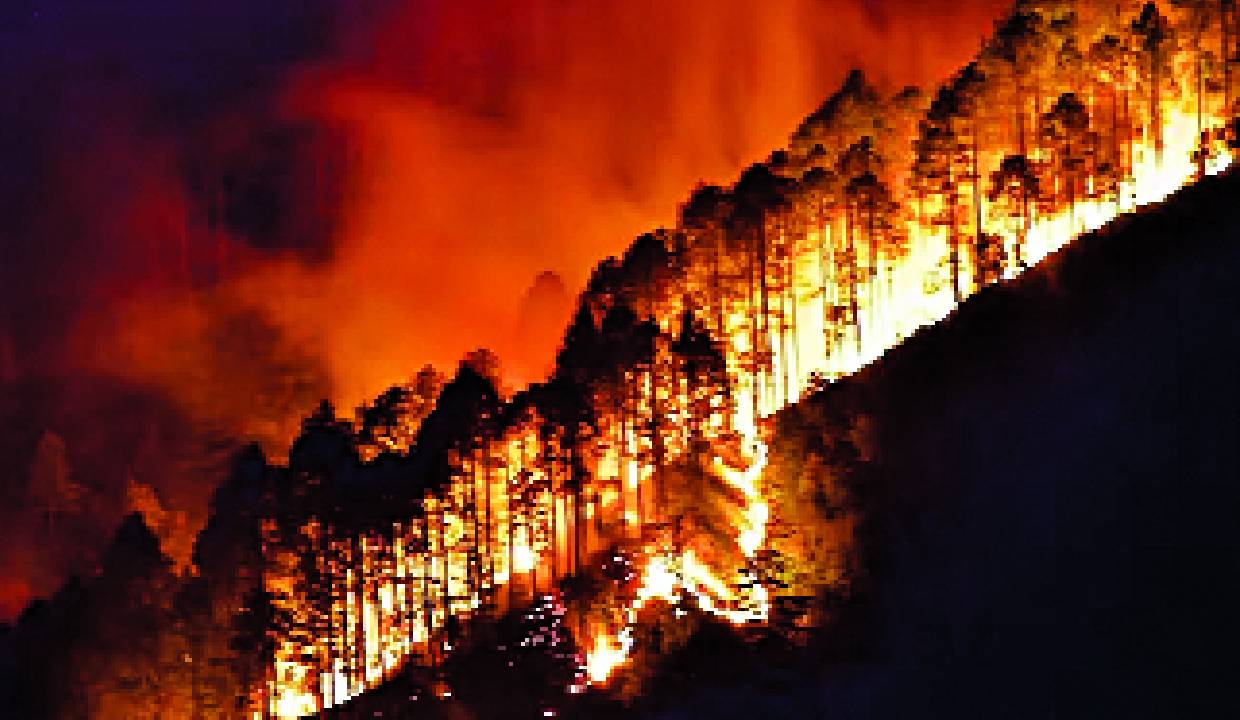
Every year, thousands of wildfires erupt across the globe, consuming vast stretches and degrading ecosystems while releasing significant quantities of carbon into the atmosphere. In India, they pose a recurring and systemic challenge — one that leads to habitat fragmentation, loss of the genetic pool, including that of most domesticated plants and animals, and disruption of rural livelihoods. They undo conservation gains while undermining ecological stability across regions.
The economic implications of forest fires are equally severe. A 2025 study estimates that annual losses - including timber, non-timber forest products, and carbon sequestration — amount to nearly `1.74 lakh crore. Satellite-based monitoring by the Forest Survey of India (FSI), using MODIS and SNPP-VIIRS systems, reveals that almost 36 per cent of the country’s 8.27 lakh sq. km total forest cover is ‘prone to frequent forest fires.
Data shows that between 2023 and 2025, the fire-affected area has increased by 16 per cent, while complementary data from the World Resources Institute and Global Forest Watch suggest that 44 per cent of India’s tree cover loss between 2023 and 2024 was attributable to forest
fires alone.
Forest fires, being of a predominantly ground-sweeping nature, except in some hill states like Uttarakhand, are generally considered low-impact events. Handled primarily by the Forest Department, forest fire is notified by the National Disaster Management Authority (NDMA) as a ‘disaster’. The enormity and consequences of forest fires, however, indicate that they are different from sudden-onset disasters like earthquakes and floods.
They are, in fact, ‘foundational disasters’ that can potentially act as a primary trigger for the devastation of the nation’s natural capital and agricultural production, earthquakes due to hydro-seismicity caused by disrupted seasonal replenishment of the water table over successive years in the forest’s ‘benefitshed’ areas, devastating flash floods and debris flows due to loss of forest cover and impermeability/soil hydrophobicity of the forest floor, increased human-wildlife conflict, etc.
A relentless series of successive disasters with ecological and socio-economic collapse may thus unfold over time as a result of forest fires. Studies show that over ninety per cent of forest fires are anthropogenic and driven by traditional forest-based livelihoods, agricultural cycles, and commercial activities that follow seasonal ecological transitions.
Thus, as months pass, successive forest fires from December onwards are caused due to the setting of fires for promoting grass growth for grazing, burning of the forest floor under mahua trees to facilitate flower collection, setting of fires to promote a fresh flush of tendu leaves, jhum cultivation, etc.
There are also instances of forest fires due to the accidental jumping of sparks during preventive fire-line burning operations, deliberate setting of fires for generating employment in fire-fighting work, kindling of forests to take revenge on foresters, burning of bridle-path strips, setting fires for hunting smaller wild animals and keeping larger ones at bay, etc.
The overall threat recedes with the monsoon before re-emerging in November, with agricultural stubble burning near forest fringes initiating the annual cycle of vulnerability. FSI’s Alert-to-Detection (A/D) ratio analysis indicates distinct ‘reason-specific signatures’ of forest fires. It reveals that, transitioning from the capturing of small, scattered fires, the ‘Large Forest Fire’ (LFF) algorithm switches from point alerts to event tracking in March-April, keeping pace with the massive, systematic ‘broadcast burning’ for triggering the dormant buds of the tendu plant to produce better-quality leaves.
The peak of India’s fire season is thus dictated by commercial interests.Despite the criticality and growing scale of the crisis, funding patterns indicate that the Centre’s allocation for the Forest Fire Prevention and Management (FFPM) scheme has remained modest `40 crore, `35 crore, and `37.5 crore over the past three years.
In contrast, the NDMA oversees a `5,000 crore scheme launched in July 2023 for the “Expansion and Modernisation of Fire Services”, primarily designed for urban fire response. Some states are using portions of these funds to procure wildland-urban interface equipment to prevent forest fires from spreading into human settlements.
In early 2025, an additional `818.92 crore (including a central share of `690.63 crore) was allocated for forest fire mitigation across 144 high-priority districts in 19 states. Experts note that much of it remains focused on post-disaster response rather than long-term prevention strategies. Legal and institutional challenges make fire prevention and control on the ground difficult. Apprehending offenders in forest areas remains difficult, as forest guards often patrol alone and may not find witnesses to establish intent.
Historically, the provisions of the Indian Forest Act, 1927 provided a strong legal deterrent against offences, including trespass and kindling a fire in a manner that endangers a forest. Trespass, being the first step before the commission of any other offence in the forest, and the fear of it being prosecutable, precluded the occurrence of many offences, including arson.
The Jan Vishwas Act, 2023, aimed at decriminalising ‘minor offences’ to improve ease of living and doing business, has diluted penalties related to trespass and forest fires. With trespass becoming compoundable with a penalty of up to `500, the fear of imprisonment that served as a strong psychological and legal deterrent is gone.
Similarly, leaving the country’s ecologically “priceless” resource burning in a protected forest now attracts a penalty of up to `500. Experts warn that such minimal penalties are negligible “transaction costs” for offenders, particularly in activities like tendu leaf collection and trade.
Concerns have also been raised about the widespread grant of Community Forest Resource Rights under the Forest Rights Act, 2006 in ineligible cases, which has created erroneous perceptions regarding jurisdictional matters, ultimately leading to a visible decline in accountability for forest protection.
Unfortunately, illegal grants continue to be facilitated by the creation of geospatial proxies through an improperly designed ‘potential CFRR area Atlas’ being prepared in various states. In this context, Gadchiroli district’s reality of consistently recording the highest fire alerts, often overshadowed by the “success story” narrative, should be an eye-opener.
At the national level, the FSI continues to provide critical baseline data on forest fires. However, experts argue that its methodologies require substantial upgrades. Improvements in satellite resolution, clearer definitions of fire events, and a shift beyond the current “tree cover” proxy are needed to accurately capture ground-level ecological damage.
Integrating fire detection systems with real-time ground assessments could significantly improve the effectiveness of enforcement. Any strategy for preventing forest fires must consider the complexity of the reasons behind them, the problems of the chronically depleted frontline workforce in the forestry sector, and the deepening paradox within India’s statutory landscape.
As forest fires grow in frequency and intensity, India must move beyond reactive firefighting to a more preventive approach. This includes strengthening early warning systems and expanding public awareness. Given their role as ‘gateway crimes’ to encroachment and degradation, the decriminalisation of trespass and forest fires must be reconsidered.
With commercial interests often involved, stricter legal provisions, penalties linked to biodiversity loss, and incentives for fire-free practices such as tendu management are essential. Further, auditing all CFRRs granted under the FRA to weed out illegal recognitions, empowering local institutions, strengthening frontline staff, and adopting AI-based predictive modelling for pre-positioning personnel in high-risk zones are necessary.
The restructuring of the financial landscape to prioritise prevention over reaction must be undertaken, and adequate budgets must be provided for forest fire management.
To prevent forest fires from triggering a cascade of disasters, India must adopt a comprehensive strategy grounded in rigorous prevention, ecological restoration, unyielding legal deterrence, and institutional coordination without further delay.
Without this, the nation risks accelerating environmental degradation, undermining the livelihoods of its forest-dependent communities, and the ecological decapitalisation of forest-dependent economies. The urgency is a categorical imperative, and the matter is simply non-negotiable.