Two nations, One vision: Delhi–Seoul axis
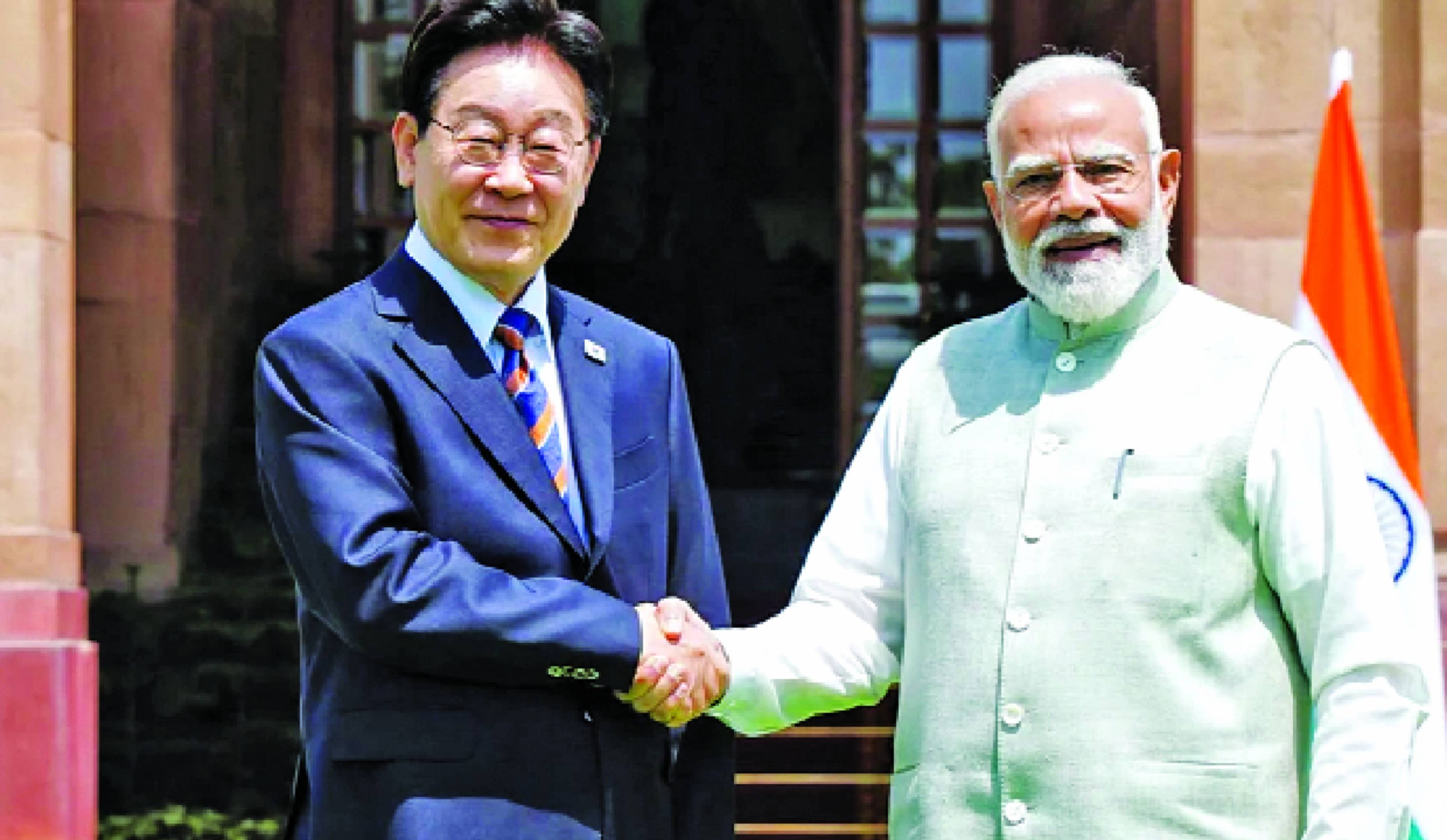
When South Korean President Lee Jae-myung landed in New Delhi on April 19, he carried the weight of eight lost years. The last state visit by a South Korean leader was President Moon Jae-in (2018). This gap spanned a pandemic, the Ukraine crisis, the Iran war, global supply chain disruptions, and emerging geopolitical shifts in Asia. This makes the summit not a routine renewal of ties but a deliberate act of ‘strategic recalibration’ between India and South Korea.
This visit did not come in any geopolitical vacuum. Its immediate diplomatic genealogy traces to the G7 Summit in Kananaskis, Canada (June 2025), where Prime Minister Narendra Modi and President Lee held their first bilateral meeting and agreed on cooperation in commerce, investment, technology, and shipbuilding.
They met again on the sidelines of the G20 Summit in Johannesburg (November 2025), where Modi personally extended the invitation. In addition, the sixth India-South Korea Foreign Policy and Security Dialogue (FPSD) held in Seoul (February 2026) provided a foundation for this visit, leading to an upgrade in bilateral relations.
Both India and South Korea are mid-sized, significant powers with large economies. India, now the world’s fifth largest, and South Korea, the twelfth, are navigating a disruptive global order marked by economic protectionism, trade weaponisation, and rising power assertiveness.
In the words of Prime Minister Modi, both share commitments to democratic values, the rule of law, and a stable Indo-Pacific outlook. The shift in the relationship is not sentimental but structural and contextual.
The composition of the South Korean delegation makes this visit distinct. President Lee arrived with over 200 individuals — ministers, senior officials, and business leaders representing key industrial sectors.
This does not appear to be a delegation assembled merely for protocol; rather, it reflects a market-entry force. When industry leaders in semiconductors, shipbuilding, and defence manufacturing accompany the President, the signal is clear: Seoul is here to build a long-term presence and strengthen bilateral relations.
The economic context explains the ‘why’. The Comprehensive Economic Partnership Agreement (CEPA), signed in 2010, has delivered growth but also accumulated trade imbalances. The two sides have now committed to upgrading CEPA, identifying asymmetries, expanding market access, and aligning it with evolving global supply chain realities.
Bilateral trade has grown from $14 billion in 2010 to $27 billion in 2025, with Indian imports at around $18.5 billion. India expects that CEPA 2.0 will address non-tariff barriers, boost services exports, and rebalance trade flows.
The two sides have signed 25 agreements focusing on enhancing steel exports from India, establishing a new Steel Dialogue, setting up Korean Industrial Townships, and joint production of anti-aircraft guns and missiles. Additional agreements include AI research, science and technology education, space exploration, digital payments, sports, and cultural exchanges.
An India-Korea Business Forum at Bharat Mandapam brought together industry leaders to translate summit commitments into tangible investments. The digital payment interoperability initiative could facilitate flows for small and medium enterprises, often the last beneficiaries of such agreements.
New platforms have been launched to streamline financial flows and boost industrial links, including the India-Korea Financial Forum (IKFF) and an Industrial Cooperation Committee. The aim is to achieve $50 billion in bilateral trade by 2030, with a focus on technology, resources, and long-term supply chain stability.
Cooperation in the semiconductor sector deserves special attention. India is advancing its Semiconductor Mission 2.0, backed by a `76,000 crore incentive programme. India is actively seeking South Korean support to achieve its semiconductor ambitions. The India-Korea Digital Bridge (IKDB) provides an institutional channel to integrate India’s manufacturing incentives with South Korea’s technological strengths. Under the ‘plus one’ strategy, India is positioning itself as a global base for assembling, testing, marking, and packaging semiconductors.
This is not a one-way arrangement. While India seeks technology and capital, it offers South Korea market diversification, reduced dependence on Chinese exports, and a skilled workforce. An India-Korea chip corridor could reduce global dependence on Taiwan-centric fabrication - a goal aligned with broader strategic interests.
In shipbuilding, South Korea remains a global leader in LNG carriers, container vessels, and offshore platforms. The Comprehensive Framework for Shipbuilding and Maritime Logistics outlines partnerships in greenfield clusters, upgrading Indian yards, and building a $25 billion pipeline for 400 vessels.
To address shortages of specialised maritime engineers, both sides have agreed to train 10,000 engineers through KOICA. For India, Korean capital and expertise align directly with its Viksit Bharat 2047 vision.
India provides land, labour, and a growing market, while South Korea brings technology, training standards, and global contracts. This partnership also carries strategic weight, especially as West Asian tensions disrupt shipping routes through the Strait of Hormuz.
The India-ROK Joint Strategic Vision document signals that both nations view this relationship in civilisational and strategic terms. Rabindranath Tagore’s “Lamp of the East” for Korea reminds us that this partnership has deep historical roots. The long-term agenda of this summit aims to transform this legacy into a powerful engine for industrial growth and strategic cooperation.
By converging their strengths, India and South Korea are forging a forward-looking partnership, turning diplomacy into tangible outcomes. In the illumination of the East, both nations stand together as trusted partners.