Defection by design: How the ‘merger’ clause is reshaping Parliament
A recent political development in the Rajya Sabha has once again exposed a constitutional paradox that has long remained under-examined. Seven Members of Parliament belonging to the Aam Aadmi Party-six representing Punjab and one representing Delhi-have shifted allegiance to the Bharatiya Janata Party. Numerically, this constitutes more than two-thirds of the party’s strength in the House, thereby attracting the “merger” exception under the Tenth Schedule of the Constitution of India. Constitutionally, the recognition of this shift by the Chairperson is unassailable. Normatively, however, it raises a deeper question: has the law, in preserving stability, diluted representation?
The anti-defection framework, introduced through the 52nd Constitutional Amendment in 1985, was designed to combat political opportunism and ensure party discipline. It sought to prevent elected representatives from betraying the mandate on which they were elected. Yet, it also carved out an exception: where not less than two-thirds of a legislature party agree to a merger, disqualification would not follow. This exception, found in Paragraph 4 of the Tenth Schedule, was conceived as a pragmatic safeguard, recognising that political realignments at the party level may sometimes be legitimate.
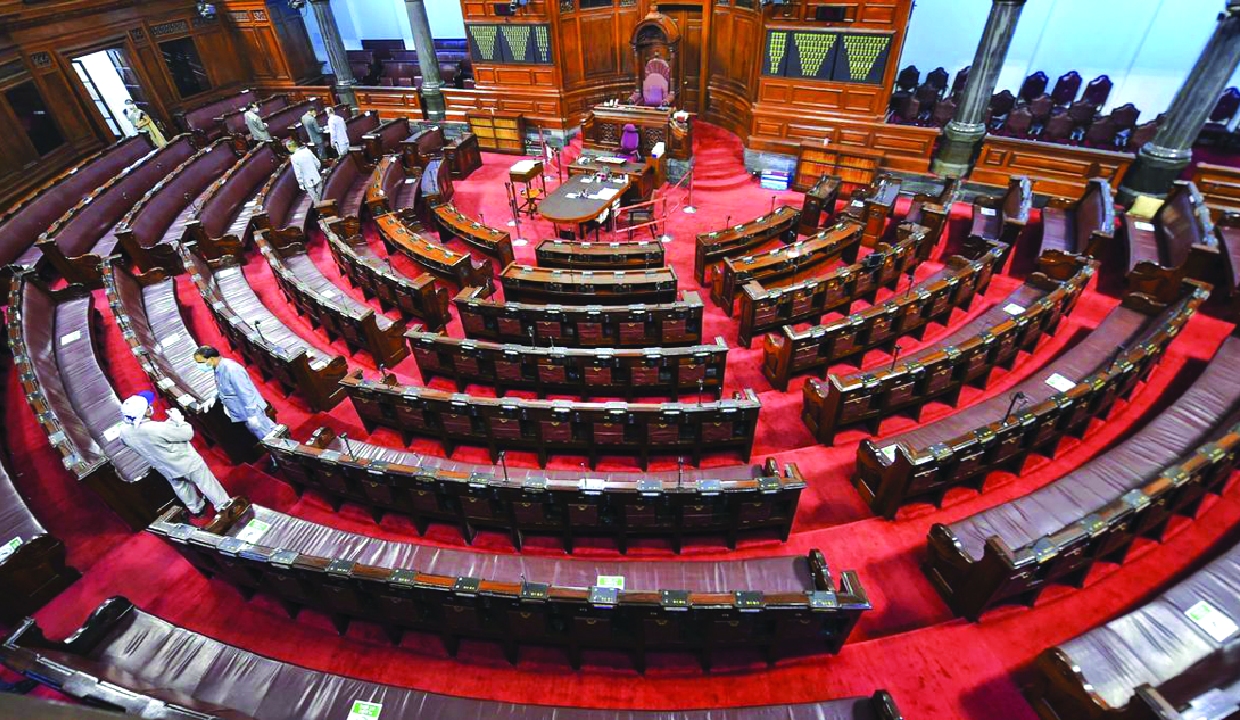
However, what appears doctrinally sound begins to fray when tested against the institutional role of the Rajya Sabha. Unlike the directly elected lower house, the Rajya Sabha is not merely a chamber of political contestation; it is a federal institution. It is designed as the Council of States, a forum where states, through their indirectly elected representatives, participate in national lawmaking. Members are elected by state legislative assemblies, embedding within them a fiduciary obligation to articulate state-specific concerns in the Union legislature.
This design reflects a carefully calibrated constitutional vision. India may be described as a “Union of States”, but its parliamentary architecture ensures that states are not rendered voiceless in national decision-making. The Rajya Sabha acts as a deliberative check on the Lok Sabha, scrutinising legislation and, in many cases, serving as the final gatekeeper. No ordinary legislation can become law without its assent; constitutional amendments require its concurrence by a special majority. In matters affecting the federal balance, the Constitution goes even further, mandating ratification by at least half of the states under Article 368 of the Constitution of India.
Against this backdrop, the recent shift assumes a different character. Punjab sends seven members to the Rajya Sabha. These members were elected by a state legislature led by the Aam Aadmi Party, reflecting a particular political mandate within the state. Their role, therefore, extended beyond partisan alignment; they were expected to serve as the voice of Punjab in national deliberations, especially where central legislation might affect state interests.
When six out of these seven members realign with the ruling party at the Centre, a structural tension emerges. Can representatives, elected through one political mandate within a state, effectively discharge their representative function after aligning with a different political formation, particularly one that governs at the Union level? More pointedly, can they meaningfully oppose or scrutinise the very executive they now politically support?
The anti-defection law offers a formal answer: yes. By treating such a shift as a “merger”, it immunises these members from disqualification. But this legal fiction-that a legislative supermajority necessarily reflects a genuine party merger-deserves closer scrutiny. In practice, what is being recognised is not always the merger of political parties at the organisational level, but rather the coordinated defection of legislators. The distinction is subtle but constitutionally significant.
The original intent behind the merger exception was to accommodate situations where an entire political party, as an organisational entity, decides to merge with another. The two-thirds threshold was introduced to address a practical concern: what if a faction of legislators resists such a decision? The Constitution sought to protect both collective political strategy and individual legislative autonomy. It did not intend to provide a route for large-scale defections that leave the original party structure intact but hollowed out within the legislature.
This is where the present episode becomes instructive. The constitutional mechanism has operated correctly; the outcome, however, appears to strain the spirit of the provision. What we witness is not merely a shift in party numbers, but a potential erosion of the federal voice that the Rajya Sabha is meant to embody.
The deeper concern, therefore, is institutional rather than partisan. If the composition of a state’s representation in the Rajya Sabha can be effectively transformed mid-term through the merger exception, the link between state mandate and parliamentary voice becomes attenuated. The Council of States risks becoming, in effect, a chamber of shifting political loyalties rather than stable federal representation.
This is not to argue for an absolutist anti-defection regime. Political mobility and realignment are intrinsic to a democratic system. But when constitutional provisions designed for stability begin to undermine representational integrity, a recalibration becomes necessary. One possible approach is to revisit the interpretation of “merger” to require demonstrable organisational integration between parties, rather than merely a numerical threshold within the legislature. Another is to reconsider whether members elected to represent states should be held to a higher standard of accountability in cases of political realignment.
Ultimately, the question is not whether the law has been followed-it has. The question is whether the law, as currently structured and interpreted, continues to serve the constitutional vision it was meant to uphold. In the quiet arithmetic of two-thirds, we may be witnessing the gradual dilution of something far more substantive: the voice of the states in India’s parliamentary democracy.
Abhinav K Shukla is Assistant Professor of Law at Hidayatullah National Law University, Raipur and Abhinav Narayan is an Advocate & Columnist; Views presented are personal.