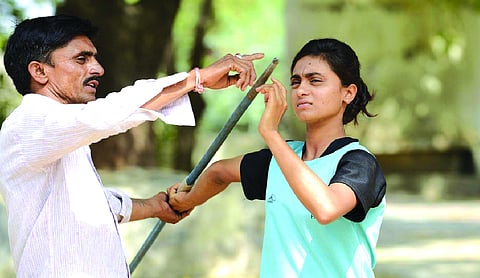

When I stood on the podium as Kettlebell World Champion, people asked which training facility I came from. What sports science team supported me. What recovery protocols I followed. The honest answer surprised them: I had a coach who believed in me, a family rooted in Army discipline, and a hunger that no lab could have designed.
Both my parents served in the Indian Armed Forces. Growing up in that environment, fitness wasn’t a lifestyle choice; it was a way of being. Pre-dawn drills weren’t motivation. They were just Tuesday. That story, in different textures, is the story of almost every elite Indian woman in sport. It is not primarily a story of systems. It is a story of soul. And right now, India stands at a rare crossroads where that soul is finally beginning to meet the system it has always deserved.
“The West built the pipeline first and the athletes followed. India has always had the athletes. It is finally, urgently, building the pipeline.”
The infrastructure gap between India and Western sporting nations is real, and it matters. Title IX, the landmark 1972 US legislation, banned gender discrimination in federally funded education - and its impact on women’s sport was seismic. Before it passed, fewer than 295,000 girls competed in high-school sport in America. By 2019, that number had risen to 3.4 million.
Today, 60 per cent of American high-school girls participate in organised sport. Women now make up 44 per cent of all NCAA athletes, compared to under 16 per cent before 1972. Norway, the Netherlands, and Australia have invested for decades in gender-neutral coaching pipelines, sports nutrition, and physiotherapy access, often from as young as twelve. The result isn’t just more women competing. It’s women competing longer, better, and with far fewer career-ending injuries that come from undertrained, under-supported early years. In India, that support structure has historically been the exception, not the rule. Talent has too often been discovered after it already proved itself, which means untold numbers of girls never got the chance to prove it at all.
But the data doesn’t capture everything. Mirabai Chanu grew up in Manipur carrying firewood for her family because they couldn’t afford the bus. She became an Olympic silver medallist and world record holder in weightlifting. Deepika Kumari practised archery on handmade bamboo bows in Jharkhand before becoming world number one.
These are not feel-good footnotes. They are evidence of something the scoreboard doesn’t show: the conditioning that comes from consequence.
When failure isn’t an option you philosophically reject but a reality you literally cannot afford, you develop a relationship with pressure that no training programme can manufacture. India’s women athletes have been learning that lesson for generations.
The Women’s Sports Foundation’s landmark 2024 Play to Lead study, spanning seven generations of women athletes, confirmed what coaches here have known intuitively: girls who play sport develop leadership skills, emotional resilience, and decisiveness under pressure that last a lifetime. Seventy-one per cent of women with formal leadership titles — manager, director, C-suite — had been youth sport participants.
The field is not just a playing surface. It is a classroom for life. “Where Western athletes learn resilience as a studied skill, Indian athletes carry it as lived experience and then as a competitive edge.”
For generations, the unspoken contract for ambitious Indian women was this: you may excel, but only in one direction. Career or family. Medals or motherhood. Public achievement or private fulfilment. Mary Kom simply refused to sign it, and did so in the most unambiguous terms. A six-time world boxing champion, an Olympic medallist, a daughter, a wife, and a mother of three. Not sequentially. Simultaneously. She is not an anomaly. She is a blueprint. The capacity to carry multiple heavy things at once, to train through exhaustion, to compete through doubt, to return to the ring after heartbreak, is not something a sports science lab teaches. It comes from life. And Indian women, by necessity and by character, have been training for it their entire lives.
Across India’s cities, a quiet revolution is underway. Women who work full-time, raise families, and also train, not because they have the luxury of doing so, but because sport has become non-negotiable to who they are. They train at 5 a.m. They compete on weekends. They mentor younger girls on evenings when most people are watching television. This hybrid model, where women fold sport into already full lives, is uniquely Indian in texture. Globally, elite sport tends to demand exclusivity: you either commit entirely or not at all. India’s women are showing a third way.
And increasingly, formal structures are arriving to support it. The government’s Khelo India initiative has opened national pathways for young athletes across genders and disciplines, with over 5,600 athletes competing across 36 states and union territories at the 2024 Youth Games alone. Corporate sponsorships are growing. Social media visibility has made stars of athletes from small towns who once trained entirely in anonymity. So is the gap between Indian and Western women athletes about genetics or biology? The science is clear: no. Athletic capacity does not follow national or ethnic lines. Kenyan and Ethiopian women dominate long-distance running. East Asian women lead in gymnastics and precision sports. India’s Mirabai Chanu holds world records.
The differences are structural, not biological: pipeline, funding, access, and time.
What changes when you take an athlete shaped by scarcity and give her access? The answer, playing out in real time across Indian sport, is that she becomes extraordinary. Not in spite of where she came from, but in some irreducible way, because of it. I have a coach. I have a support system. I am one of the luckier ones. But the foundation, the absolute refusal to quit, the understanding that discomfort is not a reason to stop, was built long before any of that arrived. It was built in cantonments, in pre-dawn runs, in a childhood that treated discipline not as punishment but as preparation. Multiply that story across the millions of girls in this country who are already running, lifting, throwing, and swimming, most of them with far less support than they deserve. India’s sporting era is here — women are leading the way.
The writer is a Kettlebell World Champion and advocate for women in sport; Views presented are personal.