Beyond Mandal: The new politics of social justice in UP
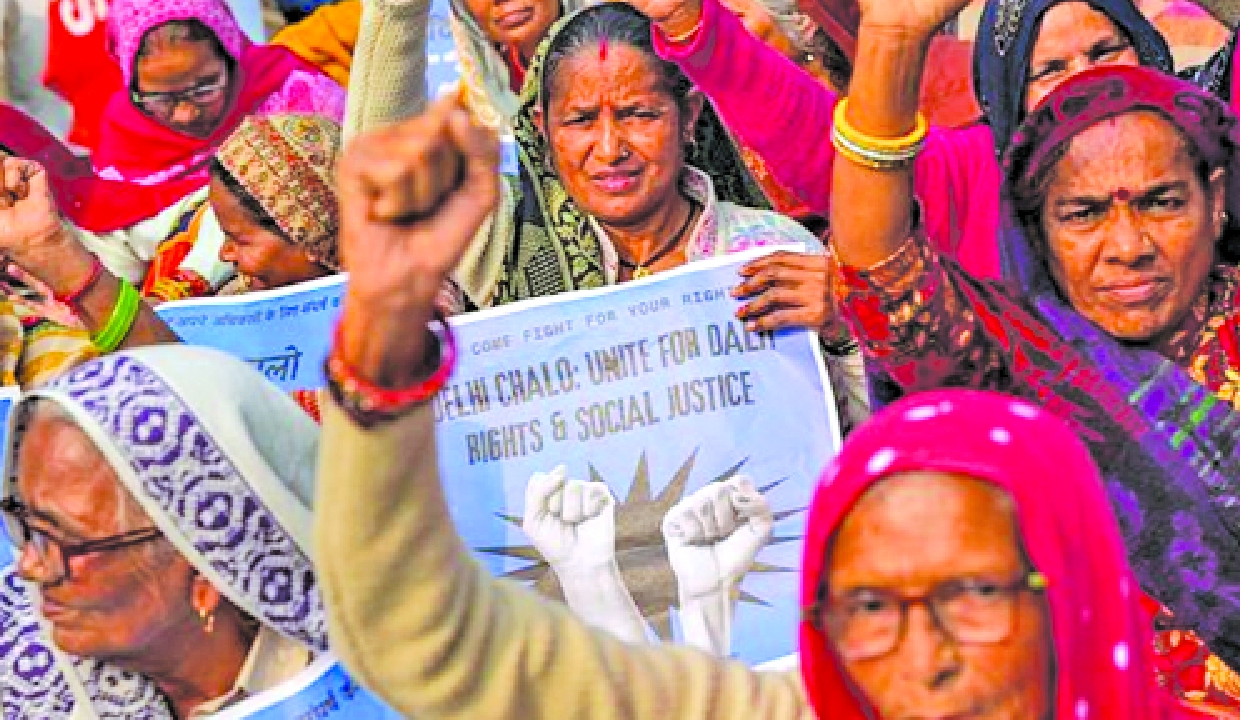
For decades, Uttar Pradesh's political theatre was held hostage by the binaries of Mandal politics. Parties like the Samajwadi Party (SP) and Bahujan Samaj Party (BSP) built their electoral empires on caste mobilisation. Yet, in practice, this translated into the empowerment of dominant sub-castes-Yadavs and Jatavs-while the vast majority of marginalised groups remained locked out of real economic mobility. When Yogi Adityanath assumed office in 2017, the conventional wisdom in Lucknow's drawing rooms was that the BJP was an upper-caste party incapable of breaching this Mandal fortress.
Nearly eight years later, that fortress lies in ruins. Yogi has not only breached it but has rewritten the very rules of social justice in India's most populous state, shifting the discourse from the politics of symbolic identity to the politics of measurable access.
The defining feature of Yogi's approach to marginalised communities is his rejection of tokenism in favour of ruthless, data-driven delivery. Consider educational welfare. Historically, scholarship distribution in UP was a byword for bureaucratic apathy and middlemen corruption; funds meant for Dalit and OBC students routinely vanished into the pockets of intermediaries. The Yogi government aggressively digitised this pipeline, leveraging Direct Benefit Transfer (DBT). The results are starkly visible in the ledger. The recent state budget allocated Rs 3,402 crore specifically for backward class welfare, with over Rs 3,060 crore earmarked for OBC scholarships alone.
By cutting out the broker, the state ensured that funds reached the intended beneficiaries. To date, over Rs 3,350 crore has been distributed directly into the bank accounts of nearly 28 lakh students-comprising 13.5 lakh OBCs and 6.7 lakh SC students. A Kurmi student in a remote village or a Pasi girl in a semi-urban town now receives her educational dues without greasing palms. This is social justice translated into actual bank balance.
Furthermore, the government's universal welfare schemes functioned as the most aggressive anti-poverty drive in UP's history. Schemes like the PM Awas Yojana, free ration distribution, Ayushman Bharat and the Jal Jeevan Mission were implemented at an unprecedented scale. Because SCs and OBCs constitute the overwhelming majority of the state's poorest demographic, they naturally emerged as the primary beneficiaries. Selection was officially based on economic deprivation rather than caste, yet the outcome was intrinsically social. A pucca house, a cooking gas cylinder, and a tap water connection did more for the material dignity of a marginalised family than decades of political rhetoric.
However, Yogi's most profound, yet understated, contribution lies in structural expansion. The administration did not tamper with constitutional reservation quotas-a bogey often raised by opposition parties to incite fear. Reservation percentages remained intact (SC: 21%, ST: 2%, OBC: 27%). Instead, Yogi expanded the pie. The unprecedented establishment of government medical colleges, engineering institutions, and universities across UP meant that a 21 per cent SC or 27 per cent OBC reservation was no longer confined to a stagnant pool of seats. By multiplying the number of government medical and technical seats, the administration ensured that the absolute numbers of SC and OBC students entering elite professions surged. This is real empowerment: not a guarantee on a piece of paper, but an actual seat in a classroom.
Politically, this structural empowerment was mirrored by a tectonic shift in representation. Yogi engineered a micro-caste strategy, recognizing the deep-seated resentment brewing among non-dominant OBCs and non-Jatav Dalits who felt sidelined by the SP and BSP's monolithic caste monopolies. Communities like the Nishads, Rajbhars, Mauryas, Kushwahas, and Lodhs were brought into the cabinet and given organisational heft. This was a structural dismantling of the "caste headman" model. By elevating leaders from these smaller, historically ignored communities, the BJP decentralized political power, making the backward-class umbrella genuinely representative rather than a facade for one or two dominant groups. Crucially, the much-debated law and order crackdown has had a deeply social justice-oriented impact. In rural UP, the marginalised were historically at the mercy of local strongmen-often from dominant castes-who usurped their land and throttled their access to justice. The state's aggressive dismantling of these criminal networks provided the poorest with the space to exercise their constitutional rights without fear. A Dalit entrepreneur filing a police complaint without facing coercion from a local mafia is a profound, underappreciated marker of social empowerment. Critics rightly point out that deep structural inequities-landlessness, caste atrocities, and educational disparities-persist. Welfare delivery, however efficient, is not a substitute for land reforms. Yet, to dismiss Yogi's achievements as mere electoral arithmetic is to miss the woods for the trees. Structural reforms take generations, but the foundation laid over the past eight years is undeniable.
By pivoting from identity to access-access to education, to housing, to safety, and to political representation-Yogi Adityanath has not just secured a vote bank; he has orchestrated a silent, tangible revolution for UP's marginalised. He has proven that the true metric of social justice is not the volume of caste rhetoric, but the quiet hum of a DBT notification on a poor student's mobile phone.
The writer is BJP State Executive Committee Member (Jharkhand), Founder, Om Aarohanam, Member, DISHA (Government of India), & Member, Environment Committee; Views presented are personal.