Quiet diplomacy, loud undercurrents
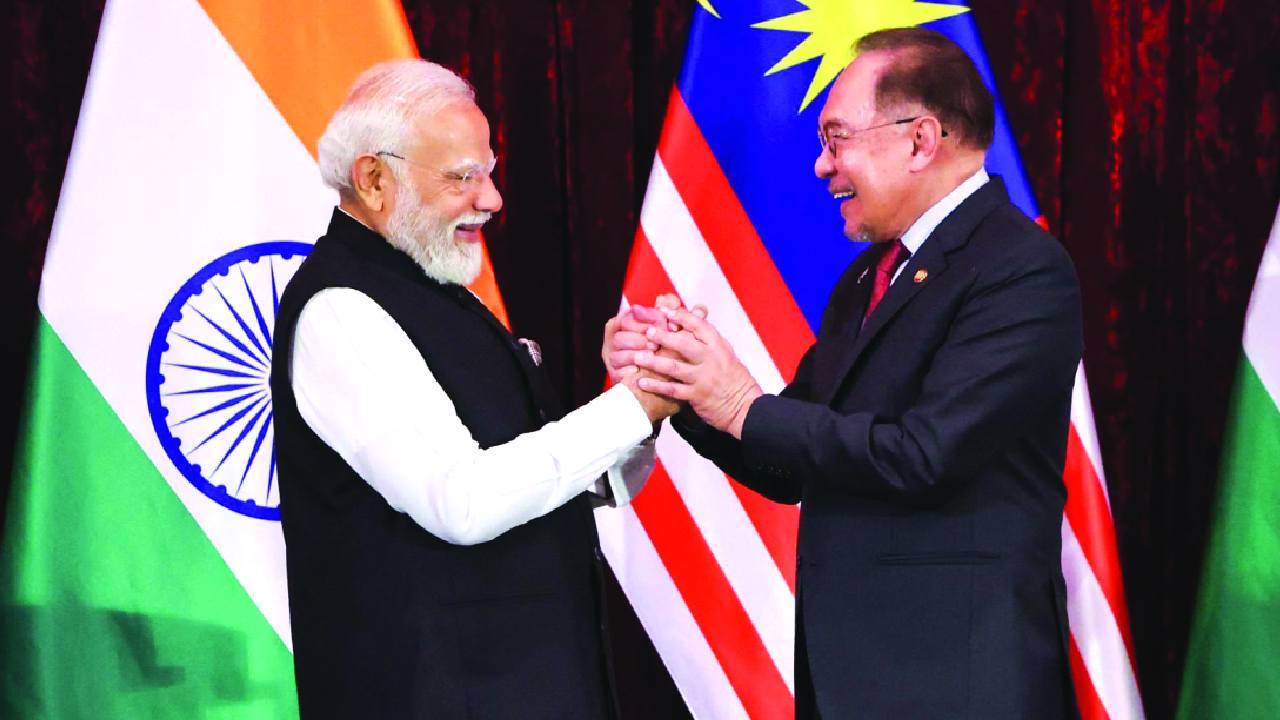
I was in Malaysia when Prime Minister Narendra Modi arrived on February 7,on an official visit which lasted less than 24 hours and contained no extraordinary fanfare or excitement. Instead, several NGOs led by an independent preacher, Zamri Vinoth, had planned a rally timed with his arrival to protest against the illegal construction of Hindu temples. PM Datuk Seri Anwar Ibrahim said he would not allow any rally to stoke racial tensions and ordered the police to break up the rally and arrest the organisers. The crackdown ensured the protestors and the planned disruption fizzled out. Ibrahim added he would not permit any movement that would disrespect an honoured guest. Ibrahim has been consistently saying the construction of temples will follow the same laws as mosques and churches. Malaysia is a multiracial Muslim-majority country sourcing its history from the British colonial period. Peace and harmony have prevailed, though ‘Bhumiputra Malays’ enjoy preferential treatment. The Sultan of Selangor province, Sharafuddin Idris Shah, noted that up to 687 unauthorised temples existed — including Hindu, Buddhist, and Chinese temples. On a visit to Penang Island, I did notice one Hindu temple — a clear encroachment - like one sees in Delhi or Noida. I must add that there is some discomfort with Modi’s treatment of Muslims in India, and the extradition of Zakir Naik is a bone of contention between the two countries.
While India-Malaysia diplomatic relations were established in 1957, ties have thrived from ancient times due to the third-largest Indian diaspora in Malaysia, especially Tamils. Prominent were two early events: then Prime Minister Jawaharlal Nehru sent on deputation Maj Gen Enayat Habibullah as Deputy Army Chief of the Malaysian Army; Tunku Abdul Rahman, son of the first Prime Minister of the same name, was enrolled as a cadet in the National Defence Academy, Pune, whose first Commandant was Habibullah. Then Malaya became the breeding ground for the first major Chinese insurgency in Southeast Asia, which was comprehensively eliminated in 1968 by British Gurkhas led by Lt Gen Gerald Templar, considered the first guru of counter-insurgency. In Penang, there is a memorial dedicated to the Gurkhas recalling the Malay insurgency from 1948 to 1970, the Indonesian confrontation, as well as the reignition of the insurgency. Nepali filmmaker Milan Chams has made a film, Gurkha: The Warrior, to commemorate their contribution to the Malayan insurgency. Its pre-release screening in India on 20 February during an India-Nepal event is to highlight the valour of Gorkhas, which Nepal has declined to recognise as Agniveer.
Modi’s meeting with Ibrahim marks the grounding of the Comprehensive Strategic Partnership of 2024. Ibrahim was in Delhi last year, but Modi could not reciprocate the visit. At the public reception on 7 February, Modi highlighted the special relations founded on the Indian diaspora, with a majority being Tamils. He announced the Thiruvalluvar Chair at the University of Malaysia and the new Thiruvalluvar Centre for Shared Heritage. On his visits to Malaysia and Sri Lanka, Modi has been emphasising Tamil bonding with an eye on elections in Tamil Nadu. Looking at Ibrahim, Modi said: “I know he likes MGR songs” — except that in Tamil Nadu, the BJP’s primary rival is not a party founded by MGR but one led by Karunanidhi. During the delegation-level talks on February 8, several issues were discussed and 11 MoUs were exchanged on labour, tourism, connectivity, education, agriculture, healthcare, digitalisation (UPI), and disaster management. More importantly, notes were exchanged on semiconductors, defence, and national security. Talks have been ongoing on India modernising Malaysia’s SU-30 fleet and Scorpene submarines. There was discussion on the sale of Astra missiles for SU-30 aircraft and Dornier aircraft. In addition, more integrated cooperation was sought in UNPKO. Both India and Malaya were involved in early UN peacekeeping in Congo to ensure that copper-rich Katanga did not secede from Congo. Bilateral trade is a mere $20-25 billion, conducted under the ASEAN-India FTA and India’s Act East policy. The one sticky issue which has become the litmus test of bilateral relations is Zakir Naik, who was provided refuge in Malaysia. The matter is believed to have been discussed at one-on-one talks between the two Prime Ministers. Delhi wants him extradited for money-laundering and hate speech crimes. Last year, when Ibrahim was on an official visit, during his presentation at the Indian Council of World Affairs in Delhi, he said: “Zakir Naik can be extradited following legal processes and evidence provided by India”. Malaysian High Commissioner in Delhi Muzaffarshah Mustafa said: “We can consider his extradition after due diligence and the rule of law by both countries”. In my conversations here, it was clear that Zakir Naik, like Sheikh Hasina (for different reasons), will not be extradited.
Soon after Modi’s aircraft lifted off, politics about illegal temples seized the headlines. Ibrahim’s directions to local councils that all unauthorised temples be cleaned up met with an avalanche of objections, particularly regarding Hindu temples constructed during the pre-independence colonial period. Also on 8 February, Pakistan’s Naval Chief Admiral Naveed Ashraf arrived in Malaysia. Diplomatic niceties such as keeping your honoured guest’s rival country at bay for some time are no longer observed. Sri Lanka, Nepal, and Bangladesh used to observe this protocol; not any longer. Another issue that cropped up after Modi’s visit is India’s plan to open a consulate in Sabah province. There is more to this than meets the eye, as regional parties in Sabah have raised the issue of sovereignty. Politics is heating up here, though elections are due only at the end of 2027.
Malaysia considers India militarily and economically a strong neighbour, and having close ties benefits the country given the strong and rich contribution of the Indian diaspora. The reaction to Modi’s visit was no great shakes, as Malaysians are preoccupied with domestic issues. Political parties and the community agree that relations with India are strategic, friendly, and forward-looking. Ibrahim’s personal support for shared values on long-standing ties is a great boost, but most of all, India as a comprehensive strategic partner will be a great asset for Ibrahim’s ruling party, which assumed power in December 2020.
The writer, a retired Major General, served as Commander, IPKF (South), Sri Lanka, and was a founder member of the Defence Planning Staff, now the Integrated Defence Staff; views are personal