Pak Indus playbook at UN, India’s moment to respond
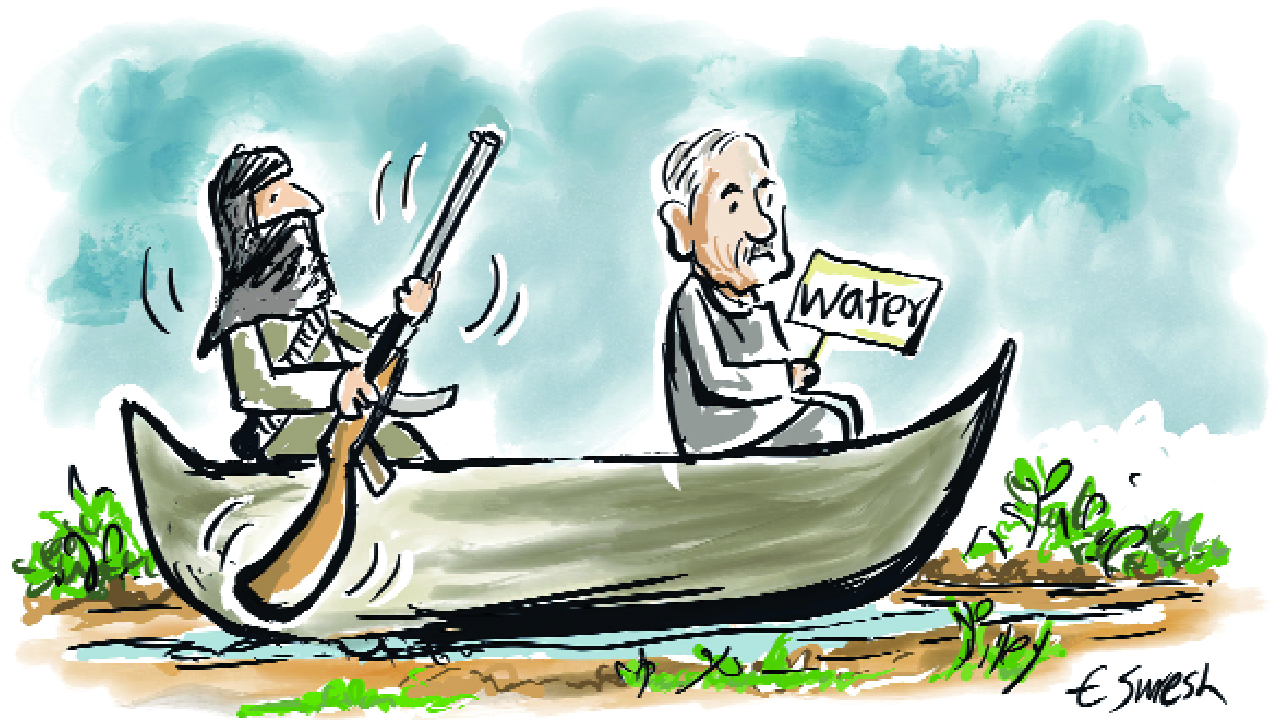
At a Pakistan-hosted Arria-Formula meeting of the United Nations Security Council on 31 January, Pakistan’s Permanent Representative Asim Iftikhar Ahmad argued that India’s suspension of the Indus Waters Treaty (IWT) is “not merely a bilateral concern” but a “test case for the international system”. If a binding treaty governing shared natural resources can be set aside unilaterally, he warned, then no agreement anywhere is safe from politics.
It was a carefully timed intervention ahead of the UK and US presidencies of the Security Council, intended to pull the IWT out of its bilateral and technical setting and recast it as a question of global treaty sanctity and moral indictment. By this logic, India appears to be weakening the rules-based international order.
The strategy has deep historical roots. In 1952, Pakistan’s first foreign minister, Zafrullah Khan, stood before the Security Council and accused India of repeatedly “turning off” the waters flowing into Pakistan. His words were emotive by design. In a land where every drop revived “parched earth” and sustained human life, he said, India’s conduct was “most callous”. A question of river regulation was reframed as a humanitarian outrage caused by an upper riparian.
Five years later, in October 1957, Zulfikar Ali Bhutto, then a young minister in Ayub Khan’s cabinet and part of Pakistan’s UN delegation, advanced the argument during debates in the General Assembly on defining aggression. Any definition, Bhutto insisted, must include “economic or indirect aggression” if a lower riparian was deprived of its natural river rights. Interference with irrigation waters, he warned, could bring Pakistan to “total annihilation”.
Across decades, the vocabulary evolves but the design holds. Zafrullah framed water as humanitarian injury. Bhutto framed it as economic aggression. Asim Iftikhar Ahmad now frames it as a threat to the global treaty system. The objective never changes, to brand India as an upper riparian that can turn water into a weapon. The flaw in this narrative, then and now, is that it treats treaties as sacred texts detached from the conduct of the parties bound by them.
The IWT, signed in 1960 after years of negotiation, was a practical arrangement meant to keep hostility away from river management so both countries could use water for development. Peace did not follow between India and Pakistan, yet the treaty survived the wars of 1965, 1971 and 1999, prolonged tension, and cross-border terrorism because it relied on restraint and good-faith implementation.
That foundation has eroded. Over the years, Pakistan has used the treaty’s dispute resolution provisions less for clarification than for delay. Every Indian hydroelectric project permitted under the treaty has been contested. Neutral experts, courts of arbitration, and procedural appeals have been activated in parallel and sequence, turning what was meant to be a technical process into a rolling legal contest. This is the context Pakistan will obscure at the UN, and India must ensure it is brought squarely into the discussion.
Treaties do not exist in isolation. They operate within a broader environment of political conduct. For decades, India upheld the treaty despite provocation and cross-border terrorism. The expectation that one side must show permanent restraint cannot endure indefinitely. Treaty sanctity cannot mean that one party can freeze the rights of another through constant legal activation and then claim moral high ground in global forums.
This is where Pakistan’s historical messaging and present tactics converge. By raising water at the UN across generations, Pakistan has cultivated a diplomatic memory in which India appears as a potential water aggressor. That memory is now being activated at a moment when India has questioned the misuse of treaty mechanisms after the Pulwama terror attack by suspending routine cooperation such as hydrological data sharing and participation in arbitral processes. Pakistan portrays this as treaty abandonment. India must insist that this is a dispute about how the treaty is being used, not whether it should exist. The distinction matters. If Pakistan’s framing prevails, it creates a troubling precedent. Any state could immobilise another’s treaty rights by constantly triggering legal procedures and then appealing to international opinion when resistance follows.
Pakistan is also attempting to bring the World Bank back into the conversation. As the original broker of the Indus negotiations, the Bank occupies a unique place in the treaty’s history. With Ajay Banga now heading the institution and simultaneously part of President Donald Trump’s advisory “Board of Peace”, new diplomatic channels open up that Pakistan will seek to leverage. The aim is the same as in 1952 and 1957, to widen the discussion beyond the bilateral framework. India cannot afford to treat these moves as isolated episodes. They form part of a long, consistent strategy accompanied by a record of cross-border terrorism that has steadily eroded the trust on which the treaty functioned. India’s response at the UN and other international platforms must be firm, factual, and historically aware. It must remind the world that the treaty survived wars because India honoured it. It must underline that the present strain arises from the gradual breakdown of cooperative conduct, not from any sudden departure by India.
River treaties can anchor peace, but their stability is not the responsibility of the upper riparian alone. It rests equally on the conduct of the lower riparian. Nearly three quarters of a century after Zafrullah first raised water in the Security Council, and after Bhutto cast it as aggression, Pakistan is repeating the same script in updated language. India now needs a diplomatic script of its own, one that recognises this continuity and answers it with clarity, context, and confidence.
The writer is Senior Fellow at the Manohar Parrikar Institute for Defence Studies and Analyses, New Delhi; views are personal