Operation Sindoor: India’s Dharam Yudha
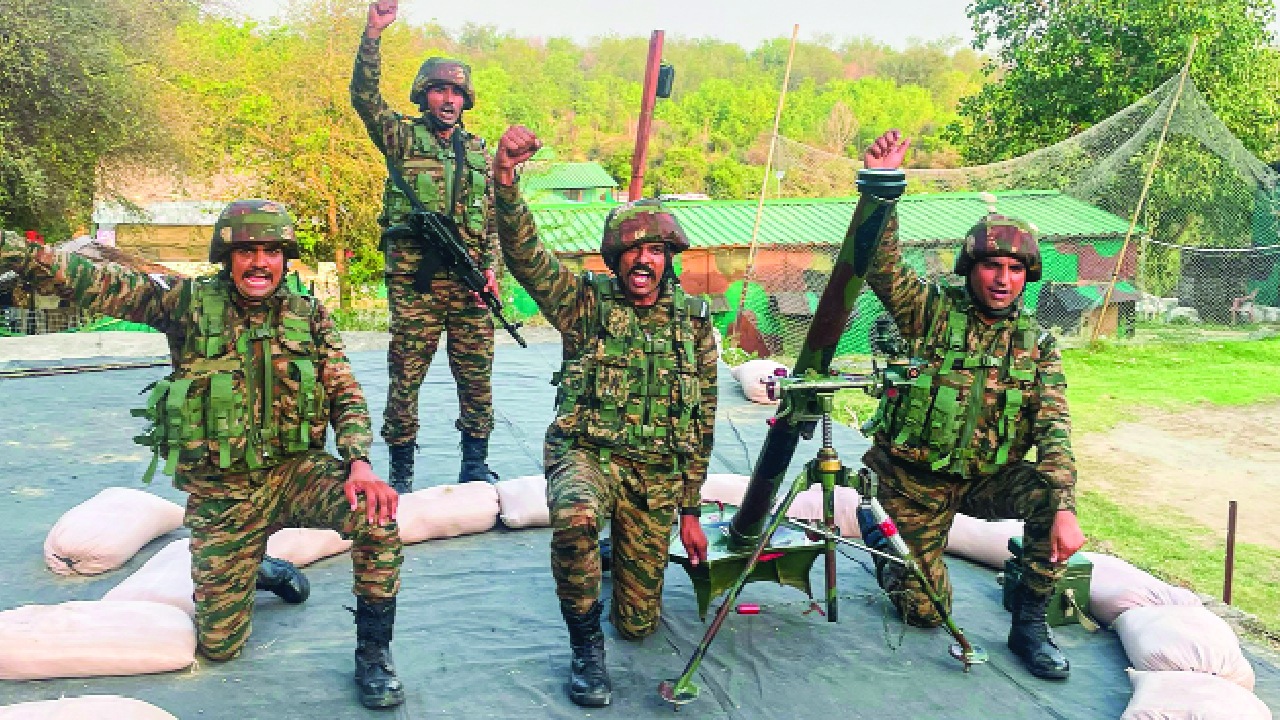
While inaugurating the 10th International Gita Conference, the Defence Minister of India stated that during Operation Sindoor, India’s action was guided by the message which Lord Krishna gave to the Pandavas: that war should not be fought for revenge or ambition, but to uphold righteousness. Operation Sindoor was a dharma-based ethical action that India adopted. Lord Krishna emphasises that ethical war is an unavoidable duty (svadharma), without personal attachment to the fruits of action.
On the battlefield of Kurukshetra, Lord Krishna reminds Arjuna of his kshatriya dharma —” Looking to your own duty you should never waver, for there is nothing higher for a kshatriya than a righteous war.” Dharma must be protected by wielding righteous force when needed. Adharma should be vanquished by dharma, or else it would be a sin. However, Krishna qualifies the act of war with a rider. The war must be dharmika, that is, fought according to established rules. The Mahabharata elsewhere details these rules. Some of these include not attacking a warrior who has laid down his arms, no killing of non-combatants, and no use of celestial weapons on ordinary soldiers, etc. The main tenet of Lord Krishna’s preaching is that the warrior must act without desire for fame or personal gain, or else the act becomes tainted.
The doctrine of nishkama karma is the Gita’s core principle for the ethics of war. Lord Krishna further insists on equanimity. Ethical war is fought without hatred towards the enemy and without triumph in victory. This vision teaches that one should not harbour hatred. The Pandavas fought not out of personal enmity but because adharma had reached such a point where only force could restore balance.
A war fought without moral anchoring degenerates into mere power play. Hence, we see that Operation Sindoor was launched on these principles — it had a just cause of dharma over adharma. It followed rules that avoided the killing of civilians, and there was no personal hatred, ego, greed or desire, except that it was just and fair, with the aim of dharma over adharma.
The Bhagavad Gita is a profound Indian text on the ethics of waging war. It speaks eloquently on the tragic necessity of war, especially when adharma threatens the social and moral universe. The Pahalgam attack, targeting tourists specifically for their religious identity, represented a direct assault on India’s constitutional principle of equal respect for all religions and demanded a dharmic response.
Principles of Proportionality
The Bhagavad Gita is a synthesis of various strands of Indian religious thought, including the Vedic concept of dharma (duty, rightful action). It forms the didactic portion of the Mahabharata. Operation Sindoor, with its carefully calibrated objectives, exemplified this principle. Its objective was to uphold national sovereignty and protect civilian lives without precipitating a broader military conflagration.
Operation Sindoor’s methodology was in keeping with the dharmic principle of ahimsa (non-violence) in its discriminatory application. India held that it was a measured response to the blatant attack on Indian tourists and was aimed at seeking justice against terrorists. It had no intent to attack the Pakistani military. It carefully discriminated between combatants and non-combatants, between the guilty establishment and innocent populations, and thus echoes the Ramayana’s treatment of warfare, where Rama consistently distinguishes between Ravana’s forces and innocent citizens of Lanka.
The Ramayana’s Model
Rama was a true Maryada Purushottam who, throughout the epic, repeatedly acted with restraint: he gave Ravana multiple chances to return Sita peacefully and insisted on fair combat. He initiated diplomatic solutions through Hanuman’s embassy to Ravana. In past instances of friction between India and Pakistan, India had repeatedly offered cooperation in joint investigative teams despite Pakistan’s uncooperative response to the Mumbai 2008, Pathankot 2016 and other probes. When diplomacy failed, India’s military response was both decisive and restrained — targeting military objectives while sparing civilians. It focused on dismantling terrorist infrastructure and reflects the dharmic obligation to protect innocents on both sides of the conflict. India’s no-first-use policy for nuclear weapons, the fact that Pakistan was the first to hit military targets, and that India’s strikes were targeted at terrorist infrastructure with no attempt to capture territory, all demonstrate adherence to the Gita’s teaching that dharmic action must consider the welfare of all beings.
Doctrine of Proportional Escalation
Both the Gita and the Ramayana believe in the maxim that violence must be bounded force, which is unrestrained and destroys the moral authority of the warrior and delegitimises the cause itself. Rama consistently applies proportionate force, using the least amount necessary to achieve legitimate objectives. Operation Sindoor not only acted with restraint but was also a graduated response to adharmic aggression. Operation Sindoor was also guided by the principle of “equal intensity in the same domain”.
Relevance of Ancient Wisdom
Time and again, it has been proved that contemporary conflict resolution can only be achieved within the framework of dharma. The teachings of the Ramayana and the Bhagavad Gita are as pertinent today as they were in the past. Dharma prioritises justice over victory, protection over domination. This is what constitutes true strength.
War as Tragic Necessity
Neither the Ramayana nor the Bhagavad Gita romanticise war. The Gita does not celebrate war but accepts sombrely the duty fulfilled at great human cost. Leadership requires humility, accountability and a willingness to bear moral burdens. Operation Sindoor vindicates the timeless relevance of dharma-yuddha principles. India’s integrated military action was within the framework of righteous duty, proportional force and the protection of non-combatants. The operation was successful in achieving tactical objectives while securing international support and avoiding full-scale conflict. It confirmed the enduring wisdom that true national security is rooted not in the mere capacity for destruction, but in the disciplined, righteous and proportional application of force, guided by dharmic principles.
The writer is the Director, Bharat Ki Soch. He is a retired IPS and has served as Chairman of Haryana Public Service Commission, DG — ITBP, DG — NDRF and Commissioner of Police, Kolkata; views are personal