One Year of the World Trumped
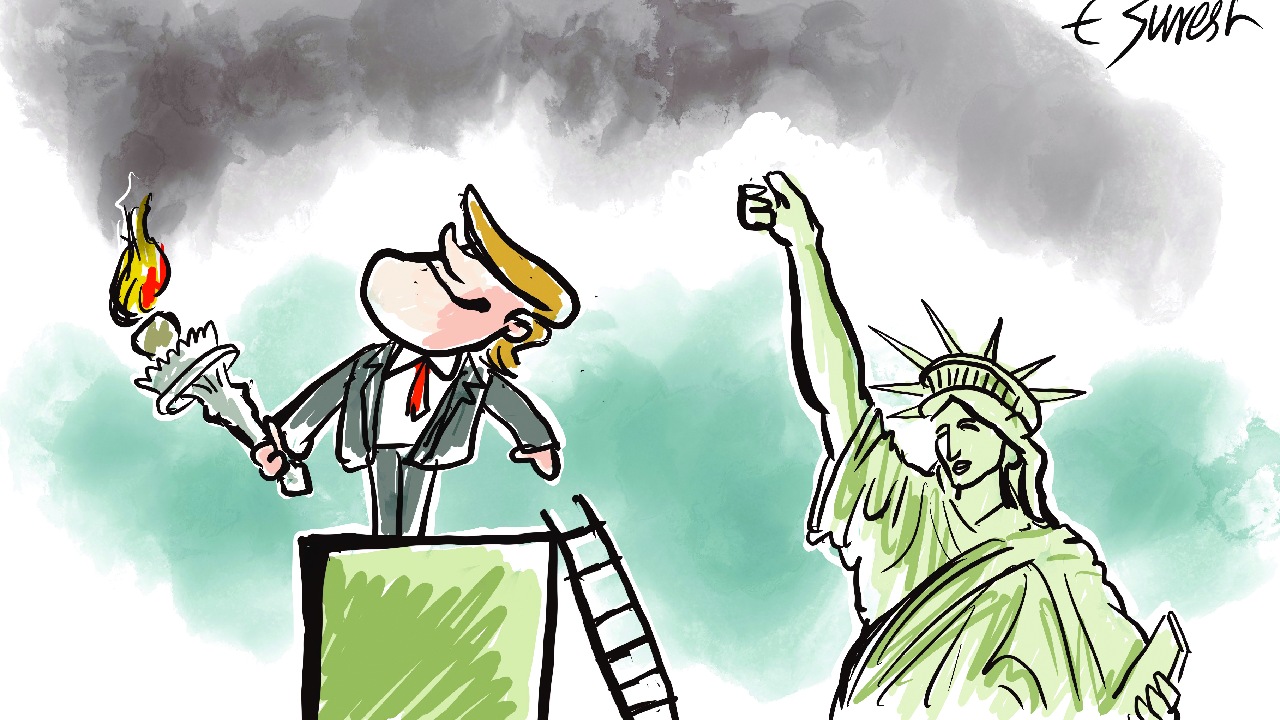
US President Donald Trump will complete the first year of his second term on January 20. Trump's second-term foreign policy, which began in January 2025, represents a significant departure from traditional US approaches, even compared with his first term. His foreign policy actions-including withdrawals from international agreements and the aggressive use of tariffs-highlight a turn towards
unilateralism that has raised concerns about global stability and the durability of long-standing alliances.
Trump's new approach has been more revolutionary than evolutionary, triggering significant shifts in international relations. The defining elements include a renewed focus on the Western Hemisphere under the Monroe Doctrine, strained relations with European allies, and a move away from democracy promotion towards transactional diplomacy-signalling a major strategic realignment.
As CNN observed, Trump “destroyed agencies such as USAID, fired thousands of USAID workers, set government prosecutors on his enemies, and mocked justice with pardons for January 6 rioters.” During this period, Trump's foreign policy underwent more dramatic changes than during his first term. His unpredictability repeatedly shocked the world and contributed to a sense of global instability. Trump's supporters welcomed his negotiating style and emphasis on American interests, while critics warned that such actions could weaken long-term alliances. The hallmark of his second term has been the rapid and expansive use of executive authority, creating a perception of overwhelming presidential power.
Trump's withdrawal from multilateral agreements such as the Trans-Pacific Partnership (TPP) and the Paris Climate Agreement raised concerns about the United States' long-term influence and credibility in global institutions. He exited the TPP in his first week in office and later withdrew from the Paris accord, reinforcing his scepticism towards international frameworks he believed constrained American sovereignty. He has shown little enthusiasm for alliances, frequently portraying European partners as weak. During the year, Trump held several calls with Ukrainian President Volodymyr Zelenskyy and Russian President Vladimir Putin, and also met Putin face-to-face in Alaska in an effort to end the war in Ukraine. While the conflict appears to be moving towards a resolution, progress has been slower than Trump anticipated, largely due to Russian resistance.
Relations with Europe became increasingly strained, complicating efforts to promote democratic values. At the same time, the administration placed renewed emphasis on the Western Hemisphere, a shift that has generated concern among regional partners.
Trump initiated the withdrawal from the North American Free Trade Agreement (NAFTA) and pursued renegotiation, alongside imposing tariffs on products such as solar panels and washing machines. He has used tariffs as a strategic weapon even against allies, secured the release of hostages from Gaza, and launched a pressure campaign against the Venezuelan government. US military action led to the capture of Venezuelan leader Nicolás Maduro following strikes on the country.
Maduro and his wife were brought to the United States, where he was indicted on drug charges in New York. The National Security Strategy released in December outlined a markedly different vision for global engagement. It shifted away from democracy promotion and instead prioritised narrowly defined national interests, identifying mass migration as the most significant external threat-above challenges posed by China, Russia, or terrorism.
The strategy presents a world divided into spheres of influence dominated by the United States, Russia, and China, and calls for reinstating the Monroe Doctrine to reinforce American dominance in the Western Hemisphere, with particular focus on Latin America and the Caribbean. On Ukraine, the United States continued to provide military aid to Kyiv even as Trump pursued direct dialogue with President Putin. Both President Zelenskyy and former President Joe Biden were blamed for the conflict. Peace negotiations, including US-Russia talks held in Saudi Arabia in February 2025, have progressed slowly. Trump's efforts to mediate between Israel and the Palestinians have continued, with the United States maintaining strong and unequivocal support for Israel. India entered 2025 with optimism about what a second Trump presidency might mean for bilateral relations. Public opinion in India was largely positive about Trump's return to the White House. However, expectations were quickly challenged as the administration raised tariffs, tightened H-1B visa rules, and struck trade deals with China. Most recently, India faced a major shock after Trump backed legislation proposing a 500 per cent tariff on exports to the United States.
Trump once declared, “America will reclaim its rightful place as the greatest, most powerful, most respected nation on Earth, inspiring the awe and admiration of the entire world. A short time from now, we are going to be changing the name of the Gulf of Mexico to the Gulf of America.” His expansionist vision is now under way — and the world is watching closely to see where it leads.
The writer is a popular columnist; views are personal