Oman: Redrawing India’s Gulf strategy
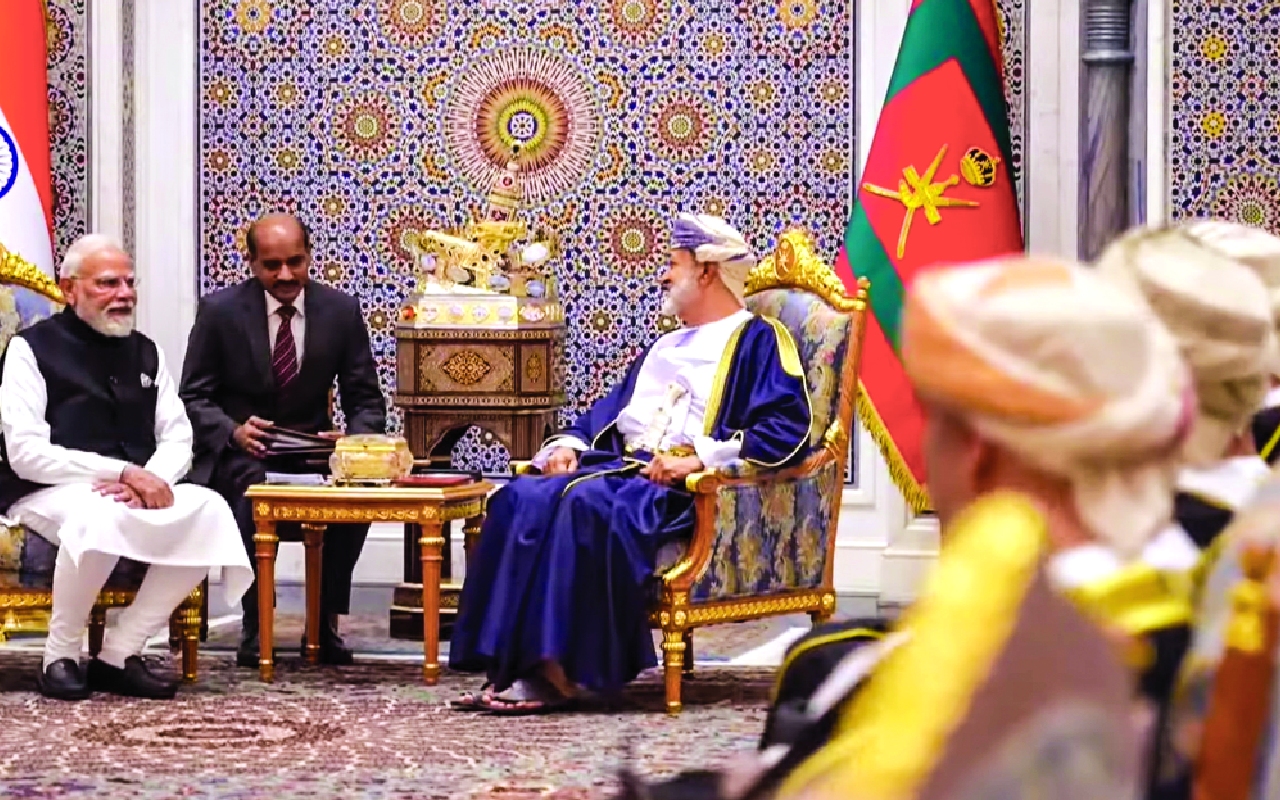
India's approach to foreign policy has undergone a paradigm shift. It is reducing its dependence on the US and the West and making tangible connections with countries in the Global South of Asia and Africa. This approach not only puts India on the moral high ground by speaking for the majority of humanity that is at the receiving end, but also serves its national interests; it is pragmatic and aligns with India's desire to become Viksit Bharat by emerging as an IT powerhouse and a manufacturing hub for the world. Prime Minister Narendra Modi's visit to Oman must be seen in this context, marked by the signing of a Comprehensive Economic Partnership Agreement (CEPA). It reflects India's outreach to Asia and Africa, which fits into New Delhi's evolving economic and strategic imagination.
The CEPA with Oman opens a “new beginning” in bilateral ties, as India-Oman relations have so far been largely centred on energy cooperation. The new trade agreement seeks to widen this narrow base into a multidimensional partnership encompassing pharmaceuticals, information technology, defence manufacturing, space technology, and advanced services. This is a win-win for both countries and fits well with Oman's Vision 2040 and India's Viksit Bharat aspirations.
For India, the agreement offers tangible economic gains. Preferential market access can boost exports of pharmaceuticals, engineering goods, food products, and services, while providing Indian companies with a stable and business-friendly base in the Gulf. Moreover, Oman's extensive network of free trade agreements with the United States and several other Gulf countries positions it as a strategic gateway rather than merely a destination market. Indian firms that invest in Oman gain indirect access to wider regional and global markets.
Oman, for its part, stands to benefit from Indian expertise in affordable healthcare, digital public infrastructure, defence manufacturing, and skilled manpower. The real test now lies in implementation-translating the CEPA from a signed document into sustained institutional cooperation and private-sector engagement.
Beyond economics, Prime Minister Modi's visit was laden with diplomatic optics and symbolism. The Order of Oman bestowed on Prime Minister Modi underscores the importance Oman places on India. It also reflects Oman's recognition of India as a stabilising partner in a turbulent region. This is particularly relevant in West Asia, where personal bonhomie carries considerable weight.
Whether in the Gulf, East Africa, or Southeast Asia, New Delhi has sought to combine trade agreements, development partnerships, and people-to-people ties without forcing countries into rigid geopolitical camps. This is a refreshing approach based on equality and mutual trust.
The discussion on regional connectivity, including the India-Middle East-Europe Economic Corridor, also underlines this approach. India's diplomacy has increasingly stressed inclusivity and economic viability over grand but brittle geopolitical designs-a lesson reinforced by ongoing conflicts in the region.