Migration, hospitality, and civilisational test
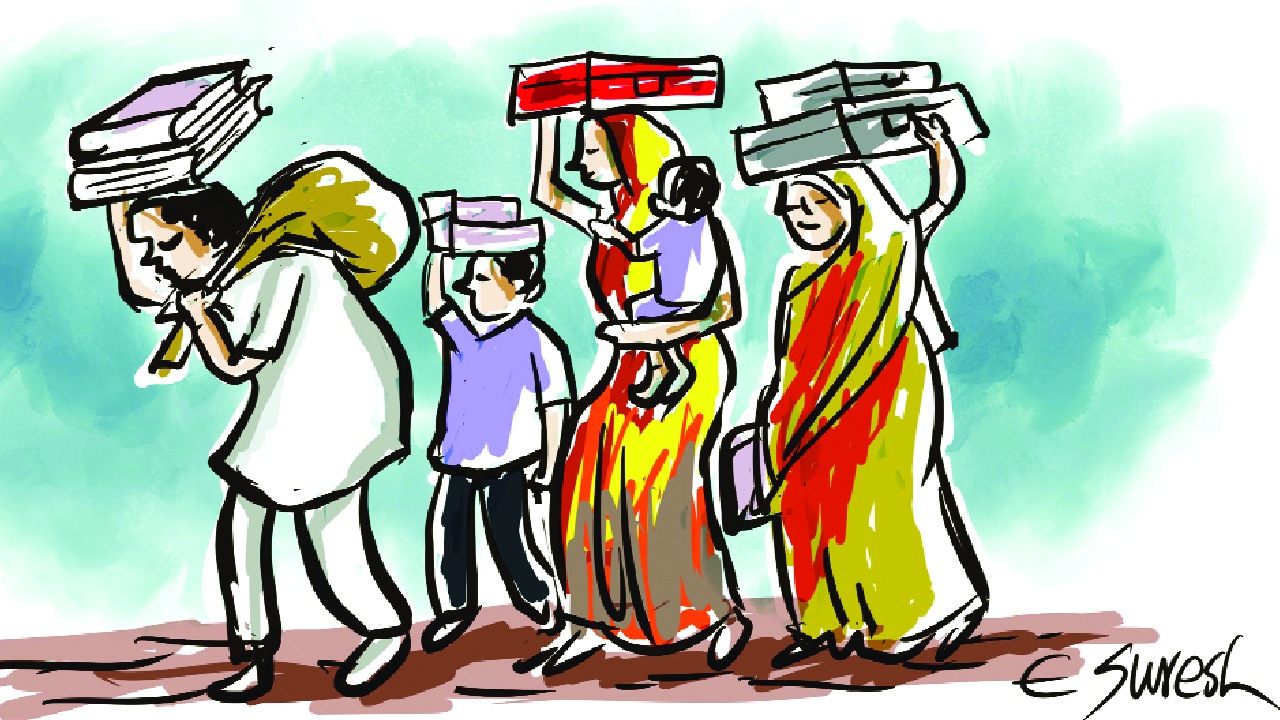
The press has lately been preoccupied with migration, largely because President Donald Trump has repeatedly threatened residents of the United States with expulsion to their countries of origin. What has unsettled many observers is not only the substance of these threats, but the tone in which they are delivered — often with a sense of bravado, as though migration were inherently an act of intrusion or infiltration. From a Hindu civilisational perspective, such framing appears alien and historically shallow.
The ancient maxim Atithi Devo Bhava — the guest is akin to the divine — encapsulates an ethical universe in which hospitality is not a matter of convenience or political calculation, but a moral obligation. To welcome the outsider with dignity was traditionally seen as a measure of one’s own refinement. This did not imply the absence of rules or discernment; rather, it reflected a civilisational confidence grounded in moral clarity.
Intellectual honesty, however, demands an important distinction. A guest, a lawful immigrant, and an illegal entrant are not the same, and conflating them corrodes public debate. Few societies understand this complexity as intimately as India. The Sanatana or Vedic civilisation is believed to be partly indigenous and partly shaped by successive waves of migration — from Persia, Central Asia, and beyond. Far from weakening India, these movements enriched it, adding layers of language, custom, philosophy,
and artistic expression. Immigration was not incidental to Indian civilisation; it was foundational. The same can be said of most great civilisations across history.
India’s civilisational strength lay in its capacity to absorb external influences without losing its core identity. This is why texts such as the Bhagavad Gita transcend geography and time. Regarded by many as part of humanity’s shared intellectual inheritance, the Gita continues to shape ethical reflection across cultures. Veteran journalist Saeed Naqvi once recounted an anecdote from Turkey, where a former president confided that after exhausting days in office he would turn to a Turkish translation of the Gita to steady his mind. Ideas, unlike borders, migrate freely — and often to humanity’s lasting benefit.
This tradition of receiving newcomers as guests endured for millennia, until certain historical incursions — marked not by peaceful migration but by conquest and coercion — clashed fundamentally with India’s ethos of accommodation. Even then, it bears emphasis that no genuine immigrant, as distinct from an invader, ever proved indigestible to Indian society. Traders, scholars, refugees, and seekers of spiritual refuge found space and acceptance. The rupture came with the Partition of 1947. Partition was not migration in any natural historical sense; it was displacement on a civilisational scale, accompanied by violence, fear, and demographic upheaval.
In its aftermath came large-scale illegal migration, generating resentment and the harsh label ghuspaithiya. India, already burdened by poverty and a vast population, struggled to absorb the sudden pressure. The geopolitical reality worsened matters: territorial balance had been lost in the west with the creation of Pakistan, while demographic pressure continued from the east. What had once been a gradual civilisational process unfolding over centuries was compressed into a few traumatic years. The scars of that compression continue to shape Indian politics.
In later decades, migration became a political instrument elsewhere as well. Bangladeshi leaders are often accused of encouraging outward migration to ease demographic stress, effectively exporting surplus population. The demographic transformation of global cities bears witness to this phenomenon. London, once styled the capital of the world, today has a mayor of Pakistani origin, elected with strong support from Bangladeshi communities concentrated in the East End. New York, America’s financial capital, has likewise elected a mayor of Pakistani origin. Whatever one’s view of these outcomes, they underscore how migration reshapes not only societies but political power.
History shows that migration has played a decisive role in both building and unravelling civilisations. Eastern Greece, or Anatolia, was rendered vulnerable to Turkish conquest through earlier Roman and Byzantine policies that altered its demographic character. Central Asia was repeatedly reshaped by waves of migration and conquest, producing both cultural synthesis and chronic instability. The United States presents the most striking example of all: a nation built almost entirely by immigrants. Europeans displaced indigenous peoples, Africans were brought forcibly through slavery, and later waves arrived in search of opportunity.
Some migrations took forms so unusual that entire territories were acquired by purchase rather than conquest. California, New Mexico, and Alaska were bought along with their inhabitants, turning land and people into commercial assets. Ancient Indian society, by contrast, placed newcomers within a moral framework of obligation and restraint. It is therefore a striking irony that a modern American president now threatens to expel the descendants of immigrants whose presence constitutes the very foundation of the American nation.
Consider finally the Jews, often described as the most persecuted people in recorded history. Expelled or marginalised in country after country, they found in India a rare exception. Across centuries, Jews in India never felt unsafe or alien. Jewish leaders worldwide have repeatedly acknowledged this singular historical record. Those who left India — such as the Cochin Jews - did so voluntarily to settle in Israel, not under compulsion. Some even returned, rediscovering that India remained their truest home.
There is a lesson here. Migration need not inevitably lead to exclusion or civilisational anxiety. Under the right ethical framework, it can foster belonging and continuity. The challenge for modern nation-states is not to deny migration’s reality, but to manage it wisely - distinguishing hospitality from lawlessness, compassion from chaos. Civilisations endure not merely by erecting walls, but by cultivating moral confidence. India’s long experience suggests that openness, tempered by discernment, remains among the surest foundations of a resilient society.
The writer is a well-known columnist, author, and former member of the Rajya Sabha; views are personal