Lotus blooms in Bengal, Vijay whistles in Tamil Nadu
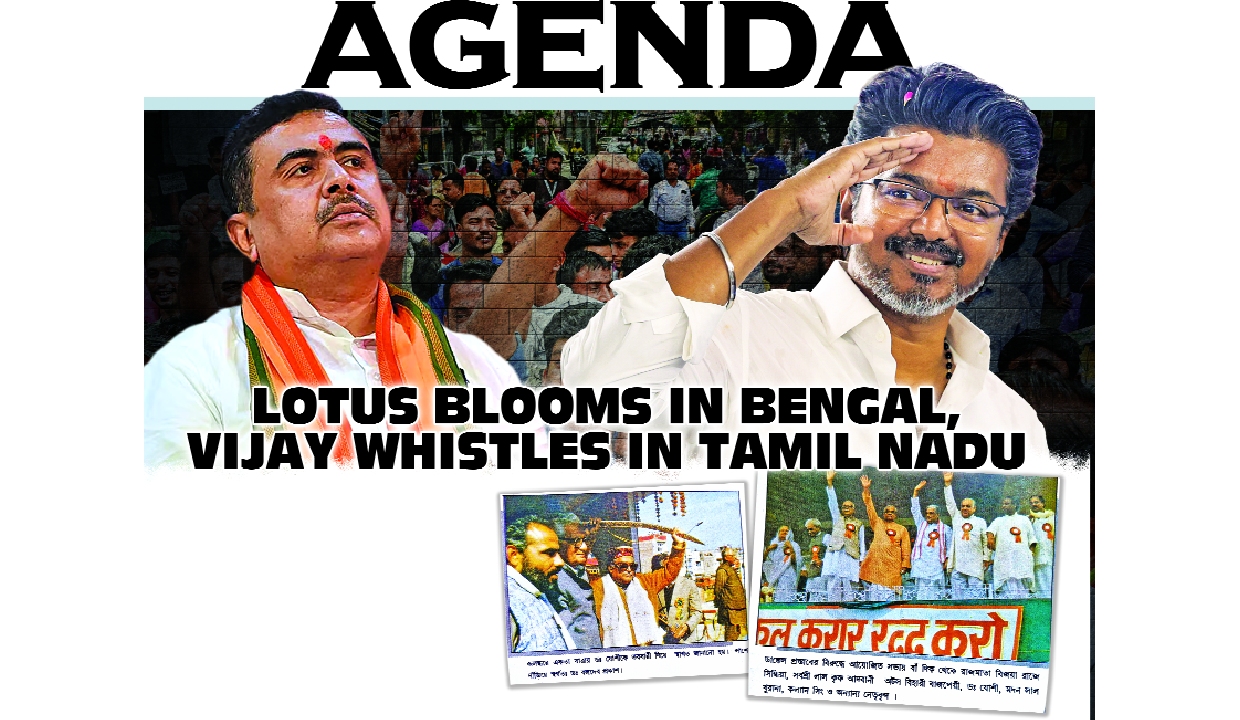
I would like to recall that during a debate in the Lok Sabha, Pt. Nehru pointed towards Dr Mookerjee and declared, “Jana Sangh is a communal party. I will crush the Jana Sangh.” To this, Dr Mookerjee got up and promptly replied to Nehru's remarks, amid applause, “My friend Pandit Jawaharlal Nehru says that he will crush Jana Sangh. I say, I will crush this crushing mentality.”
I would like to heap a lot of praise on the formation of the first-ever BJP Government in West Bengal after posting a historic win in the Assembly elections. The seed planted by the founder of the Bharatiya Jana Sangh, Dr Syama Prasad Mookerjee, has now become a full-grown lotus.
It is a matter of immense pride that the land of Dr Mookerjee has given a rousing mandate to the BJP after decades of struggle and the sacrifices of hundreds of party workers. I applaud the current leadership — Prime Minister Narendra Modi, BJP president Nitin Nabin and Home Minister Amit Shah — for rewriting history in West Bengal.
It is a great day for the BJP and crores of its workers, and I would like to extend my good wishes to the newly appointed Chief Minister, Suvendu Adhikari. It is another great moment to recall Dr Mookerjee’s relationship with another Bengal icon, Rabindranath Tagore. Notably, during his tenure as Vice-Chancellor of University of Calcutta, Dr Syama Prasad Mookerjee invited Tagore to deliver the university's convocation address in Bengali for the first time in 1937, a significant cultural milestone.
The BJP has grown over the years despite being suppressed by the governments of the day. We fought Congress and Left rule in West Bengal. Our fight with Congress began way back in 1951 when Dr Syama Prasad Mookerjee formed the Jana Sangh (the precursor to the BJP, formed on 21 October 1951), and was one of its three elected MPs in 1952 during India's first General Elections. At that point, caste was not a predominant factor in voting patterns; instead, voting was based largely on ideological divisions such as socialist, Leftist and Jana Sangh ideologies.
Pandit Jawaharlal Nehru, as Prime Minister and Congress leader, viewed the fledgling Jana Sangh as a communal party linked to RSS ideology and saw it as a threat to his vision of secularism and Congress dominance. This was a time when any kind of political dissent used to be crushed. Nonetheless, it is Congress that must be blamed for developing the tactics of decimating the Opposition and drifting away from the basic principles of democracy.
I would like to recall that during a debate in the Lok Sabha, Pt Nehru pointed towards Dr Mookerjee and declared, “Jana Sangh is a communal party. I will crush the Jana Sangh.” To this, Dr Mookerjee got up and promptly replied to Nehru's remarks, amid applause, “My friend Pandit Jawaharlal Nehru says that he will crush Jana Sangh. I say, I will crush this crushing mentality.”
Dr Mookerjee's sharp rejoinder bordered on the core idea of defiantly rejecting Nehru's “crushing” threat and framing it as authoritarian overreach. It may be recalled that the exchange was widely remembered and later cited by Atal Bihari Vajpayee, one of the towering figures of post-independent India.
The parliamentary exchange reflected hostility towards the Jana Sangh, and Dr Mookerjee used the floor to attack Nehru's policies on Kashmir, foreign affairs and national unity, while Nehru tried to portray the Jana Sangh as a fringe threat.
I witnessed the first Lok Sabha elections held in 1952. Since then, a lot has changed. Political parties now depend on technology. In 1952, slips carrying the names of candidates were given to voters, who were supposed to place them in the respective ballot boxes. There was no concept of reserved seats then, but different candidates could contest from the same seat. For instance, from Phulpur constituency, Pt Nehru contested as a general candidate while Masuriyadeen contested as a minority candidate. Things have changed now.
Coming back to the BJP's landslide win in West Bengal, I would mention that during my tenure as BJP president, I extensively toured the State to strengthen the party. We held the National Executive meeting in Calcutta in April 1993. West Bengal has always remained a focus of the BJP leadership.
The political scenario has undergone a qualitative change during this period. The BJP has emerged as a dominant pole in Indian politics, and our adversaries are unable to digest our growth.
It was very satisfying to see a BJP Chief Minister being sworn in in West Bengal. This is the culmination of Dr Mookerjee’s dream and the hard work put in by our party workers. The current leadership has left no stone unturned in ensuring that the BJP scripts history in Kolkata.
Further talking about the dynamism of southern Indian politics, where the BJP is failing to breach Tamil Nadu’s Dravidian fortress, I would state that Tamil Nadu remains one of the major State where the BJP has been unable to convert national momentum into electoral gains. Language is one issue that has been used by Dravidian parties to create north-south friction. The BJP’s struggles in Tamil Nadu reflect its inability to increase its footprint in the State. The reasons are structural, not tactical.
A key factor is cultural compatibility. Tamil religiosity, characterised by anti-Brahminical and non-Sanskritic traditions, especially the Bhakti and Self-Respect movements, stands apart from the practices favoured by the BJP. These traditions emphasise devotion while rejecting priestly rituals and the Varna hierarchy.
For example, C Rajagopalachari, despite being India's first Governor-General and a celebrated leader, was asked to step down as Chief Minister of Madras State because he was a Brahmin. This reflected the deep anti-Brahmin sentiment that shaped Tamil Nadu's political landscape.
Tamil Nadu has the maximum number of temples, and people are deeply religious, yet the BJP has not been able to gain a foothold in the State. Tamil film megastars MG Ramachandran and J Jayalalithaa shrewdly occupied the soft Hindutva space and inculcated devotion without Brahminical overtones, thus neutralising the BJP’s only natural plank inside a Dravidian framework.
While Rajaji was forced to resign for being a Brahmin, Jayalalithaa, a Brahmin woman hailing from Karnataka, ruled Tamil Nadu for years. Tamils are emotional people, and they are not influenced by the rest of India's political set-up. They believe in hero worship rather than cult politics, and this needs to be studied. Actor Joseph Vijay's rise is the latest phenomenon in Tamil Nadu politics, and it will continue.
...shock and awe of 2026 polls...
Keralam: a Game of musical chairs
Keralam maintained its tradition of alternating power between major coalitions, as the Congress-led United Democratic Front (UDF) unseated the Left Democratic Front (LDF).
Seat Count: Elections were held for 140 seats.
Key Drivers: Analysts attributed the UDF win to successful campaigning by Rahul and Priyanka Gandhi, which helped overcome internal party factionalism.
BJP Presence: The BJP made minor inroads but secured only three seats in the State Assembly.
Assam: BJP Extends Dominance
The Bharatiya Janata Party (BJP) secured a historic third consecutive term in the northeastern state.
Landslide victory: The BJP-led coalition won 102 out of 126 seats, a significant increase from their 2021 tally of 75.
Leadership: Chief Minister Himanta Biswa Sarma won his seat in Jalukbari and is set for a second term.
Opposition: The Congress Party, despite a campaign led by Gaurav Gogoi, was reduced to just 19 seats.
Puducherry: NDA holds fort
The Union Territory saw the National Democratic Alliance (NDA) return to govern for a second consecutive term.
Coalition Success: The alliance led by the All India N.R. Congress (AINRC), featuring Chief Minister N. Rangaswamy, won a comfortable margin over the Congress-led INDIA bloc.
New Dimensions: The election marked the entry of actor Vijay’s party, Tamilaga Vettri Kazhagam (TVK), which added a new competitive layer to the local political landscape.
TAMIL NADU
Party Name Seats Won
Tamilaga Vettri Kazhagam (TVK) 108
DMK 59
AIADMK) 47
Indian National Congress 5
Pattali Makkal Katchi (PMK) 4
Communist Party of India (CPI) 2
Communist Party of India (Marxist) 2
Viduthalai Chiruthaigal Katchi (VCK) 2
Indian Union Muslim League (IUML) 2
Bharatiya Janata Party (BJP) 1
Desiya Murpokku Dravida Kazhagam (DMDK) 1
Amma Makkal Munnettra Kazagam (AMMK) 1
Total 234
BENGAL
Party Name Seats Won
Bharatiya Janata Party (BJP) 207
All India Trinamool Congress (AITC) 80
Indian National Congress (INC) 2
Aam Janata Unnayan Party (AJUP) 2
Communist Party of India (Marxist) 1
All India Secular Front (AISF) 1
Total Seats Declared 293
Tamil Nadu has the maximum number of temples, and people are deeply religious, yet the BJP has not been able to make a foothold in the state. Tamil film’s mega star MGR and Jayalalithaa shrewdly occupied the soft Hindutva space and inculcated devotion without Brahminical overtones, and thus neutralising the BJP’s only natural plank inside a Dravidian framework
As told to Deepak Kumar Jha, Executive Editor, and Pramod Kumar Singh, Resident Editor, The Pioneer; Views presented are personal.