Prime Minister Narendra Modi’s Nordic outreach and new European strategy
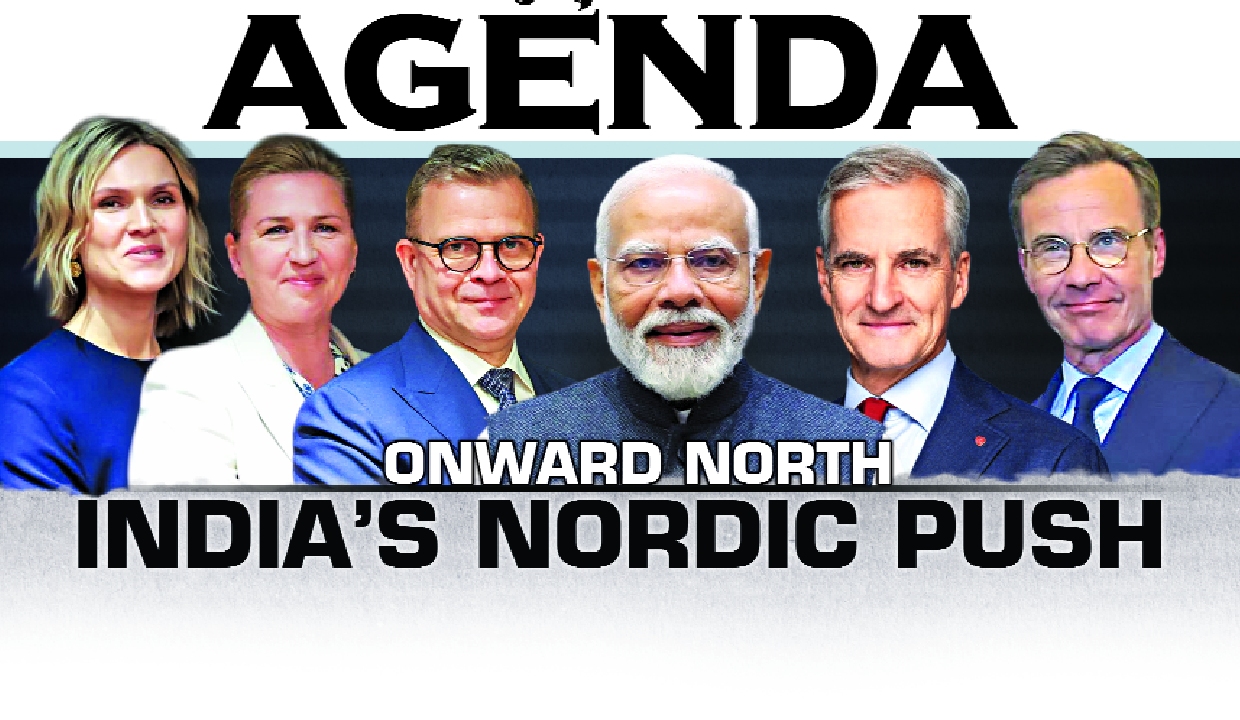
At a time when global geopolitics is being reshaped by climate crises, technological competition and shifting economic alliances, India’s growing engagement with the Nordic countries marks a significant strategic evolution in its foreign policy. The 3rd India-Nordic Summit in Oslo underlined this transformation, signalling that nations once considered peripheral to India’s diplomatic priorities are now central to its global ambitions
Prime Minister Narendra Modi’s May 2026 swing through Sweden and Norway, capped by the third India-Nordic Summit in Oslo, was not a routine European stopover. It marked a clear political decision to move the Nordic region from the margins of Indian diplomacy to a more central place in New Delhi’s strategic thinking. In the span of a few months, India elevated relations with Finland to a Strategic Partnership in Digitalization and Sustainability during President Alexander Stubb’s state visit in March 2026, with Sweden to a broader Strategic Partnership in Gothenburg in May 2026, and with Norway to a Green Strategic Partnership in Oslo a day later. Alongside this, Prime Minister Modi also held bilateral meetings with the leaders of Denmark, Finland and Iceland on the sidelines of the India-Nordic Summit. The message was unmistakable: India now sees the Nordic arc not as a peripheral cluster of small economies, but as a set of high-value partners in technology, climate action, maritime affairs and strategic diversification.
That outreach did not begin overnight. In April 2025, Prime Minister Modi and Danish Prime Minister Mette Frederiksen reviewed the expanding India-Denmark Green Strategic Partnership over a phone call. In February 2026, Prime Minister Modi met Finnish Prime Minister Petteri Orpo in New Delhi on the margins of the AI Impact Summit, and both sides pushed cooperation in quantum, 6G, renewables and defence. By May 2026, the diplomacy had become institutional: the India-Nordic relationship itself was elevated to a Green Technology and Innovation Strategic Partnership, with Finland set to host the next summit. This is what gives Prime Minister Modi’s recent Nordic outreach its significance: it is no longer episodic; it is now structured, sequenced and tied to concrete sectoral roadmaps.
Why the Nordics matter now
The immediate reason is simple enough. The Nordics may be modest in population, but they punch well above their weight in capital, innovation, standards and institutional credibility. The combined Nordic economy is now worth more than USD 2 trillion; trade with the Nordic countries touched about USD 19 billion in 2024; more than 700 Nordic companies operate in India; and around 150 Indian companies have a presence in the region. That is already a serious economic footprint.
But the deeper attraction lies in quality, not just volume. WIPO’s Global Innovation Index 2025 ranked Sweden second, Finland seventh, Denmark ninth and Norway twentieth, with Norway also leading the world on the infrastructure pillar. The European Commission’s European Innovation Scoreboard 2025 placed Sweden back as the EU’s most innovative member state, ahead of Denmark.
For India, which is trying to marry manufacturing scale with cleaner growth and better technology, that mix is rare and valuable. In a world shaped by supply-chain anxieties, tighter technology controls and the search for trusted partners, the Nordics offer exactly the kind of competence India needs: high-end engineering, green industrial know-how, digital capability and policy stability.
The timing also matters. The India-EU Free Trade Agreement was declared concluded at the January 2026 India-EU Summit, while the India-EFTA Trade and Economic Partnership Agreement entered into force on 1 October 2025. The Oslo summit explicitly linked India-Nordic ties to both these trade frameworks and underscored that TEPA carries a shared objective of USD 100 billion in investment and one million direct jobs in India over 15 years. In other words, the Nordic region is becoming one of the most practical bridges between India’s growth story and Europe’s capital, markets and advanced supply chains.
Green growth and advanced technology
This is where the relationship gets particularly consequential. Sweden has emerged as India’s most rounded Nordic technology partner. The new India-Sweden Strategic Partnership commits both sides to a shared goal of doubling bilateral economic exchange within five years and sets out cooperation in AI, 6G, quantum computing, critical minerals, sustainable mining, space and defence innovation. It also launches a Sweden-India Technology and Artificial Intelligence Corridor, upgrades the Joint Innovation Partnership, and creates a new joint science and technology centre. For India, Sweden is useful not only because it brings ideas, but because it brings industrial depth: telecom, advanced manufacturing, clean industry and defence production. India-Sweden trade in goods rose to USD 7.75 billion in 2025, and Swedish companies have already established a significant production presence in India, including Saab’s Carl-Gustaf facility in Haryana.
Denmark remains India’s most mature green partner in the region. Since the launch of the Green Strategic Partnership in 2020, the relationship has steadily moved from symbolism to implementable projects. Prime Minister Modi and Frederiksen reviewed that progress again in Oslo in May 2026, with an emphasis on climate, new technologies, AI, defence, start-ups and academic exchanges. The two sides also highlighted the Smart Laboratory on Clean Rivers in Varanasi as a practical model of technology-led environmental cooperation. On the Danish side, the newly created Green Transition Alliance India, formed in 2025, builds on earlier initiatives like the Wind Alliance India and the Green Fuels Alliance India to position Danish firms in India’s energy transition. This is precisely the sort of partnership India needs if it wants to move from climate ambition to industrial decarbonization.

The country strengths India can tap
Norway brings a different set of advantages. Prime Minister Modi’s May 2026 visit to Oslo was the first prime ministerial visit from India to Norway in 43 years, and the outcomes were substantial: a Green Strategic Partnership, Norway’s entry into the Indo-Pacific Oceans Initiative, agreements in space, health and digital development, and a sharper focus on green shipping, ports, ocean energy, carbon capture, circular economy and polar research. India and Norway also agreed to work together in third countries on Digital Public Infrastructure for the Sustainable Development Goals. Add to that the fact that Norway’s Government Pension Fund Global had invested close to USD 28 billion in Indian capital markets by December 2025, and Norway starts to look less like a niche partner and more like a serious source of capital, maritime knowledge and global development leverage.
Finland, meanwhile, is becoming India’s go-to Nordic partner on frontier digitalisation. The March 2026 strategic partnership with Helsinki prioritised 5G, 6G, AI, high-performance computing, quantum technologies, semiconductors, sustainability and start-up collaboration. The two sides agreed to create a Joint Working Group on Digitalization, a Joint Task Force on 6G with the University of Oulu and the Bharat 6G Alliance, and to co-host the World Circular Economy Forum in India in 2026. Iceland’s role is smaller but still distinctive: Prime Minister Modi’s Oslo meeting with Prime Minister Kristrún Frostadóttir focused on geothermal energy, fisheries, innovative technologies, culture and Arctic research, while the India-Iceland brief continues to identify renewable energy, biotech, fisheries and Arctic issues as core areas of cooperation. India would be wise to see these countries as complementary pieces of the same puzzle, not as separate files.
The security, Arctic and geopolitical dividend
There is also a harder strategic edge to this relationship, and it should not be understated. The entire Nordic region now sits within NATO: Finland joined in April 2023 and Sweden in March 2024, adding fresh weight to a region that already mattered to European and transatlantic security. India is not entering alliance politics, nor should it. But it is engaging a set of partners whose importance in maritime security, cyber resilience, supply-chain security and defence industry has risen sharply after the Ukraine war. The Oslo summit reflected that shift: India and the Nordics agreed to deepen cooperation on maritime security, illegal maritime activity, seafarer safety, blue economy, defence industrial collaboration and the supply of essential defence components. Sweden’s bilateral action plan separately calls for stronger cyber dialogue, defence innovation and more Swedish investment in India’s defence corridors.
The Arctic adds another layer. India has maintained the Himadri research station in Svalbard, Norway, since 2008, has held observer status in the Arctic Council since 2013, and framed its Arctic policy in 2022 around science, climate, maritime cooperation, connectivity and governance. Nordic leaders in Oslo explicitly welcomed India’s continued engagement in Arctic Council working groups and supported deeper cooperation on polar research, climate and environmental issues. This is not a vanity project. Indian officials have repeatedly linked changes in the Arctic to monsoon behaviour and wider climate consequences for India. In strategic terms, then, the Nordics help India in three theatres at once: Europe, the Arctic and the Indo-Pacific. Few other partner-sets offer that kind of overlap.
A partnership that widens India’s strategic options
The real value of the Nordic relationship is that it broadens India’s room for manoeuvre. These countries strengthen India’s global outreach not by replacing larger powers, but by giving India additional channels into European markets, Arctic governance, clean technology coalitions and standards-setting conversations. They have also backed India’s claim for permanent membership of a reformed UN Security Council, supported its NSG application, and shown a growing willingness to work with India on third-country development and multilateral problem-solving. Taken together, this suggests that the Nordic region is becoming one of the quiet force multipliers of Indian foreign policy: low on drama, high on strategic value.
That is why Prime Minister Modi’s recent outreach matters. The Nordics are not important because they are large; they are important because they sit at the crossroads of tomorrow’s strategic economy - green industry, clean shipping, advanced digital systems, trusted supply chains, polar research and resilient institutions. India brings the scale, the market, the talent and the development imperative. The Nordics bring technology, capital, climate competence and strategic trust.
As New Delhi converts that complementarity into faster execution, the northern flank of Europe can well become one of the most productive extensions of India’s foreign policy in the second half of this decade.
The real value of the Nordic relationship is that it broadens India’s room for manoeuvre. These countries strengthen India’s global outreach not by replacing larger powers, but by giving India additional channels into European markets
Harsh Vardhan Shringla, Member of Parliament (RS), a former Foreign Secretary and Ambassador to the USA; Views presented are personal.