India’s Nordic Turn: PM Modi at Oslo Summit and the need for Green Strategic Partnership
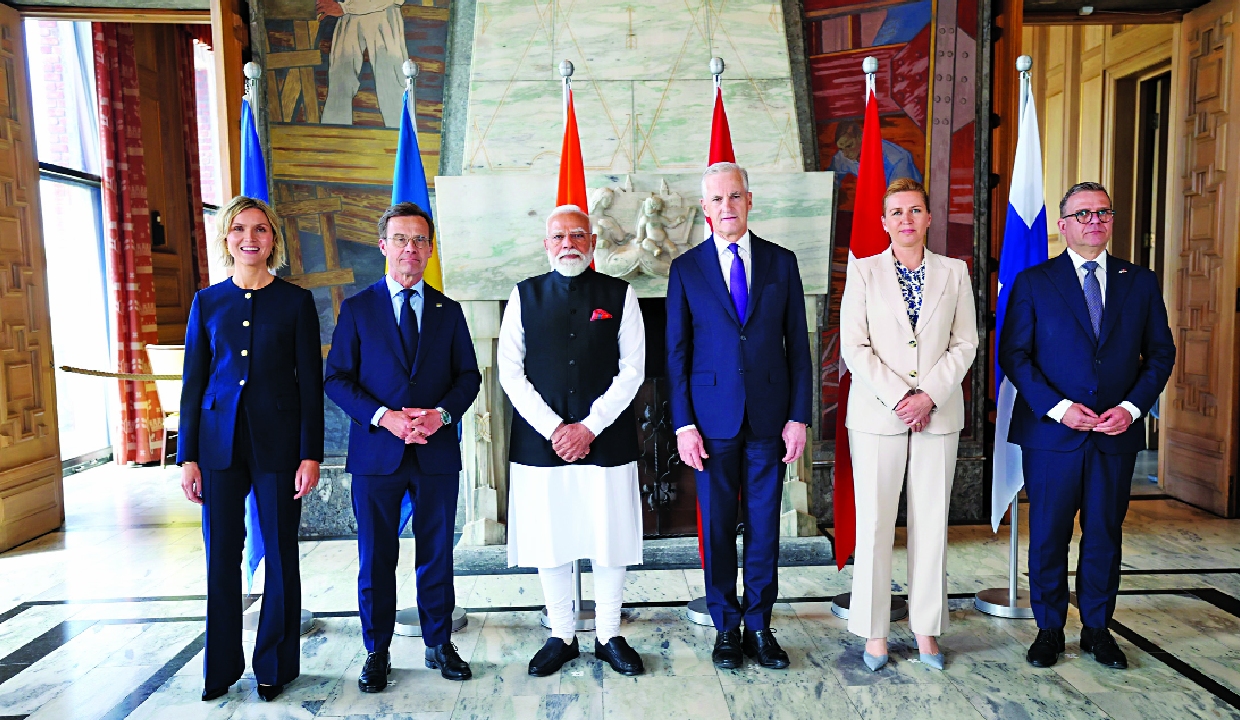
In the fast-changing global political landscape, India’s strategic outreach to Nordic countries signifies the complementarity in India - Europe relations and, more specifically, to the Nordic countries, as was witnessed in the 3rd India-Nordic Summit. The summit marked a new milestone in India’s foreign policy. It signals an obvious and strategically calibrated turn by India towards a region long regarded as peripheral to its foreign policy calculus, and Nordic countries’ foreign policy calculus is seen now as increasingly core to its ambitions as an emerging global player.
Why does this region matter now
The Nordic countries, comprising Norway, Sweden, Denmark, Finland and Iceland with a population of 27 million, are pioneers in many new and unique areas and carry considerable weight. As global leaders in clean energy, digital governance, maritime economy, Arctic research and sustainable innovation, they are a force to reckon with in terms of non-traditional security. In a world that is still trying to come to terms with climate disruption, technological localisation and precarious supply chains, Nordic prowess holds a premium.
India’s outreach with the countries in the region has been increasing in the past 15 years but with the new template of India- Nordic Summits, they have over further found a deep foundational relationship, which might be expanded with each other depending on the requirements.
PM underlined the fact that trade between India and the region has increased four times and the region’s investments in India have doubled over the last decade. Two landmark trade agreements - India’s Trade and Economic Partnership Agreement (TEPA) with European Free Trade Agreement countries (comprising of four Non-EU members Liechtenstein, Switzerland, including Norway and Iceland which are part of Nordic Summit), and the India-EU Free Trade Agreement involving Denmark, Finland and Sweden - are set to usher in what PM Modi called a "new golden era" in these relations. EFTA signed a historic Trade and Economic Partnership Agreement (TEPA) with India.
This pact, signed earlier and which came into effect on 1st October 2025, commits EFTA to $ 100 billion in investments and the creation of 1 million direct jobs in India over 15 years, securing tariff concessions and market access across various sectors. For India, this convergence of trade architecture and strategic partnership offers a uniquely comprehensive template for engagement with these economically advanced countries.
On the Greener Side: Climate, Sustainability and Environment
The partners in the summit have a shared conviction on the future of clean technologies. India has already set up massive renewable energy targets and have one of the world’s best in class solar installation programmes backed by its objective expressed in the International Solar Alliance (ISA). India, with its massive renewable energy targets and one of the world’s largest solar and wind installation programmes, brings unmatched scale, only to be matched by Nordic countries’ precision and scientific advancement. The Nordic countries bring technological sophistication with Iceland’s mastery of geothermal energy, Denmark’s leadership in offshore wind and health technology, and Norway’s blue economy innovations, which offer India access to some of the world’s most advanced green technologies and above all, these countries offer a veritable social security mechanism for their citizens, which is perhaps unmatched in the world.
The new partnership in the region also have opening in green hydrogen, carbon capture technologies and critical minerals at the base of their cooperation. Cooperation in green hydrogen, carbon capture technologies and critical minerals forms the backbone of the new partnership’s environmental agenda. India being a major greenhouse gas emitter and one of the countries most vulnerable to climate change, these partnerships are strategically important. With the Nordic know-how, India’s clean energy transition will help build domestic capacity in cutting-edge technologies - not merely as a recipient of technology transfer, but as a co-developer of global climate solutions. As the Indian PM remarked in Oslo, the partnership seeks to "combine Nordic expertise in sustainability with India’s scale to develop trusted global solutions for the future".
Technology, Defence and Digital partnership
The partnership opens new doors in next-generation technology and military cooperation. Sweden’s sophistication in advanced manufacturing and defence is especially significant for India, which is actively diversifying its defence supply chains from traditional dependence on a handful of suppliers and is looking for deepening engagement with Western technological and military hardware platforms. Finland’s leadership in telecommunications and digital technologies aligns seamlessly with India’s ambitions in 5G, advanced cybersecurity and digital public infrastructure. Denmark’s capabilities in cybersecurity and health technology complements strengths at a time when data localisation, digital sovereignty and healthcare innovation are national priorities.
The summit also underlined the cooperation in artificial intelligence - a domain where both India and the Nordic countries recognise the imperative of like-minded democratic nations setting standards and governance frameworks with priority on innovation and less economic control by major business groups, as is being witnessed of late. In terms of the talent that India has in STEM can make it happen with Nordic R & D investment for joint innovation and fair dissemination of AI technologies besides building a people-to-people infrastructure that will outlast any single government.
Maritime Security and Arctic Policy
Perhaps the most strategically underappreciated dimension of India-Nordic engagement is the maritime and Arctic frontier. Arctic, termed ‘New Africa ‘, has a lot to be explored in terms of natural resources and the new transit route. Russia has already allowed India, besides China, to look into the possibility of the Northern Sea Route, which can complement India and Nordic countries in exploring this transit route. Norway has deep expertise in the blue economy, maritime surveillance and Arctic affairs, which opens a conversation that is highly relevant for India’s evolving Indo-Pacific strategy and its interest in emerging Arctic shipping lanes. As global warming opens new Arctic trade routes - potentially transforming global logistics - India, as a major maritime nation and aspiring Arctic observer with growing stakes in polar research, holding an observer status in the Arctic council, has strong reasons to engage more deeply with Norway and Iceland.
The Nordic countries, though small in population, carry enormous credibility in multilateral institutions, climate diplomacy, and global norm-setting. Their support amplifies India’s voice in forums ranging from the UN to the WTO and the emerging architecture of AI and digital governance. As the 3rd India-Nordic Summit concluded in Oslo, both sides expressed confidence that their partnership would serve as "a model of shared prosperity, innovation, and sustainable development." In a world increasingly defined by the competition between open and closed systems, democratic and authoritarian models, India’s deepening Nordic engagement is both a pragmatic and a principled choice.
Dr Amitabh Singh, teaches at the School of International Studies, JNU, New Delhi and is a policy analyst specialising in India’s Foreign Policy, international relations and geopolitics; Views presented are personal.