Gagan Thapa’s bloodless coup rocks Nepal
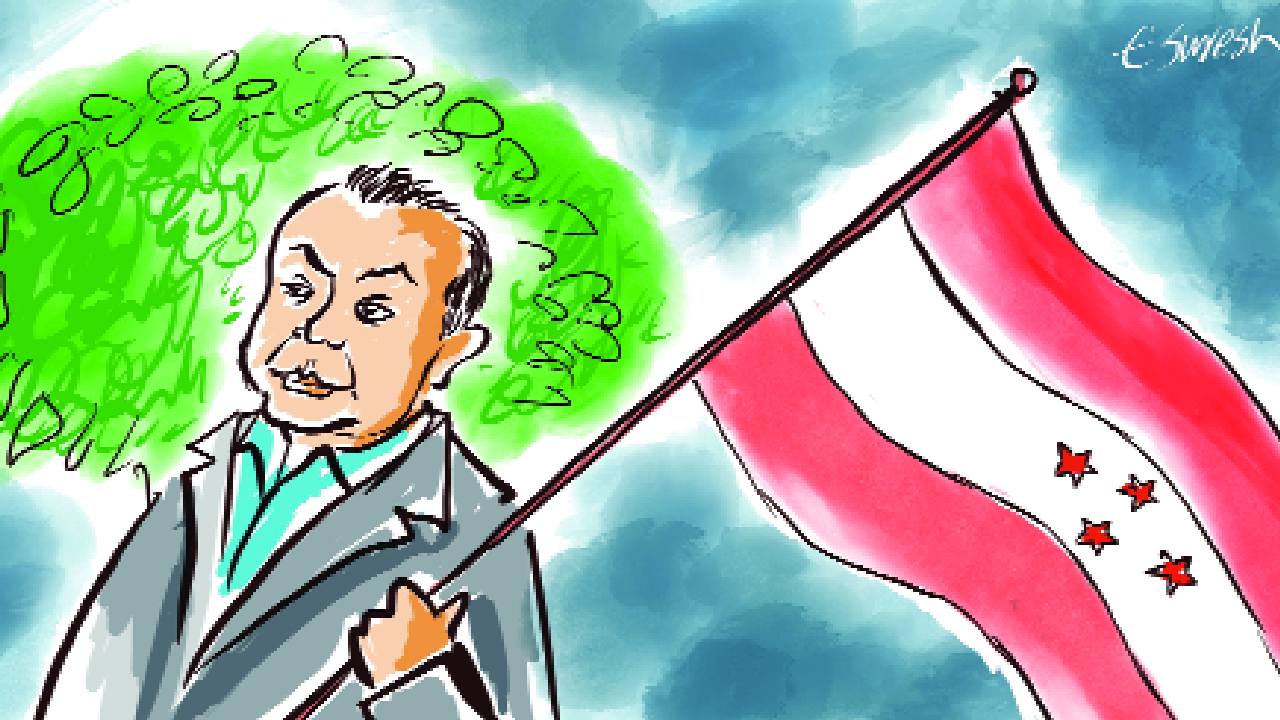
Military coups, noted Edward Luttwak, can be stunningly successful: instant transfer of power or abysmal failures: eating out of a mess tin in jail and waiting for a firing squad. In an era of disruption of the rule-based international order, when, according to UN Secretary General Antonio Guterres, the rule of law has been replaced by the rule of power, last month’s Gagan Thapa bloodless political coup was a masterstroke with no parallel in Nepal or elsewhere. It became a declared legitimate transfer of power which the stalwarts of the GOP Nepali Congress failed to pre-empt, Thapa achieving strategic surprise despite his declaratory stance. The old guard did not believe he could or would do it. With a trademark red tilak on his forehead and a solitary marigold petal perched on his receding hairline, Thapa, the newly elected President of NC at the Special Convention on January 14, said: the Gen Z Andolan message was to change neta and neeti (leader and policy), leaving the door open for reconciliation with the old guard, which the Election Commission of Nepal closed by legitimising Thapa’s coup.
Last December 7, in Pokhara, while basking in the sunshine with Dhaulagiri and Machapuchare competing for glory, an NC loyalist friend confided — as revealed to him by a high source — the Gagan plot: with the surprising collective backing of the US, PM Karki, NC veteran and President Ram Chandra Paudel, the EC, the Supreme Court and Gen Z, the Thapa coup was waiting to happen — such was the propitious conjunction of stars. Whether the Army, the most trusted and pivotal institution, was on board was not mentioned.
So how did it unfold? Even as preparations for the NC General Convention were in full flow for end-January, on December 26, senior NC General Secretary Thapa addressed a press conference and announced that if a general convention was not held, a special convention would be held in mid-January. NC senior leader Shekhar Koirala, who believed Thapa was on his side, had earlier said that if elections were not held on March 5, Parliament should be restored, the demand of 12 petitioners in the Supreme Court. During the Gen Z movement, the NC image was badly mauled, especially after the physical assault on NC President and five-time PM Sher Bahadur Deuba and his spouse, Foreign Minister Arzu Rana. When the couple departed for medical treatment to Singapore, Vice-President Purna Bahadur Khadka was made acting president. The political parties piggybacking on the Gen Z movement joined in targeted arson and assaults: Gen Z against the police, which had martyred 77 colleagues, and political parties against their rivals, who had been collectively playing musical chairs in power-sharing. Thapa’s house was partially burnt, while homes of other leaders were gutted. While Maoist supremo Prachanda and Thapa lauded the Gen Z political agenda, ousted UML PM KP Oli attacked Gen Zand called the Karki government illegal.
When the Deuba faction realised the general convention might divide NC, it was postponed until May 2026. This provided Thapa with the opening for holding a special convention. With the second General Secretary, Biswo Prakash Sharma, in tow, Thapa ordered the special convention from 11-14, January, which was already in an advanced stage of planning. Thapa’s bold and risky move — the frontal attack — achieved shock and awe, paralysing the old guard. Thapa managed to assemble 56 per cent of party delegates when the quorum is 40 per cent. Legitimate procedure was followed in the comprehensively planned convention that included smart delegate bags. On January 15, the NC Thapa faction elected new office-bearers: Thapa, president; Sharma, vice-president; three general secretaries; and 134 central committee members. On the night of January 15-16, Thapa approached the EC, applying for official NC symbols — the historic four-star flag and tree, heartbeats of traditional NC supporters. Within no time, the EC awarded NC’s crown jewels to Thapa, pre-empting the old guard.
Between January 12 and 15, reconciliation and unity moves were attempted by both sides. NC has split earlier twice: in 1952 Subarna Shamsher broke away from BP Koirala; in 2002 Deuba was expelled from NC by GP Koirala. Both times, factions reunited. This time, separation has been avoided but only in name, because elections are due on March 5. Thapa’s terms for reconciliation and unity hit most. Deuba, who had threatened to contest as an independent, in the end chose to step down as President and skip elections as decreed by the newly minted NC. On January 16, the EC recognised Thapa as President NC and awarded the flag and tree symbols to him. On 18 January, Khadka placed a writ petition with the Supreme Court, which was heard on 20 January, the date for nomination of candidates for election. The SC did not pass any interim order but asked the EC, Deuba NC and Thapa NC to return after 15 days. Thapa gave 65 of 165 directly elected seats to members of the old guard to preserve NC unity during the election despite the fracture. It was ironical that NC members who backed the writ petition against Thapa obtained election tickets bearing his signature. Thapa and Koirala were both opposed to the ousted NC-UML alliance. In another irony, the NC-UML pre-poll alliance swept the National Assembly elections on January 23, with NC winning 9 seats and UML 8 seats, making the 25-member NC the single largest party in the 59-member Upper House.
On January 21, the newly formed NC’s CWC held its first meeting, formally establishing the split. Thapa decided to conduct reforms, adopting measures for rectifying past mistakes and weaknesses. An election manifesto drafting committee and an election mobilisation committee were formed. On January 28, the SC reserved its judgment on restoring Parliament. Its verdict on which faction, Deuba or Thapa, is the custodian of the NC flag and symbol is expected next week. If the Thapa coup story I heard in Pokhara is to reach its expected closure, the SC can be expected to give the thumbs up to Thapa, leaving the Deuba faction out in the cold until the general convention. The March 5, election will be fought as a united NC. While Gen Z has spurred seismic change only in NC, helping Thapa to stage the coup and change the ‘neta’, only Parliament will enable change of ‘niti.’
The writer, a retired Major General, served as Commander, IPKF (South), Sri Lanka, and was a founder member of the Defence Planning Staff, now the Integrated Defence Staff; views are personal